
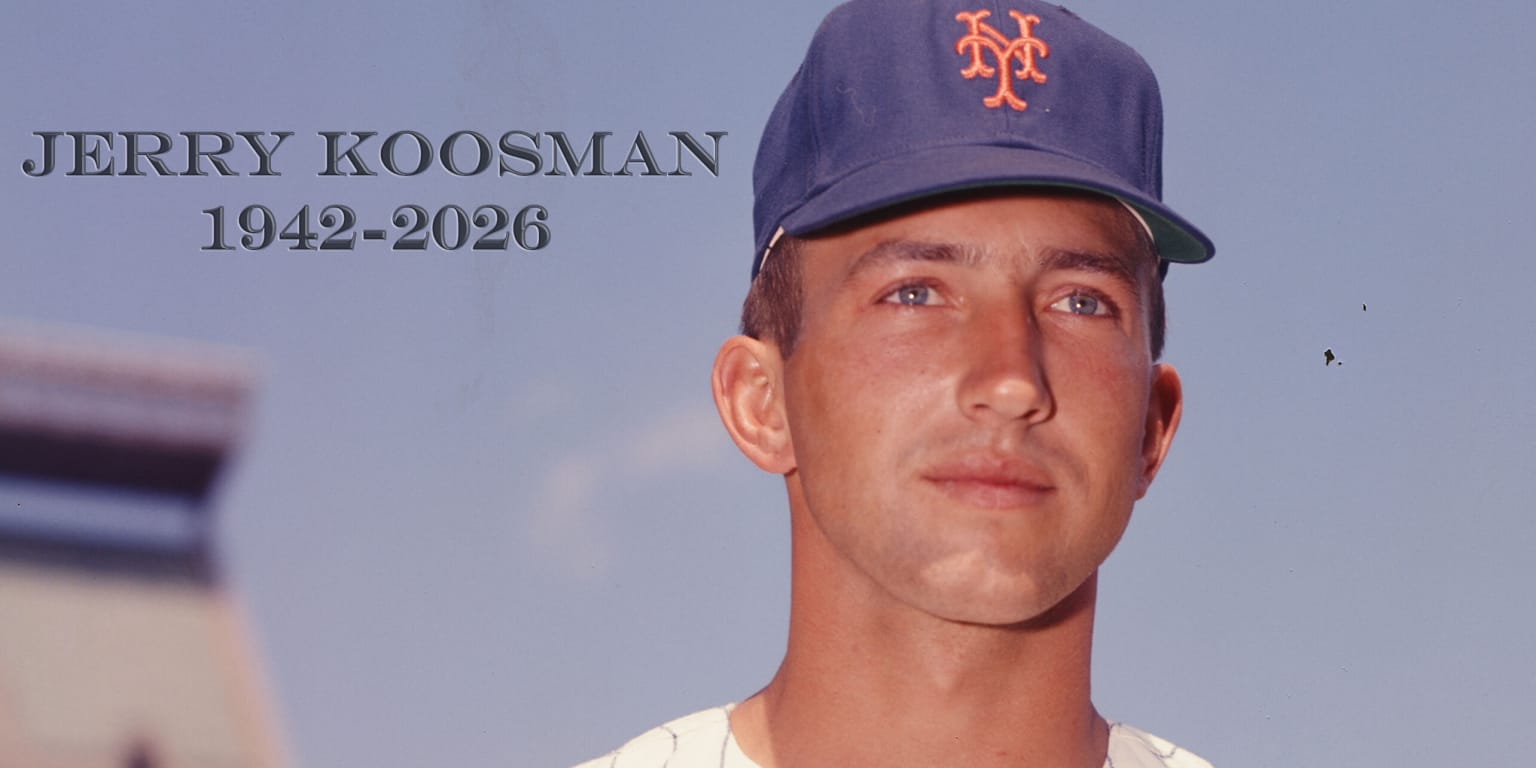
Jerry Koosman, perhaps the best left-handed pitcher in Mets history, passed away on Sunday. He was 83 years old.
During his 12 years with New York from 1967-78, Koosman won 140 games, posted a 3.09 ERA and had a 21-win season in '76. Starting in 1968, Koosman teamed with Tom Seaver to form a great duo atop the Mets’ rotation, until Seaver was traded to the Reds at the June 1977 Trade Deadline.
His most memorable moment with the Mets occurred in Game 2 of the 1969 World Series, when he played the role of stopper. He held the Orioles hitless until the seventh inning, when Paul Blair led off with a single. The Mets held on for a 2-1 victory to tie the Series at one.
Three games later, the Mets were World Series champions thanks to Koosman, who pitched a complete game at Shea Stadium in the Game 5 clincher. Koosman, in an image cemented in Mets lore, leaped into Jerry Grote’s arms after the final out.
Four years later, Koosman beat the Reds in Game 3 of the National League Championship Series and recorded a win and a no-decision in the ’73 World Series against the A’s.
Koosman's win-loss record did not always reflect his quality on the mound. In 1977, for example, he lost 20 games but with a 3.49 ERA.
Jerome Martin Koosman was born Dec. 23, 1942, in Appleton, Minn. Drafted into the Army in 1962, he played baseball at Fort Bliss in El Paso, Texas. There, according to his SABR biography written by Irv Goldfarb, his batterymate was a Queens native named John Luchese, who was impressed by what he saw from Koosman.
Luchese wrote to his father, an usher at Shea Stadium, and told him about Koosman. He passed the word to Joe McDonald, who worked in New York’s Minor League system. The Mets were impressed with what they saw and signed Koosman for $1,600 in August 1964.
Koosman made his Major League debut on April 14, 1967, but appeared in just nine games that season. In ’68, he went 19-12 with a 2.08 ERA, was named to his first of two consecutive National League All-Star teams, and finished second in NL Rookie of the Year voting to Reds catcher and future Hall of Famer Johnny Bench. Koosman averaged 31 starts and 14.3 wins per season from 1968-76, but then combined to go 11-35 with a 3.62 ERA in ’77-78.
At the 1978 Winter Meetings, the Mets traded Koosman to the Twins for right-hander Greg Field, who never reached the Majors, and a player to be named later. In February 1979, Minnesota sent left-handed reliever Jesse Orosco to New York to complete the trade. That trade involved the two pitchers who were on the mound for the last out of each of the Mets’ two World Series championships: Orosco pitched the last two innings of Game 7 against the Red Sox in 1986. Several times over the years, the two southpaws would marvel at the circumstance.
“We didn’t have long conversations because we met here [at Citi Field] or some [other place],” Koosman told MLB.com in 2021. “We did get to chat and were able to get to know each other a little bit. I was proud of him and our left-handed reputation. He did a great job. He played for a long time.”
Koosman’s 19-year career also included stints with the White Sox and Phillies. He finished his career with Philadelphia in 1985, when he was 42. His final career record was 222-209, with a 3.36 ERA and 2,556 strikeouts.
Though he threw his last pitch for the Mets in 1978, Koosman still holds franchise records for left-handers for starts (346), complete games (108), shutouts (26, tied with Jon Matlack), wins (140), decisions (277), innings (2,544 2/3) and strikeouts (1,799). Among lefties with five or more starts for the Mets, Koosman's 3.09 ERA is bested only by Matlack's 3.03.
“He was a warrior,” former teammate Ron Swoboda said in 2021. “You loved him because he was the kind of gamer that you wanted to hang out with. He played the whole game all the time and brought dominant stuff out there and a dominant attitude.”
The Mets retired Koosman's No. 36 on Aug. 28, 2021, making him the third player in franchise history to receive that honor. Seaver (No. 41) and Mike Piazza (No. 31) preceded him, as did managers Casey Stengel (No. 37) and Gil Hodges (No. 14), and Jackie Robinson, whose No. 42 was retired league-wide. In later years, Keith Hernandez (No. 17), Willie Mays (No. 24), Dwight Gooden (No. 16), Darryl Strawberry (No. 18) and David Wright (No. 5) followed.
“I’m thankful that they thought so much of me to retire my number,” Koosman said that day. “I know I’m joining a great crew that they had their numbers retired. I don’t know if I deserve it. I guess we are going to get on with it."
Koosman shouldn’t have had to think twice.