
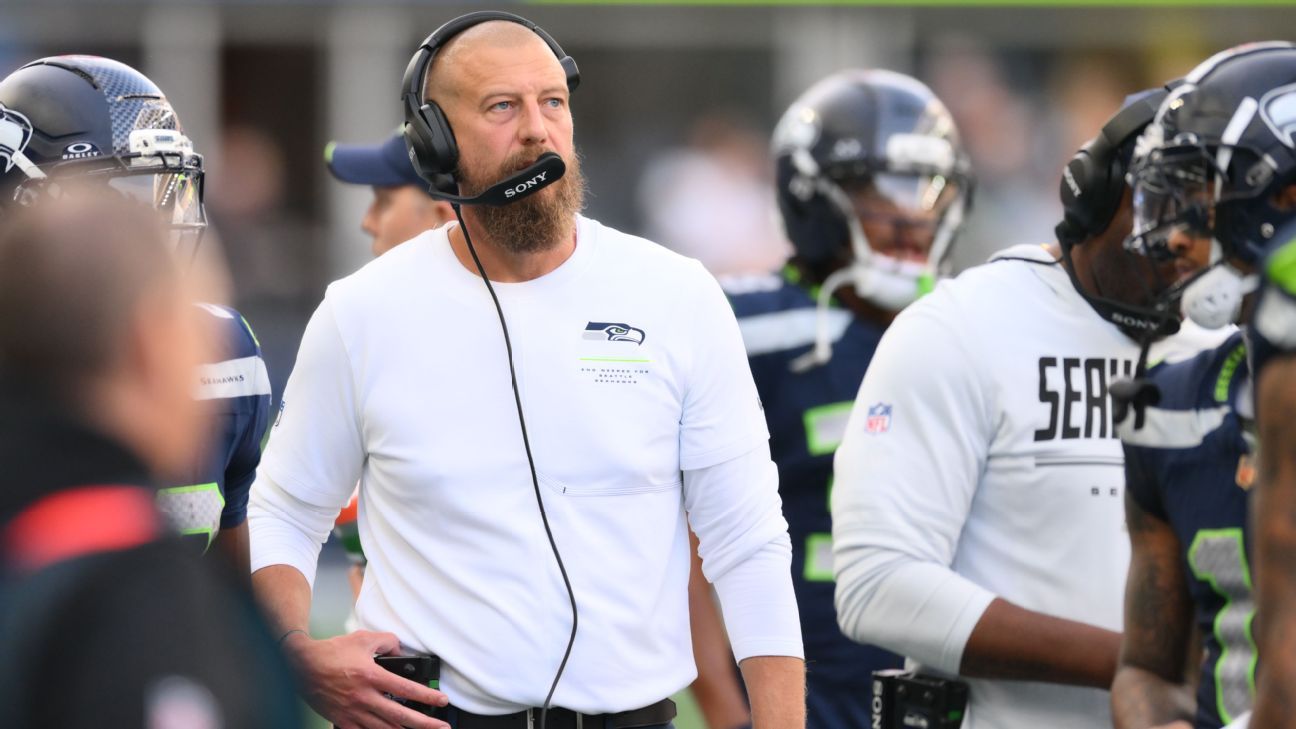
SEATTLE -- Sam Darnold has a favorite adjective for first-year Seattle Seahawks offensive coordinator Brian Fleury: stoic.
"Whether it's a good play or bad play," Darnold said over the summer, "his mentality never changes out there on the field."
That was true even when a wrench was thrown into Fleury's playcalling debut -- his starting quarterback going down on the fifth play of the Seahawks' season opener with what was later determined to be a glute injury.
After taking over for Darnold, backup Drew Lock led five straight scoreless possessions. With the Seahawks trailing by seven early in the fourth quarter, they faced a fourth-and-1 from the New England Patriots' 45-yard line. Fleury put the ball in Lock's hands, dialing up a play-action throw that resulted in a tying touchdown to wide receiver Jaxon Smith-Njigba. With Darnold watching on his phone from a nearby hospital, Lock led another field goal drive on the ensuing possession, and Seattle's defense sealed a 13-10 win with a third interception of Patriots quarterback Drake Maye.
Afterward, Lock credited Fleury for providing a calming voice amid the chaos.
"I think as a quarterback, with someone in the headset, you want them [to have the same demeanor] all the time," Lock said. "It was awesome to feel that from him tonight and see that from him and know that's what we're going to get moving forward."
It has become clear what kind of personality Seattle has spearheading the offense. There was never much question as to what the West Coast scheme itself would look like, as it's largely unchanged from the one Klint Kubiak ran before leaving to become the head coach for the Las Vegas Raiders. But there is a question of whether Fleury can pick up where his predecessor left off and coordinate a championship-caliber offense in his first season in that role at any level.
Heading into a Thursday night matchup with the Denver Broncos (3-2) at Empower Field at Mile High (8:15 p.m. ET, Prime Video), Fleury's offense ranks eighth in scoring at 26.8 points per game. But it's also 25th in expected points added and 26th in ESPN's efficiency metric, indicative of flaws that Seattle's defense and special teams have helped cover.
Those flaws? Too many turnovers and an insufficient run game. Darnold has not taken care of the ball, throwing five interceptions in three games since returning in Week 3. And neither has Seattle's backfield, which also hasn't generated much production on the ground with its top two options -- rookie first-round pick Jadarian Price (chest) and Zach Charbonnet (knee) -- currently sidelined by injuries.
Can a rookie coordinator fix those issues before the Seahawks (3-2) lose any more ground to the San Francisco 49ers (5-0) in the NFC West standings?
"His approach of trying to find solutions and working through things that arise, I think he's done a great job of that," coach Mike Macdonald said. "... I think he's doing a good job.
"But we've got to continue as an offensive staff -- and Brian's leading our offensive staff -- of generating really clear plans that we can execute, and as an offense, executing at really a higher level."
Fleury's path to Seattle
Fleury's coaching career unofficially began before his playing career ended.
As a senior at Seneca Valley High School in Germantown, Maryland, he quarterbacked the Screaming Eagles -- who were coached by his stepfather -- to a 13-0 record and a Class 4A state championship in 1997. He scored a 1420 on his SAT, walked on at Maryland and transferred to Towson after one season.
"You just knew he was going to be a coach, you just knew it," Gordy Combs, Towson's head coach at the time, told ESPN. "How he acted in meetings and knowing what was going on and paying attention all the time."
The idea of following in his stepfather's footsteps was always in the back of Fleury's mind. He began to realize that was his calling when he got a chance in the spring to compete for the starting job at Towson with two years of eligibility remaining, only for an injury to end that bid. A younger quarterback won the competition, and Fleury never got another shot.
"Immediately, I was asked to go out there and coach him, stand in the huddle with him and mentor him," Fleury said. "Really that experience is what nudged me over the edge."
Fleury accepted his role.
"He had all his oars in the water," Combs said.
After entry-level roles on Maryland's staff for two seasons, Fleury's coaching career took an interesting turn in 2005. He was hired as the secondary coach at Sacred Heart, where he would also serve as defensive coordinator and outside linebackers coach the next three seasons.
The former quarterback wouldn't return to the offensive side of the ball for another 11 seasons. That was after stints with Towson (special teams coordinator, defensive backs coach), the Buffalo Bills (quality control), the Cleveland Browns (assistant linebackers coach, outside linebackers coach) and Miami Dolphins (football research analyst, director of football research).
Fleury would have preferred a coaching gig after Cleveland, but his role in Miami had him working alongside the Dolphins' staff, arming them with insights he'd gather by studying the rest of the league. Without having to pour all of his time and energy into coaching a position group, he was free to absorb the data and begin developing his own philosophies.
"So at the time, I was a little bit frustrated because I wasn't dealing with players directly," Fleury said, "but in hindsight, it probably was one of the most valuable three-year periods of my life, just from a development standpoint."
The path to offensive coordinator included one more stop: a quality control gig with the 49ers under defensive coordinator Robert Saleh. He spent one season in that role before coach Kyle Shanahan moved him to the other side of the ball. He was a quality control coach on offense for two seasons before a promotion to tight ends coach in 2022. Though he didn't add the title of run game coordinator until 2025, he was helping Shanahan devise run plays before that.
"You talk about a person who understands all three phases," Saleh, now the Tennessee Titans' head coach, told ESPN. "He knows linebacker play, he knows the secondary. To get the growth he had with Kyle on the offensive side of the ball, I think that's where you find the greatest coaches, the ones who understand both sides of the ball. ... They can watch tape and understand what guys are trying to get accomplished from a schematic standpoint.
"I think it was a home run hire for Mike and his staff."
Fleury the playcaller
Training camp practices tend to bring out colorful language from Macdonald as he runs Seattle's defense.
"You've got to know what the f--- you're doing!" he yelled one day this summer, chiding a young defensive back after a blown assignment.
Fleury, on the other hand, had such a subtle presence that you wouldn't know he was running Seattle's offense if he didn't have a radio in one hand and a call sheet in the other.
"I think Coach Fleury does a great job of being all about ball," tight end AJ Barner said. "He runs his meetings the right way. He expects great things out of his players. He comes to work each day with the same kind of attitude that's just straight business."
Fleury, 46, has plenty in common with his predecessor Kubiak, including their low-key vibe.
"There's times [that] there's going to be fiery moments and things like that, but I thought he was so calm and collected and all that stuff," wide receiver Cooper Kupp said, comparing his last two OCs. "Brian is giving Klint a run for the money in terms of that same demeanor. ... There's just a clear understanding, so there's no jittery energy, there's no false energy.
"It's just, 'Hey, this is what I know to be true. This is how we're going to execute it. These are my expectations. We're going to go out there and make it happen and make corrections and move forward.'"
That Fleury seemed to keep to himself during camp practices might have also owed something to the fact that he was preparing to call plays for the first time.
The amount of pre-snap shifts and motions in Seattle's West Coast offense -- and the time those take off the play clock -- necessitates efficiency between snaps. That starts with decisiveness from Fleury as he gets his playcalls to the quarterback.
During camp, Macdonald went heavy on "call-it" periods that had Fleury calling plays based on the situation as opposed to a preselected script. And he continually put his coordinator through the wringer with challenging situations.
"We go through different ones every day," Fleury said over the summer. "For some reason, we're always down by a touchdown with 50 seconds left and no timeouts. I don't know who's burning through the timeouts, but it definitely helps me adjust to those situations."
Kupp, who spent eight seasons with the Los Angeles Rams playing for Sean McVay, said Fleury has a necessary trait for successful playcallers: the ability to visualize in real time how they want to attack defenses.
"Your head isn't down on the call sheet," he said. "Your head is up, seeing what's happening. You're calling it based off of, 'I know I want to get our offense into this because of what I'm seeing.' He does that on a regular basis."
Can Fleury get Darnold back on track?
The Seahawks have lost two of their past three games, in part because of issues on offense.
Darnold had just taken five sacks against the 49ers when he told Fleury that he needed to play more decisively. Since his return in Week 3, Darnold ranks 31st in average time before throw at 3.25 seconds, up from 2.86 seconds last season (21st). It has contributed to the league's sixth-highest sack rate (7.5%) over the past three weeks.
Fleury's solution, he said, is to lean more into plays that Darnold has repped extensively so that he feels more "comfortable making swift decisions." But as evidenced by his first interception Sunday, swift decisions aren't always the right ones.
Darnold was plenty decisive on the third-and-10 throw to Smith-Njigba at the line to gain -- his time before throw was 2.29 seconds -- but he was also too aggressive based on how cornerback Renardo Green was squatting on the out route. Green picked off Darnold again in the second half on a throw the quarterback said he didn't put enough air under, and so continued Seattle's rash of turnovers.
Part of Fleury's appeal to Macdonald -- and why the coach initially wanted to promote from within -- was that Darnold & Co. wouldn't have to start over. They're running largely the same West Coast system that Kubiak installed last season, an under-center offense with a run game rooted in outside zone and a passing game that goes heavy on play-action.
Despite the familiar playbook, Darnold ranks 29th in Total QBR (36.6) since Week 3. Pressure has been a factor, with Seattle ranking 25th in pass block win rate (45.7%) this season. But Lock had to deal with that as well, and he didn't turn the ball over while posting the fifth-best QBR (84.6) over the first two weeks.
"Just got to continue to trust myself, trust my feet, trust what I'm seeing, which I'm doing," Darnold said. "But just got to be better taking care of the football."
Darnold is not alone. Seattle's backfield trio of Price, Emanuel Wilson and George Holani have combined for five fumbles, losing four of them. In the Seahawks' two losses -- games that were decided by a combined five points -- Seattle's seven turnovers led to 41 points for opponents. In all, Seattle's nine turnovers are tied for fifth most in the NFL, and the 44 points opponents have scored off of those turnovers is tied for the most in the league.
"Way too many giveaways at this point in the season," Macdonald said.
Price, who is on injured reserve because of a chest injury, has to sit out at least two more games. Charbonnet is back at practice and nearing his return from ACL surgery in February, but he is ruled out for Thursday. With their attempt to add former Pro Bowl player Joe Mixon to their backfield falling through because of a failed physical, the Seahawks will have to get by for now with Wilson and Holani -- both former undrafted free agents -- leading the way. Seattle is averaging 106.0 rushing yards per game (17th) and 3.8 per carry (20th), middling rankings that owe much to a lack of available difference-makers after Price's injury and Kenneth Walker III's departure in free agency.
That's why, against the Chargers in Week 4, Seattle went to a package that had speedy receiver Rashid Shaheed lining up in the backfield, shades of how the 49ers used Deebo Samuel Sr. for years while Fleury was in San Francisco. Shaheed scored on a 22-yard toss play and later gained 5 yards on a counter run.
Fleury had planned on incorporating this wrinkle since the offseason, and a day after Price went on IR, he broke it out.
"He's been very solution-oriented in terms of trying to solve the questions that arise from things like that, which I really appreciate," Macdonald said. "I've been impressed with how he's operated. Very steadfast. Very consistent. He probably didn't [expect the injuries], but this happens in the NFL. It happens every year in some capacity, really in all three phases. I've been impressed with how he's worked through it."
Macdonald's comments have given the impression that he views Seattle's primary offensive problems as being rooted more in execution than coaching. But Fleury will nonetheless have to find the solutions. What has his demeanor been like this week as he has tried to get Seattle's offense right?
"He's been great," Darnold said. "He's been the same. Nothing's changed."
ESPN's Jamison Hensley contributed to this story.