
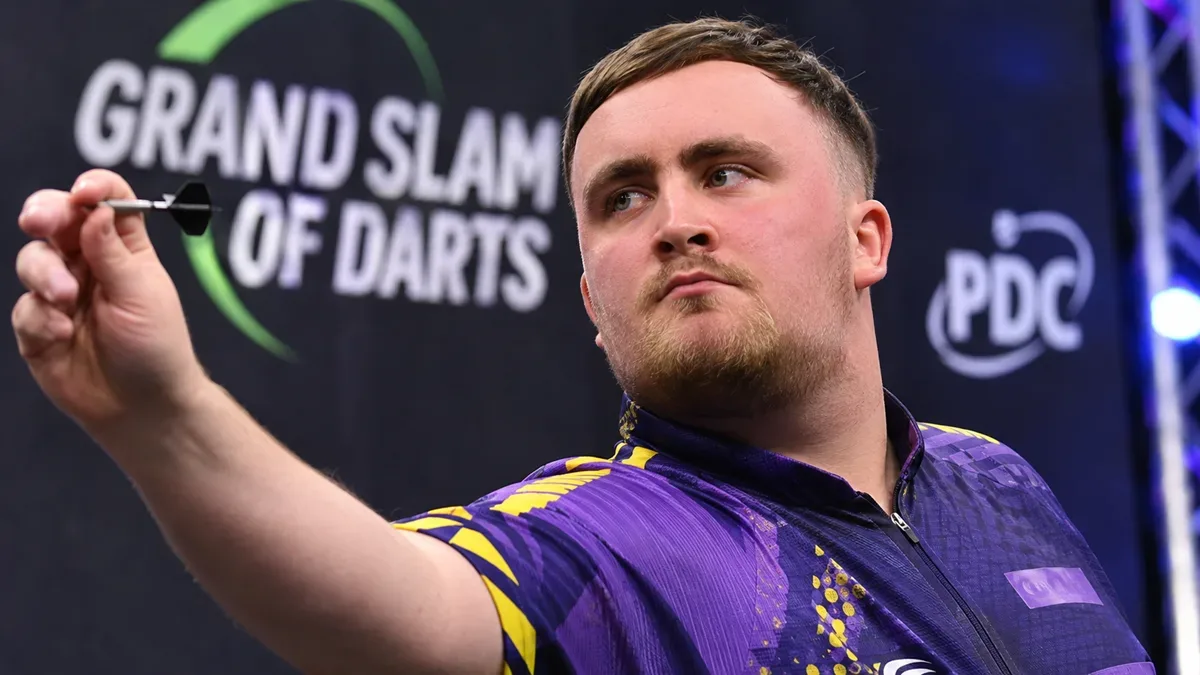
Luke Littler will begin his bid for a third consecutive Grand Slam of Darts title against Beau Greaves after the defending champion was drawn alongside the women’s darts star and Niels Zonneveld in Group A.
The 2026 Grand Slam of Darts takes place from 14–22 November at WV Active Aldersley in Wolverhampton. This year’s tournament introduces a significantly different format, with 48 players competing across 16 groups of three.
Only the group winners will advance to the knockout stages, leaving little room for mistakes in the opening matches.
The PDC’s confirmed tournament draw also places former champion Luke Humphries alongside Joe Cullen and Paolo Nebrida, while Michael van Gerwen faces Jeffrey de Graaf and Henry Coates.
Players will compete for the Eric Bristow Trophy and a record £1 million prize fund, with £200,000 going to the champion.
Littler faces Greaves in opening group match
Embed from Getty ImagesLittler arrives in Wolverhampton as the world number one and two-time defending champion. He won the tournament in 2024 and retained the title in 2025, defeating Humphries 16-11 in last year’s final.
The teenager has yet to lose a match at the Grand Slam, but his opening assignment presents an intriguing challenge.
Greaves defeated Littler 6-5 in the semi-finals of the 2025 World Youth Championship. Littler responded with a 6-5 victory when they met at Players Championship 24 in August 2026.
Their latest encounter will take place during Saturday’s evening session on 14 November.
Greaves, a three-time Women’s World Matchplay champion, has demonstrated her ability to compete against leading male professionals. However, facing the defending champion on one of darts’ biggest televised stages presents a different test.
Zonneveld cannot be overlooked either.
The Dutchman defeated Littler 6-5 at the Belgian Darts Open earlier this year and subsequently secured his first PDC ranking title at the Dutch Darts Championship.
With only one qualification place available, the outcome of Littler’s opening match could shape the entire group.
Readers can revisit Littler’s progress towards the 2026 World Matchplay final for further context on his performances against established rivals.
Grand Slam of Darts 2026 full group draw
Embed from Getty ImagesThe PDC conducted the draw on Monday 9 November, placing the 48 qualifiers into 16 groups.
Each group contains one seeded player and two additional qualifiers.
The confirmed draw is as follows:
| Group | Seeded player | Other players |
|---|---|---|
| A | Luke Littler (1) | Niels Zonneveld, Beau Greaves |
| B | Jermaine Wattimena (16) | Alan Soutar, Lisa Ashton |
| C | Josh Rock (8) | Kevin Doets, Tommy Morris |
| D | Stephen Bunting (9) | Cameron Menzies, Raymond Smith |
| E | Gerwyn Price (4) | Sebastian Bialecki, Joe Hunt |
| F | Ryan Searle (13) | Andrew Gilding, Charlie Manby |
| G | Jonny Clayton (5) | Rob Cross, Anton Ostlund |
| H | Wessel Nijman (12) | Niko Springer, Adam Sevada |
| I | Luke Humphries (2) | Joe Cullen, Paolo Nebrida |
| J | Luke Woodhouse (15) | Krzysztof Ratajski, Tom Sykes |
| K | James Wade (7) | Ricky Evans, Cam Crabtree |
| L | Michael van Gerwen (10) | Jeffrey de Graaf, Henry Coates |
| M | Gian van Veen (3) | Bradley Brooks, Carl Sneyd |
| N | Chris Dobey (14) | Martin Schindler, Jan Schmidt |
| O | Ross Smith (6) | Gabriel Clemens, Rusty-Jake Rodriguez |
| P | Nathan Aspinall (11) | Karel Sedlacek, Maik Kuivenhoven |
Several groups contain players capable of challenging the established favourites.
Group G brings together Jonny Clayton and 2023 runner-up Rob Cross, while Group K features James Wade, Ricky Evans and Cam Crabtree.
Group D also looks competitive, with Stephen Bunting facing Cameron Menzies and Raymond Smith.
Humphries enters Group I as the second seed. His principal challenge could come from former Masters champion Cullen, although Nebrida will be aiming to produce an upset.
Meanwhile, three-time Grand Slam champion Gerwyn Price begins his campaign against Joe Hunt in Group E, with Sebastian Bialecki completing the group.
Which players are the favourites?
Embed from Getty ImagesLittler stands out among the leading contenders following his consecutive Grand Slam victories.
His combination of heavy scoring and consistent finishing has made him difficult to beat in major tournaments. Nevertheless, the revised group format means even the defending champion must negotiate two potentially decisive opening matches.
Humphries remains another prominent contender.
The 2023 champion reached last year’s final and has the experience to navigate the longer matches that await successful group winners.
His route through Group I appears manageable on paper, although Cullen has the scoring ability to challenge the former world champion.
Price will also attract attention.
The Welshman has won the Grand Slam three times and understands the demands of the Wolverhampton tournament. His experience could become particularly important during the knockout rounds.
Van Gerwen is another three-time champion seeking to add to his tally.
The Dutchman remains capable of producing the sustained scoring required to defeat leading opponents, but he must first overcome de Graaf and Coates.
Gian van Veen and Josh Rock provide additional competition among the higher seeds.
Van Veen enters as the third seed and will face Bradley Brooks and Carl Sneyd. Rock, seeded eighth, must negotiate matches against Kevin Doets and Tommy Morris.
Neither should be dismissed simply because Littler and Humphries dominate much of the pre-tournament discussion.
How does the new Grand Slam format work?
The biggest change for 2026 concerns the group stage.
Previous editions featured 32 players divided into eight groups of four, with the top two advancing.
This year, the competition expands to 48 competitors across 16 groups of three.
Each player faces the other two members of their group once. Victories earn two points, while defeats earn none.
Only the player finishing first progresses to the last 16.
If three players finish level on points, the PDC separates them using leg difference, legs won, legs won against throw and, if necessary, tournament and winning-match averages. A nine-dart shoot-out can resolve any remaining tie.
The tournament also uses different match lengths as the competition progresses:
- Group stage: Best of nine legs.
- Last 16: Best of 19 legs.
- Quarter-finals: Best of 31 legs.
- Semi-finals: Best of 31 legs.
- Final: Best of 31 legs.
These changes place greater pressure on the opening fixtures. A player who loses their first match has considerably less opportunity to recover than under the previous system.
Shorter group matches can also create opportunities for lower-ranked competitors, particularly when a favourite struggles with finishing doubles.
For readers unfamiliar with the scoring system, World in Sport’s darts rules explained guide covers legs, checkouts, doubles and match formats.
Grand Slam of Darts 2026 schedule and dates
The competition begins on Saturday 14 November and concludes with the final on Sunday 22 November.
All session times below are GMT.
- Saturday 14 November: Group matches, 1 pm and 7 pm
- Sunday 15 November: Group matches, 1 pm and 7.30 pm
- Monday 16 November: Final group matches in Groups A–H, 7 pm
- Tuesday 17 November: Final group matches in Groups I–P,7 pmm.
- Wednesday 18 November: Four last-16 matches, 7 pm
- Thursday 19 November: Four last-16 matches,7 pmm.
- Friday 20 November: Two quarter-finals, 7 pm
- Saturday 21 November: Two quarter-final7 pm7pm.
- Sunday 22 November: Semi-finals at 1 pm and final at 7.30 pm
Saturday’s afternoon session opens with Luke Woodhouse against Tom Sykes.
Other afternoon fixtures include Stephen Bunting against Raymond Smith, Josh Rock against Tommy Morris and Jonny Clayton against Anton Ostlund.
The evening programme features several established names.
Van Gerwen meets Henry Coates, Humphries faces Paolo Nebrida, and Littler takes on Greaves.
The group-stage results will determine the remaining fixtures, while the knockout bracket has already been established.
The Group A winner will face the Group B winner in the last 16, with the remaining groups paired consecutively through to Groups O and P.
Grand Slam of Darts 2026 prize money
The 2026 tournament features a total prize fund of £1 million, an increase from £650,000 in 2025.
The champion receives £200,000, while the runner-up earns £100,000.
Both losing semi-finalists receive £60,000, and quarter-finalists collect £35,000.
Players eliminated in the last 16 earn £20,000.
The revised group stage also provides payments for competitors who fail to qualify for the knockout rounds. Second-place finishers receive £12,500, while third-place finishers collect £5,000.
According to the PDC’s official prize-money regulations, the increased financial rewards form part of the governing body’s wider 2026 prize-fund structure.
The Grand Slam is a ranking tournament, meaning performances can also influence players’ positions on the PDC Order of Merit.
World in Sport’s PDC darts prize-money guide explains how tournament earnings affect rankings and players’ careers.
Where to watch the Grand Slam of Darts 2026
Sky Sports will broadcast the tournament live in the United Kingdom.
Coverage begins on Saturday 14 November, with afternoon and evening sessions scheduled across the opening weekend.
The competition will also be available through the PDC’s international broadcasting partners, including DAZN and Viaplay in supported territories.
PDCTV coverage is available in eligible international markets, although geographical restrictions apply.
Can Littler complete a Grand Slam hat-trick?
Littler enters the tournament attempting to become the first player since Van Gerwen to win three consecutive Grand Slam titles.
Van Gerwen achieved that distinction between 2015 and 2017.
The defending champion’s unbeaten record at the event strengthens his credentials, but his draw presents immediate challenges.
Greaves has already shown she can defeat Littler, while Zonneveld has beaten him during the current season.
The new format means there is no straightforward route through the opening round.
Even if Littler advances, the competition includes former champions Humphries, Price and Van Gerwen, along with several players capable of producing major victories.
Saturday’s encounter between Littler and Greaves will therefore provide an early indication of how the defending champion is adapting to the revised competition.
With only one player advancing from each group, the tournament could take a decisive turn before the knockout stage begins.

World In Sport Forum
Continue the discussion
Join other fans in the World In Sport Forum and debate the biggest talking points from this article.