
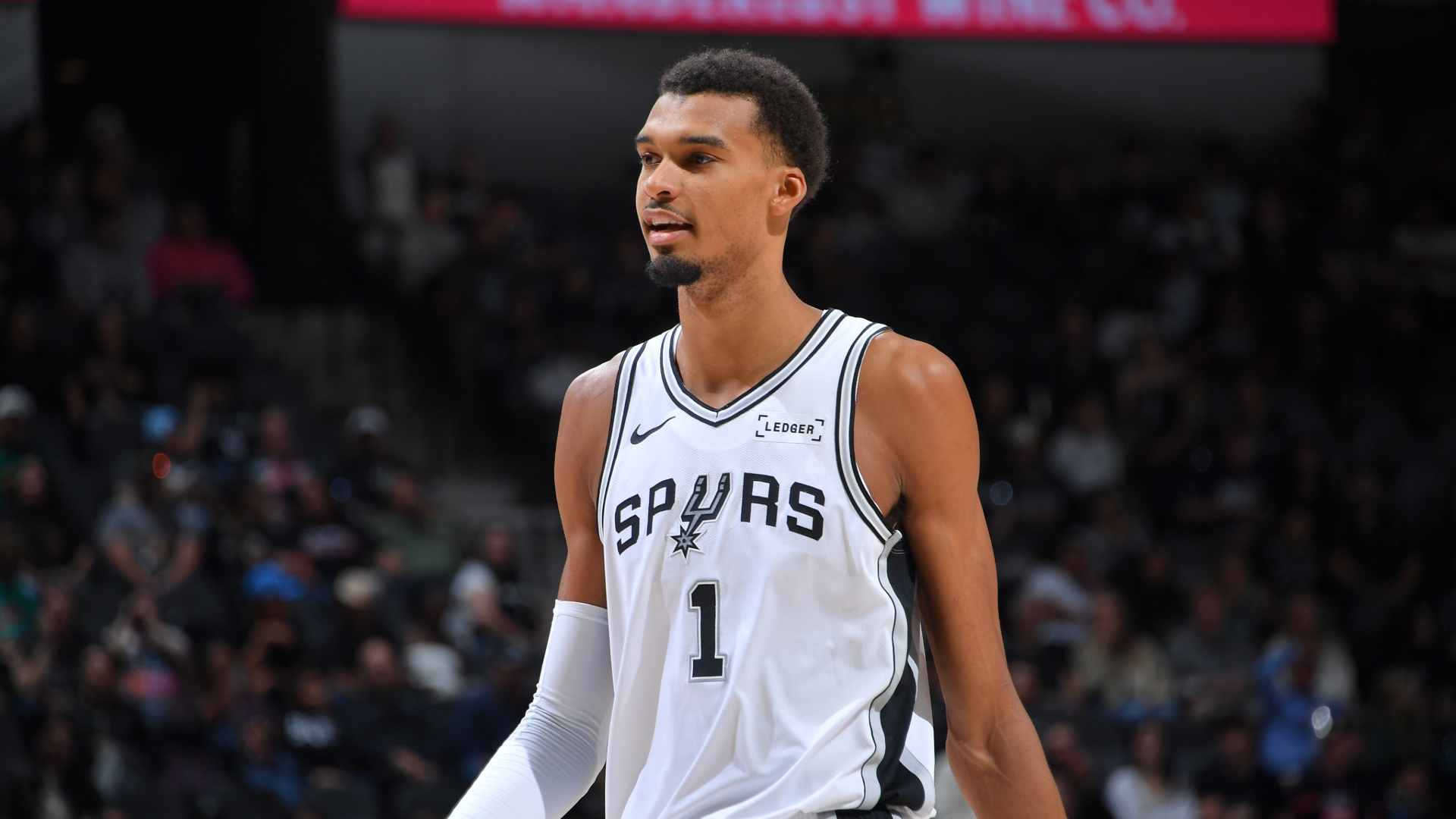
As the 2026 offseason draws to a close we have officially reached the NBA's Oct. 19 deadline for rookie extensions. First-round picks in the 2023 NBA Draft were eligible to sign rookie extensions until today, and ultimately, six of them did so:
- No. 1 overall pick Victor Wembanyama signed a five-year, $252 million extension with the San Antonio Spurs;
- No. 2 overall pick Brandon Miller signed a five-year, $209 million extension with the Charlotte Hornets;
- No. 4 overall pick Amen Thompson signed a five-year, $208 million extension with the Houston Rockets;
- No. 5 overall pick Ausar Thompson signed a five-year, $155 million extension with the Detroit Pistons;
- No. 10 overall pick Cason Wallace signed a five-year, $139 million extension with the Oklahoma City Thunder;
- No. 16 overall pick Keyonte George signed a five-year, $157.5 million extension with the Utah Jazz;
- No. 19 overall pick Brandin Podziemski signed a five-year, $110 million extension with the Golden State Warriors.
A total of seven 2023 first-round picks were not eligible for rookie extensions because they either had their fourth-year options declined or were waived earlier. The bulk of the 2023 class, however, was still eligible to negotiate, and we graded all of the deals that ultimately came.

Victor Wembanyama (No. 1 pick): A+
Terms: Five years, $252 million, player option on the final year
There is no contract Wembanyama could have signed that would not have represented an enormous organizational victory for the Spurs. The best player in the NBA in his early 20s, or really at any point in his career, always has one of the league's best contracts because the absolute top of the market is restricted by the very concept of a max salary. Nikola Jokić is underpaid even at 35% of the cap. LeBron James was underpaid for virtually his entire career. There's no amount you can pay someone this good that isn't team-friendly.
Yet Wembanyama's deal is especially notable because this isn't necessarily his max. Wembanyama signed a contract that will start him at 25% of the cap and include the standard 8% annual raises thereafter. For most players, this is indeed a max contract. However, Wembanyama could have included Rose Rule escalators in his deal that would have vaulted that starting salary to 30% of the cap if he were to win MVP or Defensive Player of the Year, or make an All-NBA Team this season. If he reaches the 65-game requirement, he is a virtual lock to do so.
We've seen other players, most notably Tyrese Haliburton, play through injuries in ways that proved detrimental over the longer term for the sake of ensuring eligibility for that Rose Rule bump. The Spurs have been notoriously cautious with Wembanyama's health thus far in his career, and justifiably so given his uncommon physical proportions. If Wembanyama had wanted the 30% max, the Spurs would have given it to him, and they almost certainly would not have stood in his way if he'd attempted to make medical decisions that steered him towards eligibility. The easiest way to burn a bridge with a player is to cost him money. Now, the Spurs won't have to worry about that. They can be as cautious as they want, knowing Wembanyama has nothing to gain by playing when he shouldn't.
If Wembanyama is merely as good as he was at the end of last season for the duration of this deal, it's one of the best contracts in the NBA. If he improves in all of the ways that we suspect he should, it rises to the level that some of the best LeBron contracts did as an all-time value deal, even despite a max or max-adjacent price tag. Injury is the only concern here, but it's not enough of one to lower this grade. Any team in the NBA would have been thrilled to sign Wembanyama to this contract.

Brandon Miller (No. 2): B+
Terms: Five years, $209 million
Miller, more than any other player in this class, exemplifies how rookie extension negotiations have changed in recent years. Think of how many promising yet ultimately unaccomplished top draft picks used to get blind maxes. Franz Wagner, for instance. Michael Porter Jr. Andrew Wiggins. If you were drafted in the lottery and showed even the faintest whiff of future stardom, especially as a wing, it was just a no-brainer. You got maxed. Miller didn't.
He didn't come all that close, either. While we don't yet know the contract's structure (and Charlotte has the flexibility to get creative on that front), the lowest possible starting point would come in between 20% and 21% of next year's projected cap. The max extension for most players in this experience bracket would start them at 25%. The Hornets seemingly negotiated down to the final minutes before Monday's deadline and secured some of the more favorable terms you'll ever see on a player of Miller's ilk. With LaMelo Ball gone, he and Kon Knueppel are the franchise players now. He's a No. 2 overall pick at the NBA's most valuable position coming off of a breakout season, yet when you adjust for inflation, he's making less than Brandon Ingram on his current deal.
Ingram is the worst-case scenario for Miller from an archetypal standpoint. They can both get too jumper-heavy, though Miller's, thankfully, tend to come from behind the arc. Ingram has flashed considerable defensive upside at points but never sustained it. Miller took a real step on that front a year ago, but he has further to go if Charlotte is going to survive with its relatively undersized front court.
Miller has improved noticeably in each of his NBA seasons. Life without Ball is going to get harder, and that's the test here. Almost 63% of Miller's shots were assisted a year ago. A lot of Ball's creation burden is now going to fall on his shoulders. Miller has to get to the rim and the line more. He'll have to grow as a passer too, especially with all of the doubles he's about to see in his post-Ball world. Today, this contract is fine. It becomes a steal if Miller grows into the more well-rounded cornerstone the Hornets are hoping he can be.
But one of the benefits of taking a step back, as Charlotte did this season, was that it gives players like Miller more room to experiment and develop. He's in a friendly environment to do so given all of the shooting Charlotte has accumulated. This is his team now, and if that works out as well as Charlotte hopes, getting him this far below the max could create one of the better contracts in basketball.

Amen Thompson (No. 4): B-
Terms: Five years, $208 million
The Thompson twins are tricky to value because they really don't have any appropriate points of comparison. In Amen's case specifically, the closest you could probably come is Dyson Daniels on his $25 million-per-year contract. Thompson is just shy of $42 million annually, but he's better at just about everything. The Thompsons are the two best non-center defenders in the NBA, save perhaps Alex Caruso, whose load gets managed pretty aggressively by the Oklahoma City Thunder. Daniels is a decent rebounder, solid playmaker and great transition player. Amen is better than him at all of those things.
The hope coming into last season, especially with Fred VanVleet injured, was that Thompson could use those extra on-ball reps to grow into something resembling Russell Westbrook: the nuclear athlete who made up for his limitations as a shooter by getting to the rim at will. It hasn't happened yet, though Houston's low-shooting ecosystem and uninspiring offensive scheme certainly played a role there. Thompson bears some responsibility here as well. He has work to do as a ball-handler and finisher. He doesn't have Westbrook's preternatural aggression, though that's hardly a fair standard to hold anyone to.
What we mostly established last season was that Thompson is more wing than point guard, even if he has some point guard traits. It's easier to get away with lacking a jump shot when the ball is in your hands and the offense is running through you. There aren't exactly recent examples of teams winning championships with Thompson-esque players making more than 20% of the cap. More often, players who share a few of his traits -- Caruso with his defense and supplementary playmaking, Josh Hart with his rebounding and transition excellence -- are making a lot less money and at least offering some sort of 3-point threat.
Thompson is an anomaly in this respect. We're not used to teams making this sort of bet on a player like him, though players like him hardly even exist. The modern NBA is perhaps a bit friendlier to players like him than the one we lived in even, say, five years ago. The possession game is king now, and players who can generate turnovers, own the offensive glass and dominate in transition are worth their weight in gold. The Rockets were at the forefront of that shift. This is a bet on their team-building philosophy as much as it is on Thompson, specifically.
Thompson's absurd athleticism, matched in the current NBA only by his brother, will have to hold up through his late-20s for this contract to work. He'll have to grow as an on-ball scorer as well, perhaps not to Westbrook's level, but certainly beyond the 20 points per game threshold. Those are reasonable goals, though, and Houston is asset-rich enough to tailor a roster to Thompson's needs. The Rockets aren't in their final form yet, but tailoring that eventual roster around a player as singularly gifted as Thompson is ultimately the right decision. This deal isn't without its risks, but all in all, it's a reasonable figure.

Ausar Thompson (No. 5): B
Terms: Five years, $155 million
We may not have a helpful out-of-family comparison for the Thompson twins, but their deals compare interestingly against one another. They cover the same term, but Ausar will make just under 75% of what Amen makes in that time frame. Ausar might genuinely be the only non-center in the NBA who could credibly argue to be a level above Amen defensively, though Amen's greater offensive workload plays a role there. There was a real argument that among non-Wembanyama mortals, Ausar Thompson was the NBA's best defender last season. After Game 7 of Detroit's second-round loss to the Cleveland Cavaliers, Kenny Atkinson noted that "the tactical adjustment we made was avoiding Thompson. We were just like, if he's near the ball, throw it to someone else."
The tracking data more than supports that notion. Donovan Mitchell shot 5-of-20 in the series with Thompson as his primary defender. James Harden was 0-for-8. Oh yeah, and he had nine blocks, 12 steals and 28 deflections in the series. Ausar does everything on defense. He is genuinely transformative on that end of the floor. He's just far behind his brother as an on-ball offensive player. He still brings the offensive rebounding. He's getting better as a secondary playmaker and he's a willing cutter, but he's such a limited scoring threat that his presence can be a real offensive drag. Jalen Suggs only loosely pretended to guard him in the first round of the playoffs, and that's a big reason the Orlando Magic nearly toppled the Pistons in a humiliating No. 1 vs. No. 8 first-round matchup.
The first and most important question for non-point guard perimeter players offensively is shooting. Neither Thompson has yet developed any sort of 3-point shot. You're employing them for mostly the same reasons, starting with defense. Would you want to pay a roughly $10 million annual premium for that star defender to have some on-ball juice? That depends on a dozen factors. If the Rockets think Amen still has offensive star potential, the answer is yes. I've grown pretty dubious on that front. I think it's likelier that Ausar sneaks closer to Amen's level now.
They're ultimately going to function similarly within your roster construction. You're still going to have to surround both with more shooting and creation than their teams have so far. Those things are expensive. With that in mind, I think by a hair I'd rather pay Ausar than upgrade to the premium model. The flexibility to surround these two with the sort of teammates they'll need is paramount, and since I'm getting the most important traits out of both, that $53 million gap is just enough that I think the Pistons did slightly better in their deal with a Thompson twin.

Cason Wallace (No. 10): B+
Terms: Five years, $139 million
No team was under more pressure to secure an extension with their 2023 draftee than the Thunder. Normally, teams hesitate to tender offer sheets in free agency because they are almost always matched. But the whole league knows how tight Oklahoma City's finances are, and everyone would love to weaken the NBA's best roster. Wallace was therefore a near-lock to not only secure an offer sheet, but one that was structured as inconveniently as possible for the Thunder. Throw in his new starting role and the possible elevation in value that will come with it, and the Thunder did very well to secure Wallace before the season began.
The initial value of the contract is strong. Remember, Wallace, like both Thompson twins, has made an All-Defensive team. He's not the on-ball player that Amen is and he's not nearly as versatile defensively as either of them given the vast size disparity, but he has the one trait they're both dying for: a somewhat reliable 3-point shot. Considering none figure to be primary shot-creators at any point in their career, you could argue that is the single most desirable offensive trait any star defender of their ilk could have. Wallace has it, and he's making less than both of them. We throw around the term "3-and-D" wing so frequently for a reason, folks.
Wallace obviously is not quite a wing. He can't guard up the positional spectrum like the Thompsons can and he'll never be the rim-protector that they are either. But he's a relentless on-ball pest who generates among the most turnovers in basketball at a point at which turnover-generation has never been a more valuable trait. Even if he's not the game-breaker that the Thompsons can be defensively, the gap is relatively small, and if Wallace never grows offensively, his shooting affords so much more lineup and roster-building flexibility than either of the Thompsons offer.
And then of course, we have to acknowledge the chance that Wallace does grow offensively. This is his first crack at a full-time starting role, but he thrived in a small sample with a higher-usage role a season ago. In a nine-game stretch that Shai Gilgeous-Alexander missed a season ago, Wallace averaged just under 15 points and over five assists per game despite relatively weak 3-point shooting. He's never going to be a primary creator or anything close to it. He lacks the tight handle or first step and he never gets to the line. But he showcased real growth as an individual scorer, and if he can build on that as a permanent starter while maintaining the role player skill set that got him here, this contract has a chance to become a meaningful bargain.

Keyonte George (No. 16): A-
Terms: Five years, $157.5 million
There are real holes to poke in George's game. There are notable metrics that considered him the NBA's worst defender last season, and even the friendlier ones acknowledge that he is extremely vulnerable. He needs to become more of a point guard than a pure scorer. The only players to average as many turnovers as he did last season with fewer assists were forwards: Paolo Banchero and Jaylen Brown.
With Darryn Peterson coming in, Ace Bailey stepping into a bigger role and just the general reality that this team is now trying to win, there are going to be fewer on-ball opportunities available. From a scoring perspective, that should suit George fine. He's easily scalable as a ball-handler and the Jazz got plenty out of him off of the ball last season. But playmaking is a real necessity here, and growth from George will be the first place the Jazz look to try to find it.
Got that out of the way? Cool. Getting this level of scoring from a player this young who showed so much improvement last season would have been borderline unimaginable under previous collective bargaining agreements. George's deal projects to start at 16.31% of the 2027-28 salary cap, according to Spotrac.
Think of other notable defensively deficient scoring guards who have extended over the past few years: Tyler Herro started at just below 20%, Jordan Poole just above it, and Jalen Green was closer to 22%. George outscored and out-assisted all three of them in their third seasons. He admittedly did that on a tanking team with plenty of shots at his disposal, but only Poole was more efficient, and that's hardly a fair comparison since, you know, he was playing with Stephen Curry.
You could credibly argue that George is more promising today than any of them were when they signed their rookie extensions... and his contract actually gets cheaper over time on a relative basis. Herro, Poole and Green all received or came close to the maximum 8% annual raises. George is getting 4% annually, so if you assume the cap continues to grow at roughly its current rate, his deal will end at 15.56% of the cap.
There is reasonable skepticism about how valuable George will be moving forward. He has to improve in a few key areas, and the NBA is moving away from smaller, all-offense guards. But George is making far less than most of the players of that archetype, and that's before we even consider the max-adjacent deals players like Austin Reaves and Trae Young just got. If this doesn't work out, the numbers are low enough that the deal remains tradable. Utah might simply find that George isn't the right sort of backcourt mate to pair with Peterson anyway. But a player this young and this talented has a chance to be a genuine steal on a contract like this, and for a Jazz team that's suddenly getting pretty expensive, contractual victories like that are an absolute necessity.

Brandin Podziemski (No. 19): C
Terms: Five years, $110 million, mutual option on the final year
Brandin Podziemski is a good player. He's a jack of all trades who affects games in a number of subtle ways. He's a great rebounder for his position. He draws charges. He's a solid enough defender who tends to rate better through the all-in-one metrics than the eye test, mostly because his strengths are off the ball. He'll make 3s and he'll create a bit of offense and you'll rarely have to worry about him when he's on the floor. But he doesn't exactly have a calling card either. He's not a point guard-level shot-creator. He's not an elite 3-point shooter or point-of-attack defender.
When you're negotiating with someone you expect to be a cornerstone of your future, it makes sense to prioritize getting a deal done even if the terms aren't perfect. Maintaining your relationships with such players matters. But when you go a bit further down the organizational totem pole, it behooves you to negotiate as hard as possible on rookie extensions. The entire deck is stacked in your favor as a team in these negotiations. The player in question hasn't made much money yet. Restricted free agency works against them finding fair market value in the following summer. One injury can derail their long-term earning power. With players like this, it only really makes sense to sign a rookie extension when you're getting great value.
What would have to happen for Golden State to get great value on these terms? Since Podziemski doesn't have those premium skills, he'd probably have to grow into an above-average starter when he's thus far been closer to a strong third guard. Such growth is possible, especially with reports out of training camp sounding quite positive. The money here is nearly identical to what Ayo Dosunmu got from the Minnesota Timberwolves, but remember, Dosunmu's contract was negotiated under entirely different circumstances. He was coming off of a strong playoff run, he had the leverage of unrestricted free agency and his team had just invested in the injury-prone LaMelo Ball as their starting point guard, making a pricey backup a necessity. Podziemski had none of those advantages.
Spending money in restricted free agency is an enormous risk. It requires tying up your cap space through the relevant portion of free agency while knowing that it may all be for nothing if the incumbent team matches. Teams are understandably more enthusiastic about doing it for players with singular, high-value traits. You need point guard-level creation and elite point-of-attack defense to win at the highest levels, so teams take bigger risks to get it. As helpful as the things Podziemski does can be in the right context, they're not the sort of things teams tend to go far out of their way for.
Barring a breakout fourth season, it was just hard to imagine someone throwing a bigger offer sheet at Podziemski than this. The Warriors probably could have squeezed him for a better deal by taking this into next summer. We've spent three years hearing about how highly the Warriors organization regards Podziemski. Maybe they're right and this turns out to be a value contract. At this moment, though, it seems as if they're paying for the player they want him to be rather than the one he's thus far proven capable of being. That doesn't necessarily make this a bad contract. It's probably par for the course for a high-end sixth man moving forward, which is where I'd expect Podziemski to fall. But these other extensions range from somewhat to extremely team-friendly in large part because the teams in question were able to successfully weaponize the harsh realities of restricted free agency into great terms. The Warriors didn't do that, and in the "every dollar counts" era the aprons have created, that may one day come back to haunt them.