
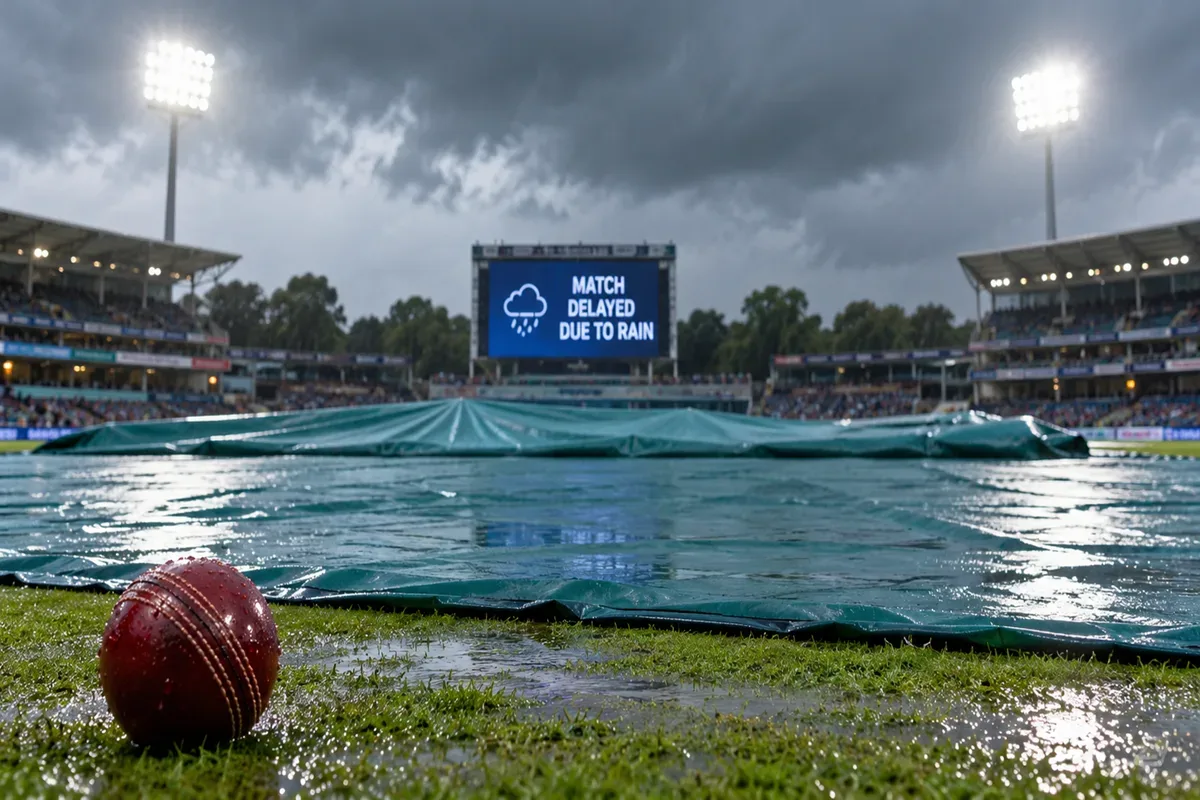
The Duckworth-Lewis-Stern (DLS) method recalculates targets and results in rain-affected limited-overs cricket by comparing overs available and wickets in hand. It is used in formats such as ODIs and T20Is, but not Test cricket.
The guide explains revised targets, DLS par scores, interruptions, minimum overs, repeated calculations, and why targets do not simply follow run rates. It also outlines the method’s history, limitations, and relationship with powerplays and net run rate.
Rain can change the course of a cricket match without a single ball being bowled. When bad weather reduces the number of overs available, the Duckworth-Lewis-Stern (DLS) method helps determine a fair target for the team batting second.
Rather than simply reducing the target in proportion to the overs lost. DLS considers two important factors: how many overs a team has available and how many wickets it has lost.
A side chasing 250 with ten wickets remaining faces a different challenge from one chasing the same total with only four wickets left. The DLS method accounts for that difference when calculating revised targets.
It is the recognised system for rain-affected One Day Internationals (ODIs), Twenty20 Internationals (T20Is) and other limited-overs competitions that adopt it.
For fans watching a rain interruption, understanding DLS makes it easier to follow the revised target, the par score and the result if play cannot resume.
What is the DLS method in cricket?
DLS stands for Duckworth-Lewis-Stern, a mathematical method that adjusts run targets when interruptions reduce the overs available in limited-overs cricket.
The system measures the run-scoring resources available to each team. Those resources depend on the combination of overs remaining and wickets in hand.
The aim is to give the side batting second a target that reflects its available opportunities compared with those of the side batting first.
For example, imagine one team scores 280 runs in its full 50 overs. Rain then reduces the opposing team’s innings to 35 overs.
Simply reducing 280 by 30% would produce 196 runs. However, that calculation ignores the fact that the chasing team begins with all ten wickets available and can approach a shorter innings differently.
DLS considers the relationship between overs and wickets rather than relying on a straight percentage reduction.
The International Cricket Council’s official DLS guidance explains the resource-based approach used to calculate targets in interrupted matches.
The method does not guarantee that both teams experience identical conditions. Instead, it provides a consistent mathematical framework for adjusting the contest.
How does the DLS method work?
The DLS method uses a mathematical model of how teams typically score runs throughout a limited-overs innings.
Its calculations centre on two resources.
Overs remaining
An over consists of six legal deliveries. In a standard ODI, each team receives a maximum of 50 overs. In a T20 match, the limit is normally 20.
Overs represent scoring opportunities. A team with 30 overs remaining generally has more opportunities to accumulate runs than one with only ten.
However, not every over has the same scoring potential.
Teams frequently approach the opening overs differently from the closing stages. Batters may spend time building an innings before increasing their scoring rate towards the end.
DLS reflects these changing scoring patterns.
Wickets remaining
Each batting team has ten wickets available. Losing wickets reduces the number of batters who can contribute to an innings.
A team with nine wickets remaining can usually take greater batting risks than one with only two.
Consequently, DLS assigns different levels of remaining resources according to the number of wickets lost.
Consider two sides at the same stage of an ODI:
- Team A have scored 120/1 after 25 overs.
- Team B have scored 120/7 after 25 overs.
Both have the same runs and overs remaining. However, Team A retain far greater batting resources because they have lost only one wicket.
If rain ends the available playing time, that difference matters when determining the resource balance.
The DLS system combines these two factors to establish how much of an innings’ scoring potential remains.
Embed from Getty ImagesHow is a revised DLS target calculated?
Match officials use the appropriate DLS calculation software to determine the revised target.
The calculation compares the total run-scoring resources available to the two teams, taking account of any overs lost during their innings.
The process follows several stages.
- Officials establish the resources available to the team batting first.
- They calculate any resources that the team lost because of interruptions.
- They determine the resources available to the chasing team, including any overs lost during its innings.
- The DLS calculation compares those resources and produces the revised target.
- Officials communicate the target and remaining overs before play resumes.
The calculations use resource percentages rather than simply comparing the number of overs.
In the published Standard Edition, a full 50-over innings begins with 100% of the available resources. Shorter innings begin with a smaller resource allocation.
The professional Stern Edition used in international cricket incorporates more sophisticated calculations to reflect modern scoring patterns. Consequently, a simplified manual calculation should not be treated as an exact substitute for the official software.
Why doesn’t DLS simply use the run rate?
A basic run-rate calculation divides runs scored by overs faced.
If a team makes 250 in 50 overs, its average scoring rate is five runs per over.
Applying that rate to a 30-over chase would suggest a score of 150.
However, that ignores how teams adjust their batting plans when they know an innings will be shorter.
A team chasing over 30 overs from the start can adopt a more aggressive approach than one preparing for a full 50-over innings.
DLS attempts to account for these differences.
This distinction is important when reading cricket scorecards and understanding why the revised target may not match a straightforward run-rate calculation.
For a broader explanation of innings, wickets and scoring, see World in Sport’s Cricket Rules Explained guide.
DLS calculation example: A rain-shortened ODI
Consider a hypothetical ODI between Team A and Team B.
Team A bat first and score 260 runs from their full allocation of 50 overs.
Team B begin their chase of 261 and reach 90/2 after 18 overs.
Rain interrupts the match. When conditions improve, officials determine that Team B can receive a maximum of 35 overs rather than 50.
The revised target must now reflect the resources lost.
For illustration, suppose the official target announced is 205 runs from 35 overs.
Team B have already scored 90 runs. They therefore need another 115 runs from the remaining 17 overs, with eight wickets in hand.
The situation becomes:
- Original target: 261 from 50 overs.
- Score when rain stops play: 90/2 after 18 overs.
- Revised innings length: 35 overs.
- Illustrative revised target: 205.
- Runs still required: 115.
- Overs remaining: 17.
These figures demonstrate how to read a revised target. The 205-run target is hypothetical and is not presented as the calculated output of the current professional DLS software.
If Team B reach 205, they win. If their innings ends on 204, the scores are tied under the revised target. If they finish below 204, Team A wins.
This example also highlights a crucial point: a DLS target is not simply the number of runs a side still needs. It is the total score required to win within the revised innings allocation.
What is the DLS par score?
The DLS par score is one of the most frequently misunderstood features of rain-affected cricket.
It represents the score the chasing team must have reached at a particular point for the match to be tied if play ends permanently at that moment.
A team’s position relative to the par score therefore determines who is ahead under DLS.
For example, suppose the par score at an interruption is 125 runs.
If the chasing team have:
- 130 runs, they are five runs ahead of par.
- 125 runs, they are level with par.
- 120 runs, they are five runs behind par.
If the match cannot resume and the minimum overs requirement has been satisfied. The chasing team would win by five runs in the first example, tie in the second and lose by five runs in the third.
The actual par score depends on the match situation and must come from the applicable DLS calculation.
Does the par score change when wickets fall?
Yes. Wickets influence the amount of batting resources remaining.
If a chasing team lose several wickets, the reduction in remaining resources can increase the par score required to be ahead at that stage.
Consequently, a team can move from being ahead of DLS par to behind it without conceding any runs.
This explains why wickets immediately before a rain interruption can have such a significant impact.
The par score also changes as an innings progresses. Fans should therefore check which delivery or completed over the displayed figure refers to.
Embed from Getty ImagesWhat happens when rain interrupts the first innings?
Rain interruptions during the first innings can produce more complicated adjustments.
Imagine Team A begins a 50-over ODI. Rain stops play midway through their innings, and officials reduce their maximum allocation.
Team A must finish batting with fewer overs than originally expected.
Team B then begin their innings knowing exactly how many overs they can face.
Although both teams might ultimately receive similar over allocations, their available resources are not necessarily equal.
Team A may have approached the early part of their innings expecting to bat for 50 overs. Team B can plan from the outset around a shorter chase.
DLS considers those differences when calculating the target.
Can a DLS target be higher than the first innings score?
Yes.
This can happen when the chasing team has more run-scoring resources available than the side batting first.
For instance, Team A might lose overs late in their innings after already using several wickets. Team B could then start a revised innings with all ten wickets available.
The resource comparison can justify a target greater than Team A’s actual total plus one run.
This outcome sometimes surprises spectators who expect rain always to reduce a target.
The important distinction is that DLS adjusts the target according to the resources available, not merely the first innings total.
What happens when rain interrupts the second innings?
When rain stops play during the chase, officials assess how much playing time remains.
If enough time is available, they may reduce the remaining overs and calculate a revised target.
Play then resumes with the updated target and revised innings length.
If further rain interrupts the match, officials can repeat the process.
Each interruption changes the resources available to the chasing team. The calculation must therefore account for the cumulative effect of those interruptions.
If rain prevents any further play, the outcome depends on whether enough overs have been completed to constitute a match.
Where the minimum requirement has been satisfied, officials compare the chasing team’s score with the DLS par score at the point of abandonment.
If the minimum requirement has not been met, the match will ordinarily finish without a result.
How many overs are needed for a DLS result?
The minimum number of overs depends on the format and the competition’s playing conditions.
Under the ICC’s October 2026 international playing conditions, +1 the standard minimum requirements in men’s ODIs and T20Is are as follows.
One Day Internationals
In an ODI, both sides must normally have the opportunity to bat for at least 20 overs.
However, a result can still be achieved if a team are dismissed in fewer than 20 overs or the side batting second reaches its winning target earlier.
For example, if the chasing team have faced only 18 overs when rain permanently ends play. A DLS result cannot ordinarily be declared unless a qualifying result has already been achieved.
Twenty20 Internationals
In a T20I, the normal minimum is five overs per side.
The same principle applies to early dismissals and a successful chase before the minimum number of overs has elapsed.
This lower threshold reflects the shorter format.
For example, if the side batting second has completed six overs before rain permanently stops a T20I, DLS can determine the result using the par score.
However, if play ends after only three overs of the chase, there will ordinarily be no result unless the match has already been decided.
Domestic leagues and individual tournaments may apply different minimums or additional provisions. Their specific playing conditions must always be checked.
What happens if a match cannot be completed?
DLS cannot produce an official winner in every rain-affected match.
A match may end without a result if rain prevents the minimum number of overs from being completed and no qualifying outcome has already occurred.
The distinction between a shortened match and an abandoned match is important.
A shortened match can still produce a winner when both teams have received sufficient batting opportunities.
An abandoned match may also produce a DLS result if the chasing side has completed the required minimum and play cannot resume.
However, when the minimum requirements have not been satisfied, the normal outcome is no result.
Some competitions provide reserve days for important fixtures. Others use tournament-specific procedures for allocating points when a match cannot be completed.
A reserve day is not an automatic feature of DLS. It must be provided for in the competition regulations.
Embed from Getty ImagesDoes DLS apply to Test cricket?
No. The DLS method applies to limited-overs cricket rather than standard Test matches.
Test cricket operates under a different structure.
A Test normally allows each team two innings, with no fixed limit on the number of overs in an individual innings.
Rain interruptions reduce the time available to complete the match. They do not produce a revised run target through DLS.
A Test can therefore finish as a draw if time expires before either team achieves victory.
This differs from ODI and T20 cricket, where the overs available to each team form a central part of the match structure.
World in Sport’s Test Cricket Rules Explained article examines how innings, time limits, draws and results operate in the longer format.
Who invented the Duckworth-Lewis-Stern method?
The system takes its name from three mathematicians whose work helped establish and develop the method.
Frank Duckworth and Tony Lewis developed the original Duckworth-Lewis system during the 1990s.
The method entered use in 1997, and the ICC adopted it for international cricket in 1999.
It offered a more sophisticated alternative to earlier rain-adjustment methods that did not adequately reflect the relationship between overs and wickets.
As limited-overs cricket evolved, scoring rates increased, and teams became more aggressive throughout their innings.
The original model consequently required further development.
Steven Stern later refined the system, particularly to better account for modern scoring patterns and high totals.
His contribution led to the introduction of the Duckworth-Lewis-Stern name in 2014.
Further updates have helped the method respond to changes in ODI and T20 scoring patterns.
Why is the DLS method sometimes controversial?
Despite its widespread use, DLS regularly attracts debate.
One reason is that the system can produce targets that appear unusual to viewers.
A side may need substantially fewer runs after losing overs, yet still face a demanding chase because it has less time to score.
Another concern is the complexity of the calculations.
Fans can easily understand a target based on average runs per over. DLS requires knowledge of resource percentages, wicket losses and the timing of interruptions.
The professional calculation also uses a more detailed model than the publicly available Standard Edition tables.
This makes exact independent calculations difficult without the appropriate software.
Does DLS favour the chasing team?
Not automatically.
The method aims to balance the available resources, but the practical effect depends on when rain falls and how many wickets have already been lost.
A chasing side with several wickets remaining may benefit from knowing its revised target and adapting its batting accordingly.
Equally, losing wickets shortly before an interruption can leave that team behind the par score.
The timing of the interruption matters because both teams may have approached their innings under different assumptions.
DLS attempts to compensate for these circumstances mathematically. It cannot recreate the tactical decisions that teams might have made if the weather had remained dry.
Does DLS consider pitch conditions?
Not directly as a separate match-specific variable.
The calculation does not independently assess whether a particular pitch is unusually difficult for batting or whether conditions become easier after rain.
Instead, it uses the scoring model and information about available overs and wickets.
This is an important limitation, especially in matches where conditions change significantly between innings.
Nevertheless, DLS remains the established method for calculating revised targets in international limited-overs cricket.
Does DLS affect powerplay overs?
Rain-shortened innings may also require changes to fielding restrictions.
Powerplays limit how many fielders can stand outside the designated inner circle during particular stages of an innings.
When officials reduce the available overs, the number and allocation of powerplay overs may change under the relevant playing conditions.
Those adjustments are separate from the DLS target calculation.
For instance, a shortened T20 innings can have a reduced powerplay period, while a shortened ODI requires adjustments to its fielding-restriction phases.
This means rain can change both the runs needed to win and the fielding restrictions governing the remaining overs.
World in Sport’s Cricket Powerplay Rules guide explains how those restrictions operate and how shorter innings affect them.
What is the difference between DLS, run rate and net run rate?
These three terms describe different aspects of cricket scoring.
Run rate measures how quickly a team scores runs, normally expressed as runs per over.
DLS calculates revised targets or determines results in qualifying interrupted limited-overs matches.
Net run rate compares a team’s scoring rate with the scoring rate of its opponents across matches, using competition-specific rules. It is commonly used to separate teams in tournament standings.
Although run rate contributes to how fans assess a chase, DLS does not simply multiply a team’s current scoring rate by its remaining overs.
Likewise, net run rate is not a substitute for a DLS calculation.
When a rain-affected match produces a result, the competition’s regulations determine how that result affects the standings and net run rate calculations.
Frequently asked questions
What does DLS mean on a cricket scoreboard?
DLS stands for Duckworth-Lewis-Stern. It indicates that the method has been applied to calculate a revised target or determine a result after an interruption.
A scoreboard may also show the DLS par score, which indicates whether the chasing team are ahead or behind if play ends at that moment.
Is the DLS target always lower after rain?
No. The target can be higher than the first innings total plus one run if the chasing team has more available resources than the side batting first.
However, a shortened chase after an uninterrupted first innings generally produces a lower target.
Does losing a wicket change the DLS par score?
Yes. Wickets reduce the batting resources available, so losing a wicket can increase the par score needed to remain ahead if play ends.
Can a cricket match finish as a tie under DLS?
Yes. If a qualifying match ends with the chasing team’s score exactly equal to the DLS par score, the result is tied.
Depending on the competition regulations, a Super Over may then be used to determine a winner if conditions permit.
Who calculates DLS targets?
Authorised match officials and scorers use the appropriate DLS software and match information to establish the revised target.
Captains and teams do not choose their own targets.
Can DLS be used more than once in a match?
Yes. If play is interrupted repeatedly and additional overs are lost, officials can recalculate the target to account for the updated resources.
Why understanding DLS matters
Rain interruptions can turn a straightforward cricket chase into a different contest.
The revised target may appear generous at first glance, particularly when a team suddenly need fewer runs to win. However, fewer overs also mean fewer opportunities to score.
Wickets add another layer of importance. A side with plenty of batting resources can respond to a shortened chase differently from one that has already lost most of its recognised batters.
The key is to understand three figures: the revised target, the overs remaining and the current DLS par score.
Together, they show what the chasing team must achieve, how much time remains and which side is ahead if rain prevents further play.
DLS cannot remove every disadvantage caused by changing weather. It does, however, provide a consistent system for determining targets and results when limited-overs cricket cannot proceed as originally scheduled.
For more cricket explainers, match analysis and tournament coverage, visit the World in Sport cricket section.

World In Sport Forum
Continue the discussion
Join other fans in the World In Sport Forum and debate the biggest talking points from this article.