
Given the recent talk about the medical care provided to NFL players (I’ll now wonder whether any “calf” injury is actually a blood clot), more attention will be paid to whether the practices match the principles that were stridently articulated earlier this week by chief medical officer Allen Sills.
“The notion that there’s external factors that any of our physicians would put a player in harm’s way -- that’s nonsense,” Sills said, among other things, in defending the handling of Eagles quarterback Jalen Hurts in London nearly two weeks ago.
The realities of professional football introduce plenty of external factors that make the situation necessarily and inherently different than the usual patient-care scenario.
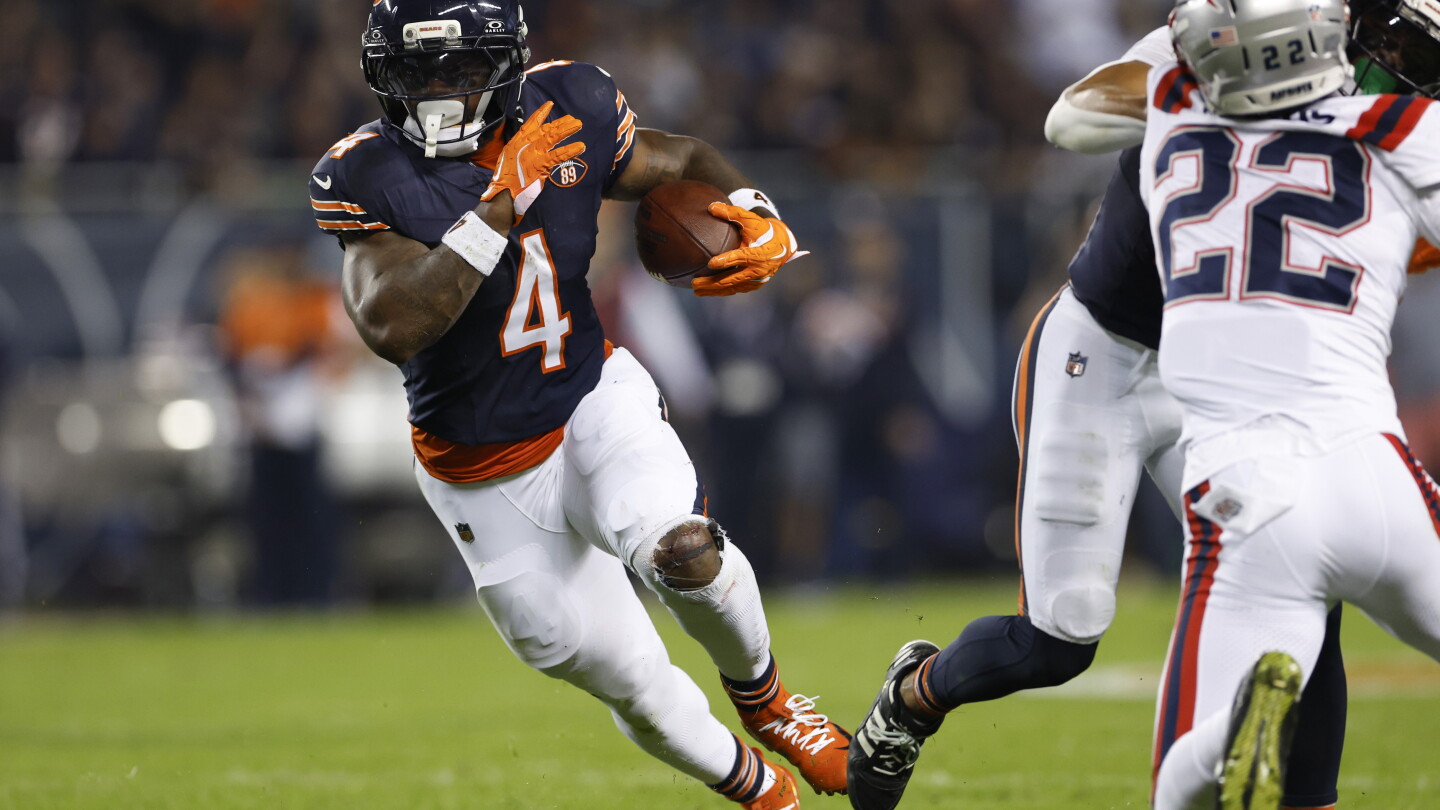
Last night, for example, Bears running back D’Andre Swift took a helmet to the knee while being tackled during the first quarter against the Patriots. Swift immediately was in pain. He got up and limped off the field.
Not long after that, Prime Video cameras provided a closeup view of Swift’s knee. The impact had ripped a large hole in his pants, and blood was plainly visible on his skin. While he wasn’t bleeding profusely, Swift was definitely bleeding.
Prime Video sideline reporter Kaylee Hartung explained that Swift had received no medical attention on the sideline.
That’s unusual, to say the least. Cuts are addressed, in order to stop and/or conceal the bleeding. The player’s blood becomes a potential biohazard for others. The exposed wound puts the player at risk of external contamination.
In this specific case, the doctors on the sideline provided no treatment to Swift. While it’s possible he refused it, the disposition of the player-patient is one of the obvious “external factors” that can compromise care. The patient, in that setting, can at times be uncooperative.
Sills opened the door to this kind of scrutiny, through his insistence that no football factors (such as the player wanting to play, the team wanting him to be available, and the team and the league hoping to justify the decision not to revise the injury report, which included no suggestion that Hurts possibly wouldn’t play).
We all know that the context makes the medical care given to NFL players different. The still-unanswered questions regarding the treatment and advice given to Hurts flows from the basic recognition that a doctor who is disconnected from the shared urgency to play should have final say over whether the player will be permitted to take the field with a potentially serious health condition.
Those questions shouldn’t be shouted down or ignored. Swift’s case is a reminder of the dynamic that can lead to certain situations where the overriding goal that players will “be available” to play needs to be overridden by a doctor who cares only about the patient and nothing else.