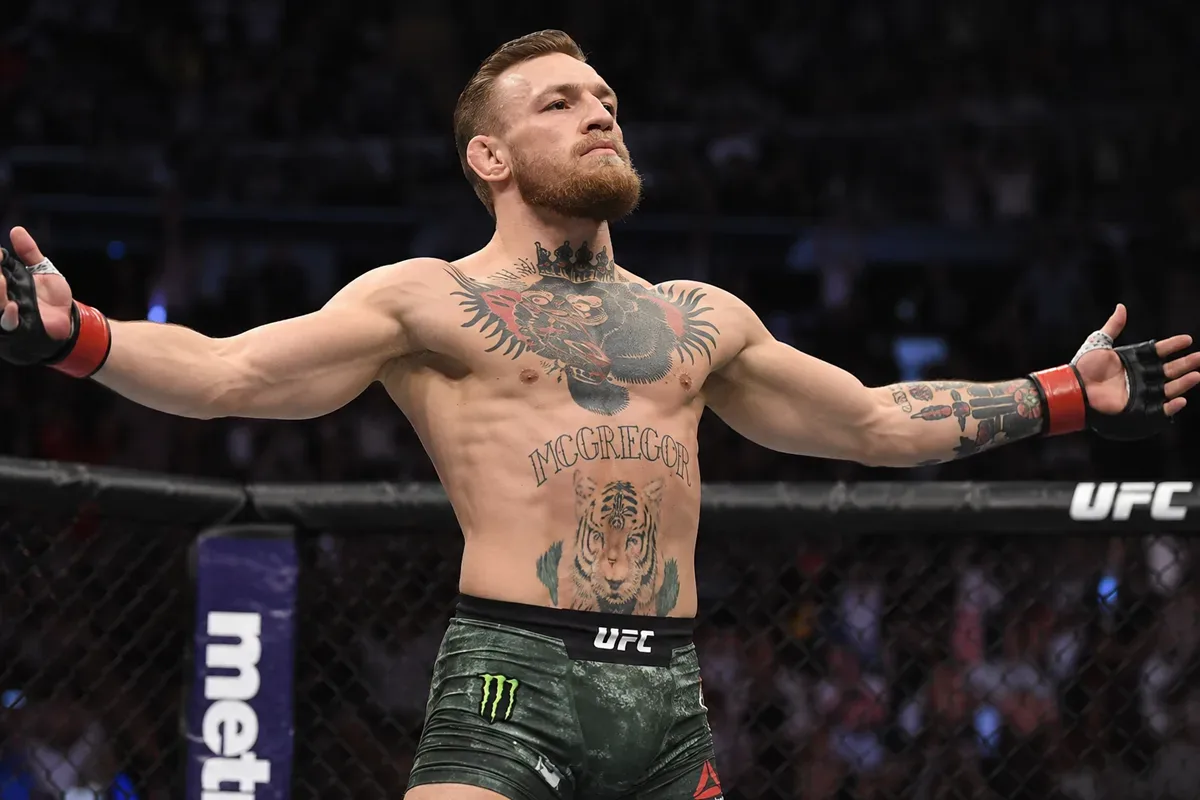
Conor McGregor became the UFC’s first simultaneous two-division champion after landmark victories over José Aldo and Eddie Alvarez. His counter-striking, promotion skills and commercial appeal transformed expectations for elite mixed martial artists.
His career also includes defeats by Nate Diaz, Khabib Nurmagomedov and Dustin Poirier, a boxing crossover, prolonged inactivity and serious injuries. A knee injury loss to Max Holloway in 2026 left his competitive future uncertain.
Conor McGregor changed what was possible for a mixed martial artist inside and outside the UFC.
The Irish fighter built his reputation around sharp counter-striking, a dangerous left hand and an unusual ability to turn predictions into performances. His ascent culminated in UFC championships at featherweight and lightweight and made him the first fighter in the promotion’s history to hold titles in two divisions at the same time.
Yet the complete Conor McGregor profile is more complicated than the championship images that defined his peak. His career includes landmark victories over José Aldo and Eddie Alvarez, defeat against Khabib Nurmagomedov, a lucrative crossover into boxing, long periods of inactivity and two major injury setbacks.
His return against Max Holloway at UFC 329 in July 2026 added another difficult chapter. Five years after breaking his leg against Dustin Poirier, McGregor suffered a knee injury only 69 seconds into the contest and lost by injury TKO.
At 38, his place in MMA history is already secure on sporting and commercial grounds. Whether his competitive career still has another meaningful chapter remains uncertain.
Early life and the move into combat sports
Conor Anthony McGregor was born in Dublin on 14 July 1988 and grew up in Crumlin.
Football formed part of his early sporting life. He played for Lourdes Celtic before combat sports became increasingly important. McGregor began boxing at Crumlin Boxing Club while still young, developing fundamentals that later became central to his MMA style.
His family subsequently moved to Lucan. There, McGregor became friends with future UFC fighter Tom Egan and began putting greater emphasis on mixed martial arts.
The pathway was far removed from the highly structured development systems available to many established sports. Irish MMA was still small, while professional opportunities were limited.
McGregor also started a plumbing apprenticeship before deciding to pursue fighting. His commitment to MMA strengthened after joining coach John Kavanagh at Straight Blast Gym Ireland.
Kavanagh became one of the central figures in his development. McGregor later acknowledged that his coach repeatedly encouraged him to become more disciplined at stages when his commitment had drifted. UFC accounts of his early career describe a young fighter who believed he could reach the organisation long before there was much external evidence to support that ambition.
Embed from Getty ImagesCage Warriors provides the breakthrough
McGregor turned professional in 2008. His early record was not perfect, but the defeats helped expose areas of his game that required improvement.
He increasingly developed a striking style built around distance, timing and southpaw attacks. Rather than simply advancing behind combinations, McGregor often encouraged opponents to move towards his left hand.
His breakthrough arrived with Cage Warriors.
In 2012, McGregor captured the promotion’s featherweight championship. Later that year, he moved up and knocked out Ivan Buchinger to claim the lightweight belt.
The victory made him Cage Warriors’ first fighter to hold two of its championships simultaneously. More importantly, it demonstrated that McGregor’s ambitions were beginning to match his results.
That double-champion achievement became a preview of what followed in the UFC.
A fast start in the UFC
McGregor made his UFC debut against Marcus Brimage on 6 April 2013 and stopped him in the first round.
His second appearance presented a different challenge. Max Holloway, then at an early stage of his own UFC career, took McGregor the distance. McGregor won by unanimous decision.
The victories continued against Diego Brandão, Dustin Poirier and Dennis Siver. The Poirier performance in September 2014 was particularly important because it demonstrated that McGregor could convert his growing profile into success against an established contender.
Momentum followed him everywhere.
His interviews and press conferences attracted attention, but his promotion would have meant little without results. At featherweight, McGregor consistently used his reach, stance and accuracy to create damaging openings.
Readers unfamiliar with the sport’s structure can find the scoring, weight divisions, and methods of victory in World in Sport’s UFC rules guide.
By 2015, McGregor was no longer simply a popular contender. He was fighting for championships.
Mendes tests McGregor before championship breakthrough
McGregor was initially scheduled to challenge José Aldo at UFC 189.
Aldo withdrew because of a rib injury, leaving Chad Mendes to accept an interim featherweight title fight on short notice.
Mendes presented a problem that McGregor had not faced at that level. His wrestling allowed him to take the Irishman down repeatedly, and he controlled significant periods of the contest.
McGregor nevertheless survived the difficult stretches, returned to his feet and stopped Mendes with strikes at 4:57 of the second round.
It was an important victory for reasons beyond the interim belt.
The fight demonstrated both sides of McGregor’s game. Mendes exposed defensive weaknesses against high-level wrestling, but McGregor showed composure and finishing ability after spending significant time underneath an opponent.
The result finally set up the meeting with Aldo.
Thirteen seconds against José Aldo
José Aldo entered UFC 194 in December 2015 as one of the defining champions of his generation.
He had not lost since 2005.
Thirteen seconds later, his reign was over.
Aldo moved forward aggressively. McGregor stepped back and connected with a short left as the Brazilian committed to his attack. Aldo fell, and the referee stopped the contest moments later.
The knockout remains one of the most recognisable finishes in UFC history. At the time, it was also the fastest finish in a UFC championship fight.
Its significance came from more than speed.
For months, McGregor had argued that his ability to judge distance and counter Aldo’s forward movement would decide the contest. The finishing sequence demonstrated exactly why his striking was so difficult to solve at his featherweight peak.
He did not need a prolonged exchange. He needed Aldo to cross into the wrong range once.
McGregor was now the undisputed UFC featherweight champion.
Embed from Getty ImagesNate Diaz exposes the limits
The next phase of McGregor’s career showed how quickly MMA can change.
A planned lightweight title challenge against Rafael dos Anjos collapsed when the champion withdrew due to injury. Nate Diaz stepped in, with the fight taking place at welterweight at UFC 196 in March 2016.
McGregor started well but could not force the early finish.
Diaz absorbed his strikes, increased the pressure and took advantage as McGregor tired. The fight ended when Diaz secured a rear-naked choke in the second round.
The defeat exposed an important weakness. McGregor’s high-output attacking style became less effective when an opponent absorbed the early damage and forced him to work deep into a demanding contest.
Rather than immediately returning to featherweight, McGregor insisted on another fight with Diaz at 170lb.
Their UFC 202 rematch went five rounds.
McGregor fought with greater restraint, attacked Diaz’s lead leg and managed his energy more carefully. He won a majority decision, giving his career a rare example of tactical adaptation across an extended fight.
Eddie Alvarez and two-division history
McGregor’s defining championship achievement followed three months later.
At UFC 205 in November 2016, he challenged Eddie Alvarez for the lightweight championship at Madison Square Garden.
McGregor produced perhaps the most complete performance of his UFC career.
He repeatedly punished Alvarez for entering punching range. His footwork kept the champion reaching, while the left hand continually arrived first.
McGregor dropped Alvarez several times before finishing him in the second round.
The victory made him the first UFC competitor to hold championships in two divisions simultaneously. He possessed the featherweight and lightweight belts at the same time before later vacating the featherweight title.
That achievement helped popularise the idea of champions moving between divisions in pursuit of a second title.
World in Sport has examined McGregor’s broader place in the sport alongside other major figures in the fighters who redefined MMA in the 21st century.
| Career landmark | Opponent | Outcome |
|---|---|---|
| Cage Warriors featherweight title | Dave Hill | Submission win, 2012 |
| Cage Warriors lightweight title | Ivan Buchinger | Knockout win, 2012 |
| UFC interim featherweight title | Chad Mendes | Second-round TKO, 2015 |
| UFC featherweight title | José Aldo | 13-second knockout, 2015 |
| UFC lightweight title | Eddie Alvarez | Second-round TKO, 2016 |
| Professional boxing debut | Floyd Mayweather Jr | Tenth-round TKO loss, 2017 |
| Return after five-year UFC absence | Max Holloway | First-round injury TKO loss, 2026 |
Career information updated to 4 October 2026.
The Mayweather crossover changes the direction of his career
Rather than defend either UFC championship immediately, McGregor crossed into professional boxing in 2017 to face unbeaten former world champion Floyd Mayweather Jr.
The spectacle demonstrated McGregor’s commercial reach far beyond conventional MMA matchmaking.
Inside the ring, however, the difference in elite boxing experience eventually told. Mayweather allowed McGregor to work early, increased the pressure as the rounds progressed and stopped him in the tenth.
McGregor returned to MMA with greater wealth and visibility, but never again produced the sustained run of UFC activity that had carried him through his championship ascent.
His career became increasingly defined by major individual events rather than consistent competition.
Khabib Nurmagomedov closes the road back to the title
McGregor returned to the Octagon in October 2018 to challenge unbeaten lightweight champion Khabib Nurmagomedov.
The rivalry had become intensely personal before the fight.
Once competition started, Nurmagomedov’s wrestling and positional control became decisive. McGregor had moments of success on his feet, particularly in the third round, but struggled to keep the contest where he wanted it.
Nurmagomedov submitted him in the fourth round to retain the lightweight championship.
The contest underlined the contrast between McGregor at distance and McGregor when forced into sustained grappling exchanges.
At his best, he controlled striking range. Against Nurmagomedov, he spent too much time responding to another fighter’s strongest area.
The post-fight disorder involving both camps also overshadowed the sporting result.
Cerrone win followed by Poirier defeats
McGregor returned in January 2020 against Donald Cerrone at welterweight.
The contest lasted only 40 seconds.
McGregor hurt Cerrone with shoulder strikes from the clinch, followed by a head kick and finished with punches. It was his first UFC victory since beating Alvarez more than three years earlier.
Two fights against Dustin Poirier followed in 2021.
Poirier stopped McGregor in the second round at UFC 257. Their third meeting at UFC 264 ended after McGregor suffered a broken leg near the end of the opening round.
The injury required extensive rehabilitation and raised serious doubts about whether he would compete again.
Those doubts lasted for five years.
Fans following his eventual return can revisit World in Sport’s detailed McGregor vs Holloway 2 UFC 329 preview.
Five-year absence ends with another injury
McGregor finally returned on 11 July 2026.
His opponent was Holloway, the same fighter he had beaten by decision in 2013.
The rematch provided a striking measure of how much time had passed. Both had become champions after their first encounter, while McGregor entered the second bout after five years without competition.
The comeback lasted 69 seconds.
McGregor injured his knee after attempting a jumping kick in the opening moments. He tried to continue, but referee Mike Beltran eventually stopped the contest, giving Holloway victory by TKO because of the injury.
UFC subsequently reported that McGregor required knee surgery, with UFC president Dana White identifying the ACL as the injury.
As of 4 October 2026, the official UFC profile for Conor McGregor continues to list him as active. His professional MMA record stands at 22 wins and seven defeats, including 19 victories by knockout or TKO.
Reports in early October indicate that McGregor has discussed April 2027 as a possible return target, but the UFC has not announced another fight.
What made McGregor’s striking different?
McGregor’s success was often reduced to the power of his left hand, but that description misses much of what made his peak striking effective.
Distance was central.
Fighting from a southpaw stance, he frequently positioned his lead right hand as a range-finder while using feints and kicks to influence an opponent’s reactions. When they overreached or entered too aggressively, his straight or counter left travelled through the opening.
His wide stance also helped him move rapidly in and out of range.
Against Alvarez, those qualities combined almost perfectly. Against Aldo, they produced a finish within one exchange.
There were weaknesses.
McGregor could slow when forced to maintain a high pace. Strong wrestlers could make his movement less effective by driving him backwards or controlling him against the fence and on the ground.
His later career also offered fewer opportunities to develop through regular competition.
Controversy and reputation beyond the Octagon
A balanced assessment of McGregor cannot separate sporting achievement from events outside competition.
In November 2024, a jury in an Irish civil case found that McGregor had raped Nikita Hand at a Dublin hotel in December 2018 and awarded her just under €250,000 in damages. McGregor denied the allegation and appealed.
Ireland’s Court of Appeal rejected his appeal in July 2025. The Supreme Court subsequently declined to permit a further appeal in December 2025. This was a civil finding rather than a criminal conviction.
The case has inevitably affected discussion of his wider public reputation. It should be described accurately and proportionately rather than either ignored or allowed to replace analysis of his sporting record.
Readers can review the RTÉ report on the Court of Appeal decision.
McGregor’s influence on modern MMA
McGregor’s sporting legacy rests primarily on a remarkable period between 2013 and 2016.
During that run, he moved from UFC newcomer to simultaneous featherweight and lightweight champion. He beat Holloway, Poirier, Mendes, Aldo, Diaz and Alvarez, with most of those victories coming before he turned 29.
His influence went beyond results.
McGregor demonstrated how effectively a fighter could combine sporting ambition, self-promotion and divisional movement. Fighters had won UFC championships at different weights before him. What changed in 2016 was that McGregor held two at once.
His popularity also helped expand the international visibility of Irish MMA and reinforced Cage Warriors as an important route from the European scene to the UFC.
That influence does not mean every part of his approach deserves imitation. His long periods of inactivity also show the difficulty of separating sporting momentum from commercial opportunity once a fighter becomes larger than the normal competitive structure.
Embed from Getty ImagesAn extraordinary peak and an uncertain ending
McGregor’s career cannot be judged solely by its later stages.
The fighter who arrived in the UFC in 2013 advanced through the featherweight division with unusual speed. Within four years, he had beaten one of the greatest featherweights in history in 13 seconds and become the promotion’s first simultaneous two-division champion.
Those achievements remain substantial.
So do the weaknesses and setbacks that followed.
Nurmagomedov dominated the areas in which McGregor was least comfortable. Poirier defeated him twice in 2021. Serious injuries then interrupted both the end of that trilogy and his long-delayed 2026 comeback.
The latest injury leaves his future unresolved.
McGregor says he intends to compete again, but age, recovery and years of inactivity make predictions difficult. Until another fight is formally announced, his UFC 329 loss to Holloway remains the final entry in his record.
Whatever follows, the central sporting facts are already established. Conor McGregor reached the summit of two UFC divisions, produced one of the fastest championship knockouts the promotion has seen and helped change the commercial expectations surrounding an elite mixed martial artist.
His peak was short compared with the longest championship reigns in UFC history. Its impact was not.

World In Sport Forum
Continue the discussion
Join other fans in the World In Sport Forum and debate the biggest talking points from this article.