
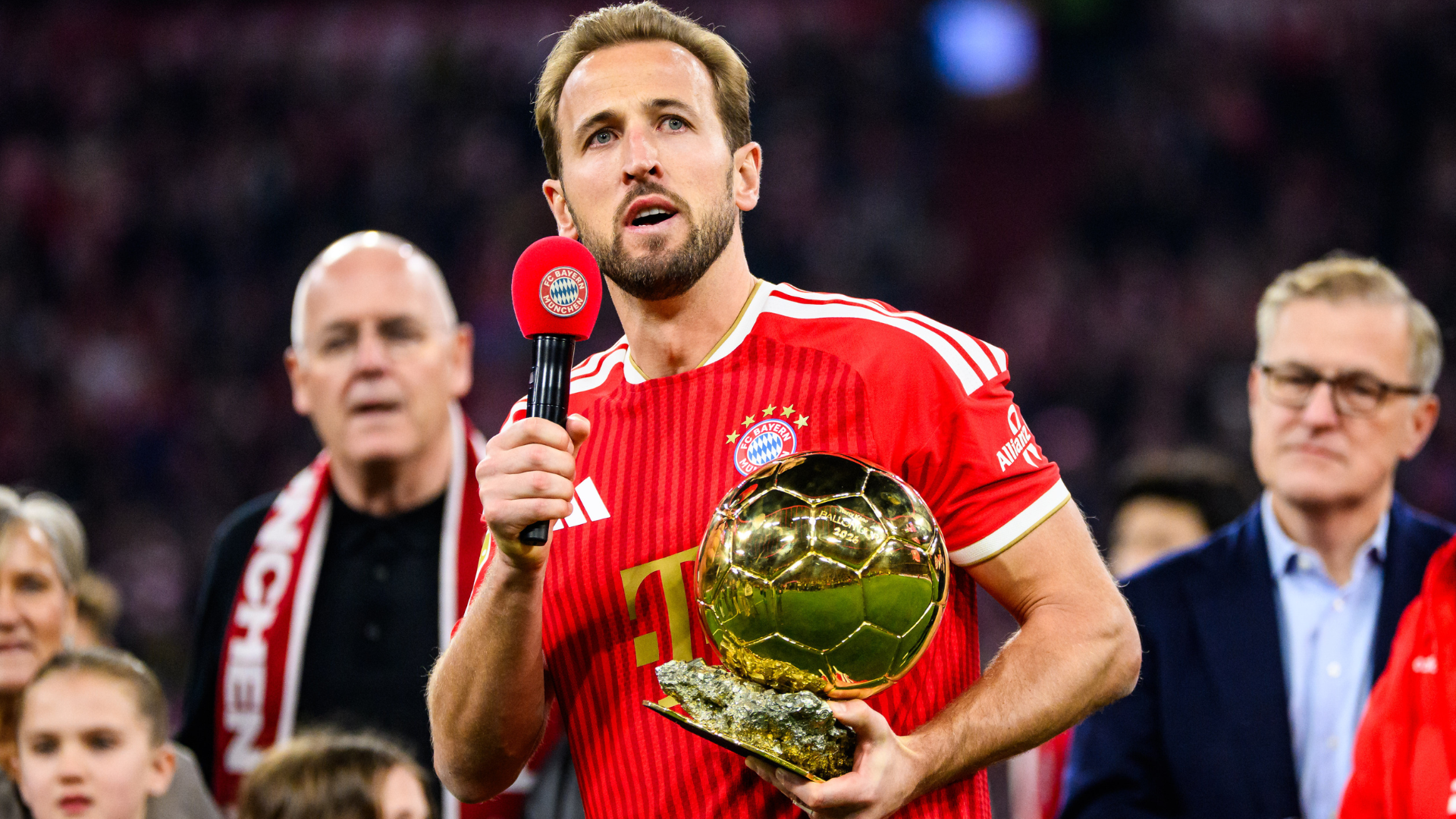
Even if the hints of a smile never fully leave his face, there is an overriding sense of practicality when Philipp Lahm speaks. He seems to have shed the intensity associated with the life of a professional athlete nearly a decade after retiring, but the characteristics of a World Cup-winning captain are hard to miss. He is friendly and open but also serious, so when the topic of conversation shifts to Harry Kane's Ballon d'Or triumph, he is politely unflinching in his assessment of what the award means for soccer in Germany.
"It helped Harry Kane and Michael Olise that they came from another country," Lahm said four days after Kane's big win. "I think it's quite difficult for a German player playing in the Bundesliga [to win the Ballon d'Or]."
A quick glance at the data would confirm the hypothesis. The last Bundesliga-based player and the last German player to win the sport's most prestigious individual award was Borussia Dortmund's Matthias Sammer in 1996. A German player has only finished inside the top three of the Ballon d'Or three times since, the last being Manuel Neuer in 2014, while Kane is only the seventh Bundesliga player to rank in the top three since Sammer's win. Lahm seamlessly links the pattern to another less-than-ideal trend in Germany's top flight -- Bayern Munich, with whom he won eight Bundesliga titles, are the division's indisputable kings.
They have lost the title just once since the 2012-13 season, a lack of competitiveness at the top of the table a natural consequence of their dominance. This is, in some ways, not Bayern's problem, but a narrative persists in Germany regardless. Players have historically been unable to reach the peaks of the game in Germany because of the circumstances, inspiring a wide-ranging set of side effects. Kane's move to Bayern was not designed to be anything other than the right move at the right time for a player talented enough to compete for the UEFA Champions League, but three years later, those invested in the Bundesliga's success are beginning to treat him as a beacon of hope.
"I do hope that the good players stay in the Bundesliga," Lahm said, "so I'm hopeful through Harry Kane that a lot of other players will follow because it's possible to win and play here."
The Bundesliga's complicated international appeal
The argument to join Bayern Munich is a straightforward one, if you ask sporting director Christoph Freund -- "you can win titles with us," both in Germany and Europe. Bayern have won the Champions League twice in the last 14 years, a feat matched only by Paris Saint-Germain and topped by Real Madrid. The Bundesliga's distribution of wealth favors them in this case, to the point that it likely played a sizable role in signing Kane and Olise. The balance of financial power in the European club game, though, has shifted as Bayern re-established their foothold in Germany -- the Premier League has become the sport's league of choice because it has the financial might to back up the claim. Players like Robert Lewandowski and Mario Gotze used to prove their worth at other German clubs (and in their specific case, Borussia Dortmund) before climbing up the food chain and joining Bayern. Florian Wirtz's jump from Bayer Leverkusen to Liverpool in 2025, though, is an example of a new world order, one some hope Kane's Ballon d'Or might change.
"It's all about the attention, so when you're successful with the German national team that's visible, but then when you play also successful soccer with Liverpool, then the attention in U.K. is much bigger," Lahm said, citing Wirtz's hypothetical Ballon d'Or case as an example, "so that would be more difficult for a German player in the Bundesliga alone, rather than changing to somewhere else outside and being successful abroad."
The Bundesliga's international appeal has not only taken a hit on the sporting side in recent years. Bayern's executives believe their club makes up around 50% of the league's brand value globally, and though they are unapologetic about their strengths on the pitch, they also argue they are doing too much of the heavy lifting. Rouven Kasper, a member of Bayern's executive board, pointed to Premier League clubs' oversized presence on preseason tours as a primary example for the Bundesliga to follow but all but questioned the league's interest in the strategy.
"The league needs to be, as well, stronger and bring more reach, but the league exists from the clubs," Kasper said. "We are the spearhead of German football, and I think together with the other clubs and together with the league, we need to be even more active in the markets ... it's not enough, and at the end, it's about people, community. We want to be approachable. We want to talk to the people. We want to be there, as the Bundesliga and Bayern alone cannot do it together with Dortmund, so we need more activities from the league and being in different markets, as the U.K. guys are doing and also the Spanish guys are doing. We will do our part."
Their part includes potentially using Kane as a hook for player recruitment, even if other leagues have their charms for the world's top talents.
"I think everybody knows the Premier League is the biggest league at the moment," Freund said. "Also, Spain is really attractive with Real Madrid and Barcelona, but we know we are Bayern Munich and the German Bundesliga is also really a strong league, a really good league, outstanding stadiums, outstanding atmosphere, and you can [perform] also on a very high level like Harry, the next step in his career, and therefore, I think Bayern Munich and also the German Bundesliga is very attractive, also, for international top players."
Some in the Bundesliga, though, are resigned to the fact that there are certain things Bayern -- and other European clubs -- will simply beat them to. Dortmund have held strong in their attempts to mount a title challenge this season, level on points with Bayern after eight games thanks to Saturday's 2-2 draw in Der Klassiker. For the foreseeable future, though, recruitment of elite talents cannot and will not play a central role in their quest to win silverware.
"We never refuse, or we never avoid to tell you guys where we are from, but in comparison to Munich, Madrid, London, Paris, Milan, we are from Dortmund and from a purely economic perspective, we are far behind them," Borussia Dortmund CEO Carsten Cramer said. "If they [are] just interested in trophies and silver, if they look for the Ballon d'Or player wearing a black and yellow shirt, maybe that is something we can't offer to them."
While Bayern's brand is wrapped in the quiet luxury of their domestic stronghold, Cramer argued that Dortmund's appeal is a qualitative one.
"In the last 13 years, we didn't become champion but though we didn't become champion, the interest in Dortmund is still increasing and the amount of people following our club on social media and wherever we travel in the world is quite huge," he said. "We are able to offer a different approach: closeness. That is the Dortmund way, and I think that is maybe one of the reasons that many, many hardcore supporters of one club do have a sympathy for us as a second-love club, which I do not complain about, and that is our way. I don't want to make us too small by saying we are a niche club, but we are for sure a bit different, and I don't complain about [it]."
Are Bayern Munich beatable?
Patrick Owomoyela, a defender for Jurgen Klopp's Dortmund team that won back-to-back Bundesliga titles more than a decade ago, can clearly map out the recipe to beat Bayern to the top. Strong squad composition and compatibility go a long way, and he believes the current iteration of Dortmund has that -- he praised head coach Niko Kovac's defensive structure and commended him for "sprinkling the creativity" into the team in the months since taking the job in January 2025. There is just one problem, though.
"Even though you know the recipe, the soup is not always the same," he said. "Even though you put in the same ingredients, it's not always tasting the same, and if it does, maybe it's not the perfect soup, you know? So you need to find that special something."
Much like Cramer, Owomoyela has a qualitative argument of his own to make when it comes to breaking Bayern's decades-long dominance in the Bundesliga. The "special something" for his Dortmund team was a sense of camaraderie, the foundation of which was Klopp's joyous approach, though he openly admitted that is a difficult thing to replicate.
"This is sometimes the mentality of the guys or the personality of the guys and how that fits together, on top of the stuff that they can do with the ball and as I said, we weren't the best in terms of playing football," he said. "We were the best team. We had the most fun. We really liked doing a lot of stuff together. We were like a family, and you don't find that all the time, and it gets harder, I would say, every year because football has changed. The plans of players nowadays are totally different ... These guys have a plan, so they want to be part of something for this period of time, but then they want to move on, and that makes it, of course, hard to find that chemistry because he is gone next year."
It is the issue he identified with Leverkusen, the Bundesliga's last champion not named Bayern. Their rise up the ranks in the 2023-24 season was ambitious and impressive, but two years later, the mainstays of their title-winning campaign were elsewhere. Wirtz left for Liverpool, as did Jeremie Frimpong, Granit Xhaka now finds himself at Sunderland, Piero Hincapie now plays for Arsenal and then-head coach Xabi Alonso made a stop at Real Madrid before landing at his current post at Chelsea. Jonathan Tah, meanwhile, went the old-school route and now plays at Bayern. The next challenger to Bayern's throne will likely face the same fate for the foreseeable future, no matter whether its stars move to Munich or settle in England.
Saturday's draw between Bayern and Dortmund, though, has offered a flicker of optimism that the Bundesliga might have a title race on its hands before the next great team gets stripped for parts. The 2-2 scoreline flatters Dortmund -- Bayern racked up 4.48 expected goals and were unlucky when the crossbar denied them on both Kane's second-half penalty and a late strike from Lennart Karl, while the visitors generated just 0.74 xG. Owomoyela argued, though, that Bayern have their flaws.
"What's it gonna take to take that away from Bayern after all these years again?" he asked. "It's just to believe that it's possible and I think the Bayern team showed in this season as well, or especially maybe, that you can wound them, you can hurt them and something is possible. You can see that in almost every game they played, even in that cup game [against second-division side Magdeburg on Oct. 28] that they just had and they won it 6-1 ... They hit the post, hit the crossbar, scored a goal, had two other big chances so now take a team with more quality, with the right kind of belief, there might be something possible."
Saturday's Klassiker only added to the Bundesliga's week of good news, presenting a different case of the league's strengths than Kane's Ballon d'Or triumph, one that will likely take precedence in the short term. The longer Dortmund keep pace with Bayern, the more intriguing the Bundesliga becomes, and at this stage of the season, the possibility of a genuine title race is easy enough to dream up. That sense of optimism, though, tends to give way to the league's current realities. Even if Dortmund answered the question in the affirmative once, there's a long way to go until anyone can definitively say that Bayern can be topped.
"We weren't really eye-level competitors," Owomoyela said about Dortmund's ability to compete with Bayern in the years since their back-to-back Bundesliga titles. "We were there and we were able to hunt, but from a little distance, and I think everybody understands that."