
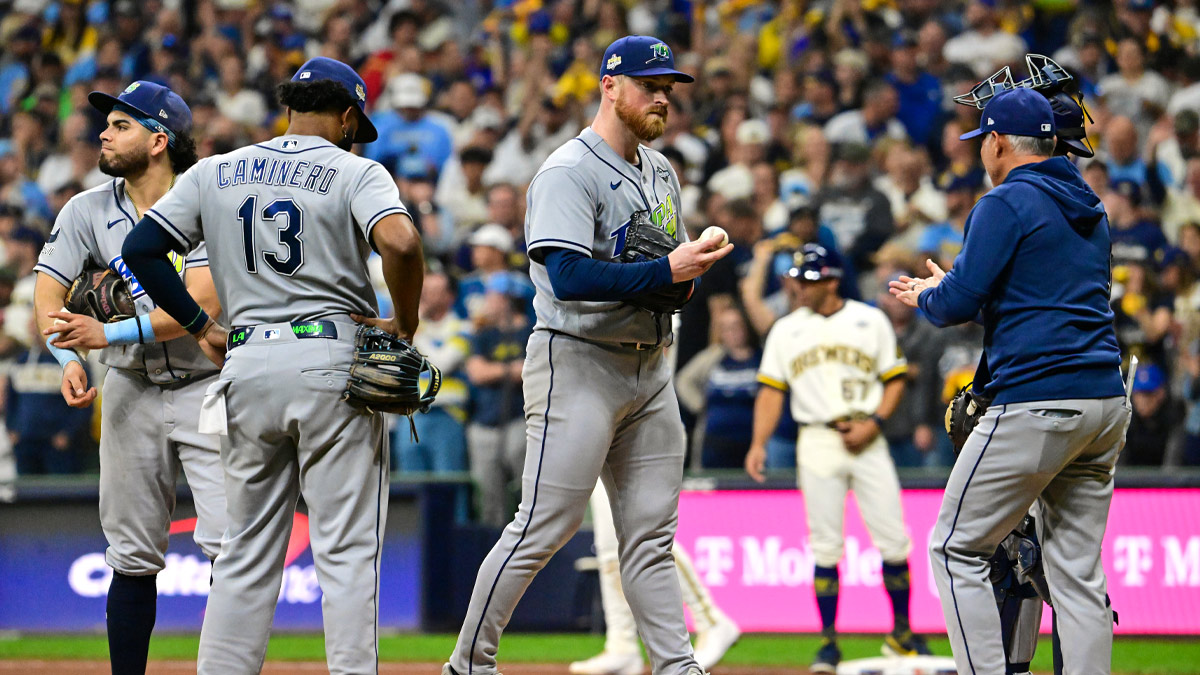
The Tampa Bay Rays enter the offseason with evidence that their championship window remains open and a painful reminder of how much work remains.
A 98-win season, an American League East title and a pennant deserve more weight than five disappointing games. Still, the Milwaukee Brewers exposed weaknesses the Rays cannot dismiss as October misfortune after Wednesday’s 4-1 loss ended the World Series.
The challenge is to improve a contender without dismantling the foundation that made it one. These three questions should guide every major decision.
Can the Rays get more from their core offense when it matters most?
Yandy Diaz, Jonathan Aranda, and Junior Caminero combined to go 11-for-57 (.193) with two RBIs and no home runs in the World Series. Diaz finished 3-for-20, leaving the Rays without the production they needed from their most productive regular-season hitters.
The damage extended beyond three hitters. The Rays scored only 12 runs across the series and went scoreless in 40 of their 48 innings. Their final 38 innings produced just six runs.
Those numbers demand an examination of the lineup, but they do not justify declaring the core incapable of postseason success. A five-game series cannot erase the performance that helped deliver a pennant.
The more useful question concerns the support around those hitters. When the core went quiet, the Rays lacked enough consistent production elsewhere to sustain pressure.
The review should focus on how opposing pitchers attacked them, which matchups limited their options and whether the bench offered useful alternatives. Those findings can guide acquisitions more effectively than assigning permanent labels to hitters whose struggles happened to arrive during the season’s five most important games.
Adding an outfielder who supplies power and credible everyday offense should be a priority. The goal should be a deeper lineup that can survive simultaneous slumps, rather than another October requiring its best hitters to solve every problem.
Defensive and base-running mistakes also mattered. Improving offensive depth would not excuse those errors, but it would give the Rays more ways to overcome them.
What will the Rays’ starting rotation look like in 2027?
The lineup needs reinforcement; the rotation first needs clarity.
Freddy Peralta can enter free agency after arriving in a deadline trade. Nick Martinez has a $20 million mutual option, while Drew Rasmussen’s club option climbed to $20 million through incentives.
The Rays should prioritize retaining Rasmussen. Declining his option would create another substantial opening when the club already faces uncertainty elsewhere. A multiyear agreement could offer an alternative, but only if both sides accept the terms.
Peralta deserves a competitive offer, too. His impending free agency creates a decision, not proof that his departure is inevitable. The Rays should determine their limit while preparing realistic replacements.
Martinez’s mutual option requires agreement from both parties. Until that process concludes, the Rays cannot treat him as either a guaranteed returnee or an established departure.
Shane McClanahan adds another financial consideration through arbitration. Trading him simply because his salary rises would require a convincing baseball explanation, particularly if other starters leave.
Prospects and trades can help replenish the staff, but replacing several established starters simultaneously would increase uncertainty. Any deal involving position-player depth also needs to account for the lineup’s own weaknesses.
The Rays should preserve enough reliable innings to prevent one offseason problem from becoming two.
Will ownership invest enough to sustain this championship window?
Article Continues BelowPatrick Zalupski’s ownership group completed its purchase in September 2025. This is its first offseason after a pennant, and the decisions ahead will reveal how aggressively it intends to support another run.
The Rays do not need an arbitrary payroll milestone to demonstrate ambition. They need enough flexibility to retain important contributors, absorb arbitration increases and pursue improvements without automatically subtracting elsewhere.
Keeping Rasmussen would provide one concrete measure. Funding an additional productive bat while maintaining pitching depth would provide another. Those choices matter more than broad assurances about building a winner.
The proposed ballpark’s targeted 2029 opening offers a longer-term backdrop, but the current roster needs attention now. Stadium planning and investment in a contender should advance together.
Labor uncertainty complicates the offseason. The collective bargaining agreement expires December 1, and a potential lockout creates questions across baseball. That uncertainty should inform planning without becoming a blanket explanation for inaction.
Ownership must also recognize that retaining the same players at higher salaries would preserve the roster rather than improve it. The front office needs room to address weaknesses after accounting for those increases.
The Rays earned this opportunity through a full season of winning. Protecting it requires supporting their offensive core, limiting rotation turnover and making targeted additions. Their response should show that reaching the World Series raised expectations for 2027.