
The Dodgers were dethroned from their familiar perch atop the baseball world when the Brewers knocked out the two-time defending World Series champions in a National League Championship Series sweep before going on to win it all.
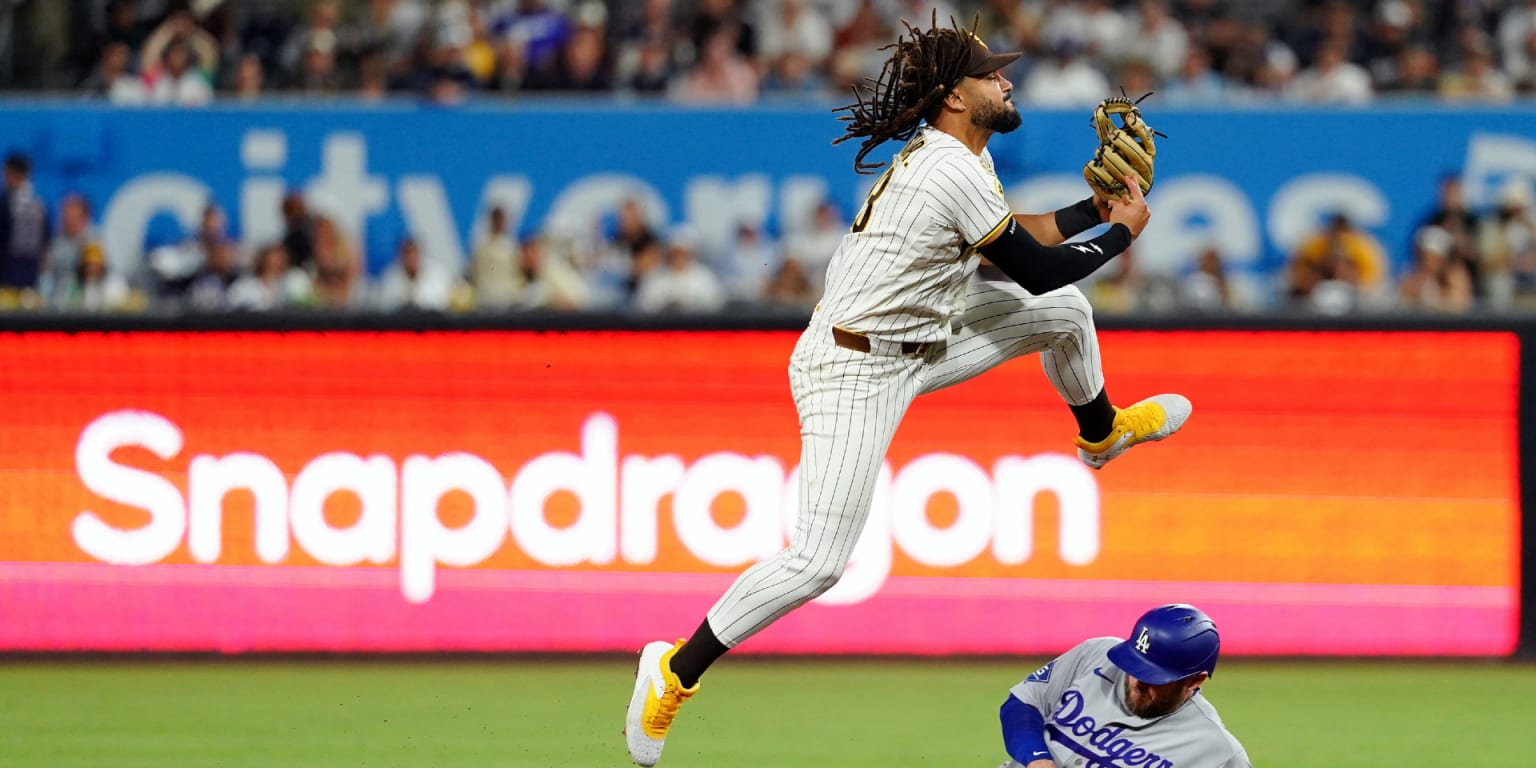
But Los Angeles still remains king of the NL West, where the club has won 13 of the last 14 division crowns. The Padres have been looking up at the Dodgers in the standings in all 14 of those years, with L.A. winning the West every year except 2021, when it finished a game behind the 107-win Giants.
The only time the Padres have had a meaningful triumph over their Southern California brethren in recent years came in October 2022, when San Diego defeated L.A. in a four-game NL Division Series.
So, what will it take for the Padres to finally win their first division title in more than two decades? And is the time to do so ripe in the wake of the Dodgers’ failed three-peat bid with an aging roster?
Nothing lasts forever
The Dodgers’ dynasty over the past decade-plus has been one of the most successful in Major League history. In that span, the franchise won three World Series titles (2020, ’24 and ’25), five NL pennants and 13 division titles, reaching the postseason every year since 2013.
But time always wins, sooner or later.
Is this it for the Dodgers? Probably not. But it could be the best opening yet for the Padres to finally beat big brother over the course of a full season.
The Dodgers entered the 2026 campaign with the oldest position-player roster, by average age, in the Majors -- 30.9 years. Elder statesmen and former MVPs Freddie Freeman (entering his age-37 season in 2027) and Mookie Betts (age-34 season) have seen their production at the plate decline in recent years.
Freeman posted the lowest OPS (.792) and home run total (16) of any full season in his career in 2026. Betts, who entered the 2025 campaign with an .897 OPS for his career, has produced an OPS more than 140 points lower over the past two seasons (.753).
Meanwhile, four-time MVP Shohei Ohtani, who dazzled us with his other-worldly two-way stardom for so many years, had an injury-plagued season that resulted in him being shut down on the mound and -- while he still delivered an elite offensive performance -- lower output at the plate.
Third baseman Max Muncy is 36, left fielder Teoscar Hernández turned 34 last month and catcher Will Smith is 32.
L.A.’s vaunted starting rotation remains one of the -- if not the -- best in the sport, but the run producers are running up against the inevitable onward march of time.
The time is now
If the Dodgers have, in fact, fallen from the top echelon of Major League clubs -- and that’s a big “if” -- whether the Padres can capitalize depends on several factors:
A revamped starting rotation
The Padres have major holes to fill in the starting rotation with ace Michael King, as well as former Cy Young Award winner Robbie Ray and right-handers Nick Pivetta, Casey Mize, Walker Buehler, Griffin Canning and Lucas Giolito all on the free-agent market.
This might be the most crucial element when it comes to determining whether San Diego has a real shot at unseating the Dodgers in 2027 -- mediocre starting pitching won’t get the job done, particularly when your counterparts in the competition are Yoshinobu Yamamoto, Blake Snell, Tyler Glasnow, Roki Sasaki and possibly Ohtani.
The Padres met last week with two-time Cy Young Award winner Tarik Skubal, but he agreed to a deal with the Mets on Sunday, a source told MLB.com. However general manager A.J. Preller and Co. go about it, San Diego needs starting pitching -- a lot of it.
Consistent production from the stars in the lineup
A major storyline for the 2026 Padres was offensive inconsistency. This was nowhere more apparent than the bizarre campaign authored by Fernando Tatis Jr. He didn’t hit his first home run of the season until May 30, and by the All-Star break, he had only five homers and a .713 OPS.
Then, suddenly, Tatis caught fire and never looked back. The rest of the way, he posted a .996 OPS with 20 homers.
But the inconsistency went beyond Tatis. Manny Machado hit just .175 with a .609 OPS in the first half, joined Tatis with a red-hot July (.921 OPS with seven homers) and then slumped to a .224/.315/.349 slash line the rest of the way.
As with Tatis, it was a tale of two halves for Jackson Merrill. He produced a .628 OPS prior to the All-Star break, then took off for a .304/.339/.569 slash line with 16 homers in the second half.
Xander Bogaerts was inconsistent, too, although it was in more of a sandwich pattern than his aforementioned teammates. Bogaerts opened the season sizzling at the plate, belting five homers in April. And in September, he had a .315/.425/.479 slash line. In between, he posted a .592 OPS with six homers in 397 plate appearances.
More consistency from the big hitters in the lineup would go a long way toward snapping a 20-year division title drought.
An encore performance from a lockdown bullpen
The Padres’ relief corps was among the game’s finest in 2026. Led by all-world closer Mason Miller and his devastating fastball/slider combination, San Diego’s bullpen was fearsome. It finished with the third-best ERA in the NL (3.53) and the most strikeouts (710).
It also featured much more than the flamethrowing Miller at the back end. Adrian Morejon (2.83 ERA), Bradgley Rodriguez (2.19), Yuki Matsui (1.83), Wandy Peralta (3.61) and Jason Adam (2.62) combined to make virtually any inning in which opponents saw a Padres reliever a difficult one.
Bullpen performance can vary widely from year to year, but San Diego needs another lockdown effort from its relievers in 2027 -- and that could involve adding another arm for the back end.
Morejon and Adam are free agents, and while the bullpen is far more settled heading into next season than the starting rotation, it’ll be of the utmost importance to ensure that the Padres’ relief group is as well-positioned as possible to deliver an encore.
Is 2027 the year?
In 57 years of Padres history, the franchise has not won a World Series. San Diego has reached the Fall Classic twice, in 1984 and 1998.
But if 2027 is to be the year that the club finally makes the ultimate run to the pinnacle of the baseball world, an NL West title and the toppling of the mighty Dodgers along the way could be just what it needs to ignite a surge all the way to a World Series championship.
There are a lot of factors involved and much would have to go the Padres’ way -- including, of course, a Dodgers decline. And some might say we’ve seen this movie before. After all, we’ve been talking about whether San Diego could usurp L.A.'s divisional hegemony since this decade began.
The Padres will take another shot in 2027, and this time, time could be firmly on their side.