
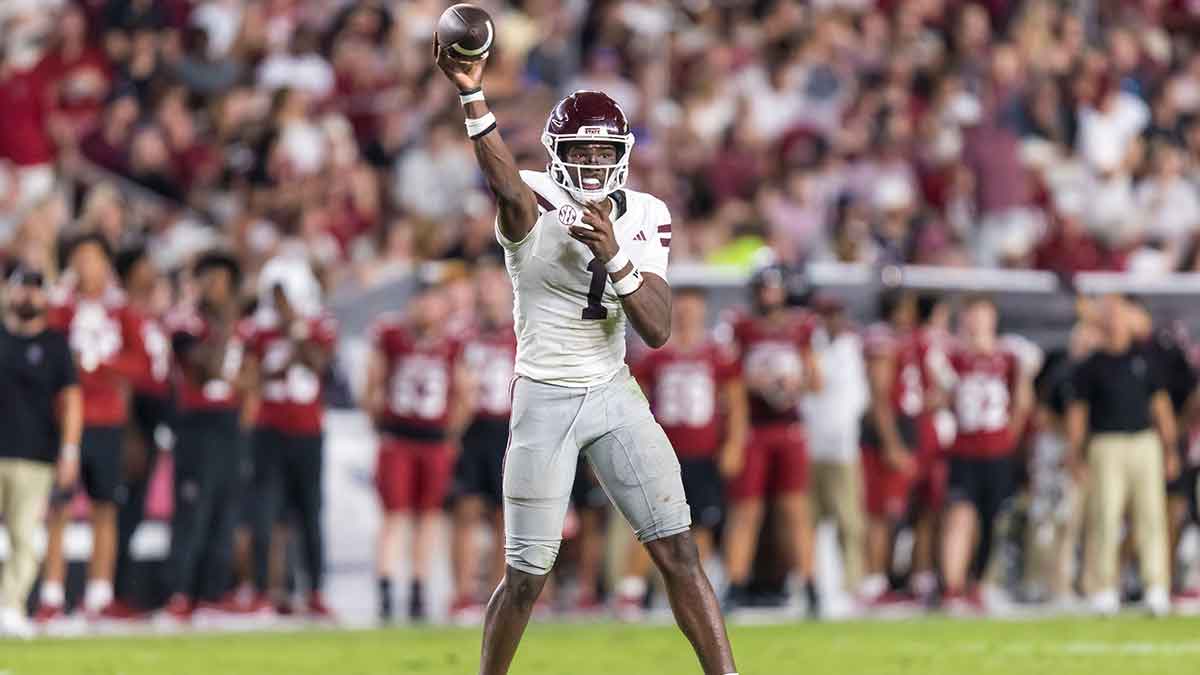
KaMario Taylor's emergence became impossible to ignore after Mississippi State erased a 16-point deficit to defeat South Carolina 41-34. The sophomore quarterback rebounded from an interception on his first pass to complete 18 of 26 attempts, throwing for 251 yards and four touchdowns, while also contributing an additional 33 yards on the ground. Former NFL quarterback Chase Daniel was particularly impressed, calling Taylor an “absolute nightmare” to defend, noting how he consistently punished the Gamecocks with both his arm and mobility.
For the Miami Dolphins, Taylor's development is intriguing for reasons that go beyond just another name entering the college football spotlight. The organization is beginning a rebuild without a proven long-term answer at quarterback and could be positioned to select near the top of the 2027 NFL Draft. Malik Willis is getting a chance to prove he can be more than a temporary starter, but if Miami remains uncertain about the quarterback position by next spring, Taylor could provide the front office with a compelling reason not to draft a quarterback simply because one is available.
However, there's an important caveat: Taylor cannot enter the NFL until 2028. He was a true freshman at Mississippi State in 2025, which means the 2027 college season will be his third year out of high school, making him eligible for the following spring's draft. Normally, this timeline would make him irrelevant to Miami's immediate quarterback decision, but the current construction of the Dolphins’ roster actually makes patience more justifiable, especially if general manager Jon-Eric Sullivan decides that the 2027 class does not feature a quarterback worth building the franchise around.
Miami has numerous needs and should not treat the quarterback position as an obligation, but rather as an opportunity. The Dolphins entered 2026 with Willis at the top of the depth chart and Kyle McCord as his backup, while the roster is still undergoing a rebuild following significant turnover at receiver, along the offensive line, and throughout the defense. De’Von Achane remains one of the offense’s most dynamic pieces, but Miami is focused on identifying which young players can become part of its next competitive core, rather than simply adding a quarterback and hoping the rest of the reconstruction will fall into place.
Using a premium 2027 selection on an offensive tackle, edge rusher, cornerback, or another foundational player could make more sense than reaching for a QB2 or QB3 in the draft simply because Miami needs one. This is super important to them if Taylor continues to develop into the type of prospect capable of leading the 2028 class.
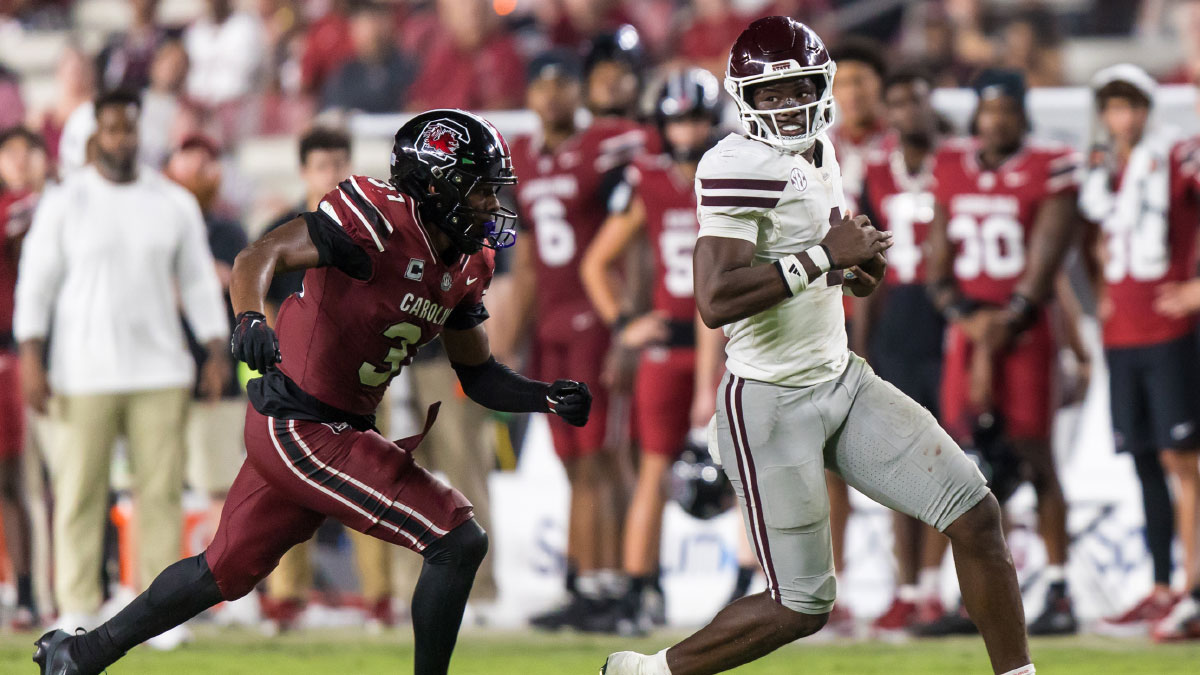
The appeal is evident when observing his performance through three games. Taylor has completed 56 of 82 passes for 832 yards, 11 touchdowns, and only one interception. His rushing ability brings his total yardage to over 1,000 and provides Mississippi State with a threat that defenses must account for on every play. At 6-foot-4 and 230 pounds, he possesses the physical attributes that NFL teams seek. Additionally, his strong start to 2026 suggests he is evolving into a quarterback rather than merely an exceptional athlete playing the position, as evidenced by his performance against South Carolina.
Taylor could have faltered after starting the game 0-for-3 and throwing an interception that allowed the Gamecocks to gain possession deep in Mississippi State territory, especially as the Bulldogs quickly fell behind 16-0 in a challenging SEC road environment. Instead, he regained his composure and began attacking downfield, throwing touchdown passes of 30 and 43 yards, and continued to produce when Mississippi State needed to make a comeback.
This type of response is significant when considering his potential for the NFL. Athletic quarterbacks can often perform well against weaker opponents without having to demonstrate how they handle adversity, but Taylor had to bounce back from his own mistake, adjust when the game became challenging, and keep attacking rather than depending predominantly on designed runs. There is still plenty of room for improvement, and three strong games shouldn't automatically elevate a sophomore to a polished NFL prospect status, but his developmental path is becoming increasingly difficult to overlook.
His freshman season hinted at this same ceiling, as Taylor threw for 629 yards with five touchdowns and only one interception, despite starting just twice, while rushing for 458 yards and leading Mississippi State with eight rushing touchdowns. The late-season opportunities highlighted why he arrived in Starkville as the highest-rated quarterback recruit in school history, and the consistency with which those physical tools are now emerging within the structure of Jeff Lebby’s offense is a notable change in 2026.
This development complicates Miami's decision for the 2027 draft. Dante Moore, Arch Manning, and several other quarterbacks will attract significant attention throughout the next draft cycle, and one of them might ultimately become too tempting for the Dolphins to overlook if they have a premium selection. There would be no reason to ignore an elite prospect in 2027 just because Taylor may declare a year later, as projecting the next draft before the current one concludes is inherently risky, with no guarantee that Miami would be in a position to select Taylor in 2028.
A stronger argument is that Taylor's emergence alleviates the urgency to find certainty.
If Miami assesses the 2027 quarterbacks and identifies a genuine franchise player, it should select him, but if their evaluation leads to more uncertainty than conviction, the Dolphins can use that pick to strengthen a roster that will eventually need to support whichever quarterback becomes the long-term solution. They could also give Willis another season if he shows sufficient development to justify it, allowing them to enter 2027 with the possibility of having one of college football’s most intriguing young passers available in the following spring.
Building that infrastructure first would also make Taylor a more realistic option if Miami eventually acquires him. Placing a young quarterback on a roster with weaknesses at offensive tackle, wide receiver, and across the defense risks turning development into mere survival. Spending another offseason and utilizing a premium draft class to address those deficiencies could create a significantly healthier situation for the quarterback in 2028.
Taylor still needs a full season and another year of college football before Miami can responsibly see him as a potential target, but his combination of size, mobility, arm talent, and rapidly improving command gives the Dolphins another reason to avoid viewing the 2027 draft as a quarterback-or-bust scenario. So, in case Miami falls in love with one of next spring’s quarterbacks, the decision will be simple: they need him, but if it's not a love story, Taylor’s progress at Mississippi State presents the kind of positive development that should make patience much less daunting.