
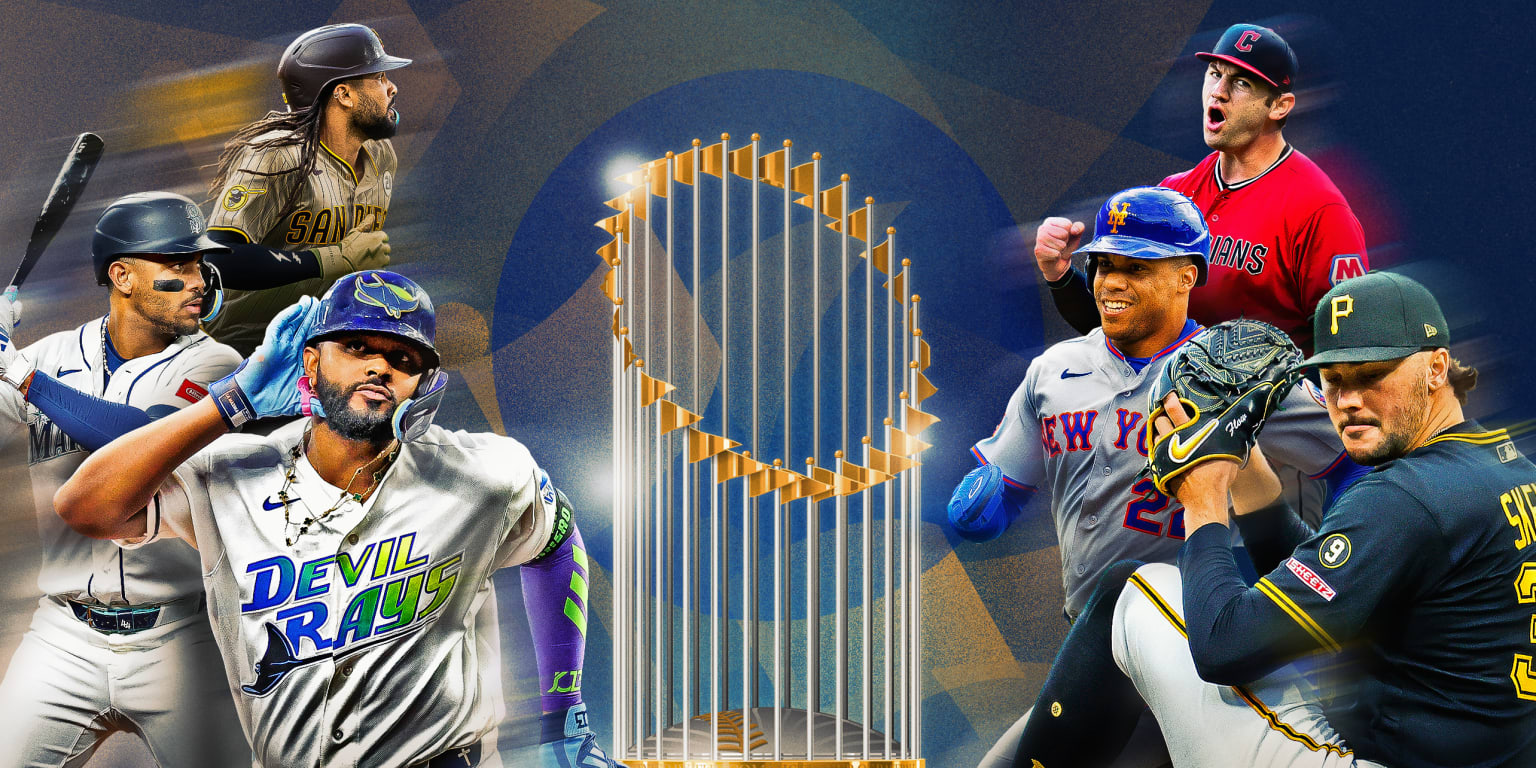
Congratulations to the Milwaukee Brewers, who, as you may have heard, just won their first World Series championship. The win was glorious for a cavalcade of reasons, one of which is that the title gets them off the list of franchises that have never won a World Series, which now numbers just four: the Mariners, Padres, Rays and Rockies.
The Brewers are the fourth first-time champion in the past 10 World Series, joining the 2023 Rangers, 2019 Nationals and 2017 Astros. And that should give plenty of hope, not only to those four remaining teams, but others that also are facing long title droughts. There are, in fact, 13 teams that have not won a World Series since MLB expanded to 30 teams in 1998.
So, let’s take a look at those 13 teams -- and rank ‘em. Which one is the most likely to be the next team to finally break through? This can mean next year, or just in the near future. If you were to look at these teams as currently constituted, whose turn might it be next? Here’s a ranking of all 13, listed with the year of their most recent title.
1) Rays (None -- debuted 1998)
No reason not to start with the team that just got closer than anyone else. The Rays didn’t show it much in the World Series, but this was the best team in the American League this year, and one that looked absolutely championship-caliber before running into a Brewer buzzsaw. Their core of Junior Caminero, Yandy Díaz, Jonathan Aranda, Shane McClanahan and Drew Rasmussen should remain intact for 2027 (though some will be hitting free agency after next year), and they’ve got tons of talent in the Minors as always, including six of MLB Pipeline’s Top 100 prospects. They’re not going anywhere. They never are.
2) Mariners (None -- debuted 1977)
This might seem like a risky proposition after the year they just had, when they may have been the most disappointing team in the Majors. But everything that made you excited about the Mariners coming into 2026 is still here, from Julio Rodríguez to Cal Raleigh to Cole Young to Colt Emerson and a starting rotation that has so much depth they may have to make a move just to clear room for MLB Pipeline’s top pitching prospect, Kade Anderson. They’ll have a new manager next year, and they’ve got to have some better luck. Don’t be surprised when many prognosticators make them their AL favorite again for 2027.
3) Padres (None -- debuted 1969)
They ended up being the team that gave the Brewers the toughest test in the postseason, and their fans will always wonder if this whole month might have turned out a little differently if all-world closer Mason Miller could have gotten that last out against Jackson Chourio in NLDS Game 2. Alas! The Padres should be loaded for bear with the same gaggle of veterans they trotted out there last year, and a new ownership group that’s eager to show the same commitment to winning Padres fans have gotten used to. It also helps that Fernando Tatis Jr. looks like an MVP candidate again. They’ll be a fun sleeper pick next year.
4) Blue Jays (1993)
The only good thing about 2026 was that the crushing World Series loss of 2025 is now a year further in the rearview mirror. Like the Mariners, the team they beat in the 2025 ALCS, the Blue Jays had just about everything go wrong this year, and the hope is that the chips will land their way again in 2027. But the biggest issue may be getting Vladimir Guerrero Jr.’s power stroke back. It is absolutely bizarre that Vlad Jr. hit nine homers in 144 games last year. How is that even possible? The Jays can compete again, but they really, really need Vlad Jr. to be Vlad Jr. again.
5) Mets (1986)
All right, so, obviously, it didn’t go that well in 2026. But the good news is that most of the damage was contained to 2026: The free agents that were signed (and performed poorly) are mostly gone. Bo Bichette is an exception, but he looked a lot more like himself from June onward and is due for a rebound. Meanwhile, the young players here took big steps forward. You should see three Mets (Carson Benge, A.J. Ewing and Nolan McLean) in the top 10 in NL Rookie of the Year voting, which is a very good sign. The Mets had a winning record in the second half of the year and, as always, are very motivated. You could do a lot worse with a sleeper pick for 2027.
6) Guardians (1948)
They got closer than anyone else other than the Rays on this list, and they did it the way they always do it: Clutch hitting, timely pitching, general relentlessness -- Guards Ball. One thing they didn’t get in 2026 was a typical year out of José Ramírez. He was wonderful in October despite not being fully healthy, though, and a full offseason should do him a world of good. Can they stay ahead of a division that looks to be improving all around them?
7) Pirates (1979)
Pirates fans might not have felt this way by the end of the year, but the team did improve in 2026: It was their first winning season -- albeit barely, at 82-80 -- since 2018. What was surprising is that the Pirates’ strength was their offense, and that they were as good as they were despite a somewhat disappointing year from Paul Skenes. You can expect him and the rest of the rotation to be better in 2027. But can the offense be that good again, especially if Brandon Lowe departs as a free agent?
8) Tigers (1984)
A 2026 season that began with high expectations wound up with 86 losses and ace Tarik Skubal traded away at the Deadline. They got some good prospects for him, though, and quietly have a rising offense, with Riley Greene and potential AL Rookie of the Year Kevin McGonigle the sort of players any team would want to build around. There are going to be questions about the pitching in a post-Skubal era, but the Tigers can compete in the AL Central -- in 2027 and beyond.
9) Orioles (1983)
It was a fairly disastrous year in Baltimore, and trading away Adley Rutschman felt like a pivot moment this franchise will be feeling for a long time. But there’s still a lot here, and they are now officially built around Pete Alonso, who was the one thing the Orioles could count on in 2026. They need Gunnar Henderson to rediscover his star form, and they could very much use a vibes transfusion. But the Orioles are hardly hopeless. It could come together at some point.
10) Athletics (1989)
Obviously, they need pitching. Lots of it. And they need to not have all their hitters get hurt like they did in the second half of 2026. But the A’s still have all those hitters, and they’re all -- save Brent Rooker -- in their 20s. Every team in baseball would want to build around Nick Kurtz and Shea Langeliers, two very different players who complement each other perfectly. There was a stretch in the first half this season when the A’s felt legitimately exciting. That can happen again -- especially if new president of baseball operations Taylor Smith finds that pitching.
11) Twins (1991)
The Twins’ offense was better than people realized in 2026, with most of their hitters still in their 20s and Byron Buxton excellent as usual (when healthy, which wasn’t as often as the Twins hoped -- also as usual). There is a little danger of the Twins being left behind by the rest of the AL Central, so while there’s uncertainty all around this organization, there’s also hope for any team with some talent to build around.
12) Reds (1990)
It was a mess of a year for the Reds, who weren’t even able to rise above last place in the NL Central despite coming off a postseason berth in 2025 and sharing a division with a Cardinals club that ostensibly was in a rebuilding year. Some of that is bad luck, with Hunter Greene’s injury issues hitting the point where you wonder if he’ll ever be right. They’ve got hitters to build around in Elly De La Cruz and likely NL Rookie of the Year Sal Stewart, but the Reds have been going backward, not forward.
13) Rockies (None -- debuted 1993)
The Rockies were more respectable in 2026 than they had been in the years before, which is at least progress. That said, they still lost 104 games. They’re at last moving in the right direction, with the new front office working behind the scenes to modernize the organization. But the road they’re traveling is still quite a long one.