

After the extended international break, the Champions League is back and gearing up for a rapid run of games. Just over three weeks from now, the league phase will be at its halfway mark, a clearer sense of the European hierarchy having emerged. Then again, we might get a bit of a sense on Tuesday night with several of the big hitters in action. Both Bayern Munich and Barcelona have games that fall into the tough places to go category. For the former, it's a journey north to Stavanger and the champions of Norway, while Hansi Flick's side will put their winning run to the test at Galatasaray, where the likes of Liverpool and Juventus lost last season.
Before we get to them, however, it's time to talk about last season's beaten finalists and their star player. After all, Bukayo Saka's season seems kinda weird.
A changing Saka?
Weird in that on paper the output looks really rather impressive, particularly in front of goal. Seven games into his campaign and Saka has three goals, one of them a penalty against Sunderland. For a player who only just scraped into double figures in each of the last two seasons, this should be an encouraging start. And yet it does not feel like Saka has set the Premier League or indeed Europe alight so far, and his performance Saturday against Leeds in the Premier League was the subject of widespread criticism with Arsenal legend David O'Leary saying that the No.7 is "not the player he was," nor the player that earned the £350,000-a-week contract.
It's not hard to see where that sentiment is coming from. As the game was winding down Arsenal's star winger was through one-on-one with Leeds keeper James Trafford. Saka seemed to get the ball stuck under his feet and bent an effort too close to the goalkeeper, whose save at least ensured Leeds only lost by a score of 2-1. As an isolated incident, no harm, no foul. It's just that Saka keeps missing these chances. Even discounting the penalty he scored, Arsenal's starboy has had a big chance -- a subjective tag applied by Opta to high-value shots -- in every game he has played this season. He has missed the last five of them.
A better hook from close range might have saved Arsenal from a heavy defeat to Brighton before the interational break, while his ballooning of a 0.7 expected goals (xG) chance against Napoli on Matchday 1 of the Champions League league phase came straight off a rugby pitch. These are infuriating misses for supporters and doubtless for Saka too, but in analytical terms they come with a positive: at least he is getting in position to miss those chances. You should worry a lot more if those shots aren't coming your way.
Good shots are coming Saka's way. The sample size of 581 minutes across seven league and European games is still small enough that we have to be a bit wary about drawing conclusions, but by this point we can at least point out some trends. Those might include Saka getting far better quality shots this season than anyone else. Going from the three shots per 90 he has hovered at in the last four seasons to 3.6 this season has delivered a doubling on non-penalty xG to 0.61. Saka's 0.177 xG per shot (again discounting the penalty) in the Premier League this season is the best by any non-striker with over 10 shots to their name.
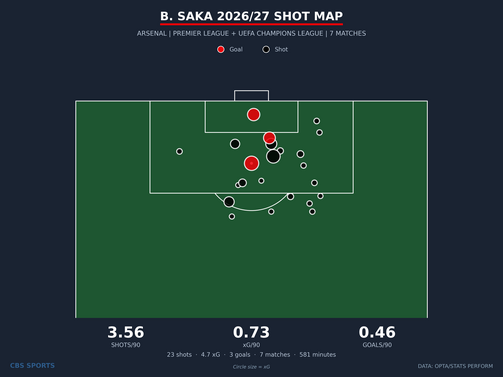
Saka still likes to cut in from the right flank and try to bend one in from range. Now, however, he is supplementing those with a lot of poacher's chances. That they aren't going in yet has brought questions, but really there is no reason to think that won't change. For his Premier League career as a whole Saka is as close as you'll get to a goals = xG scorer, 62 of the former, 62.21 of the latter. And, anyway, it is not as if anyone has had any cause to doubt his technique over recent years.
If this early season trend does keep up, then it might be a valuable addition to a game where there are questions about what else might have been lost. Since the day Saka underwent surgery to address a severe tear on his right hamstring in December 2024, there have been questions as to whether he might have lost or be able to get back the burst of youth.
The tracking evidence we have suggests that there has been no obvious change in the speeds he hits. The season where Saka's average max speed per game was at its highest, according to Gradient Sports data provided for CBS Sports, was 2021-22, when he was at 31.28 km/h. Last season he was at 30.25 km/h, this season, 30.03 km/h. The vast majority of that difference between five years ago and today can be explained by the fact that this season's Arsenal do not get to run in behind anywhere near as often as they used to, the burden of being one of the best teams in the world, etc., etc. A fair bit more might reflect the niggling injuries since that hamstring tear that have robbed Saka of physical momentum.
That aside, there is no meaningful change in the distance Saka sprints or covers at high speeds per 90. His accelerations and decelerations are largely unchanged too. With nearly 400 games for club and country in the rearview, he could be forgiven for not having the vim of youth, but it was only back in August that Saka was saying he is "on top of my body" after an injury-addled World Cup.
Even if Saka has lost that yard of pace -- and he has always been a player who found space with his brain first and then his feet -- well then at least he is adapting in the right way. Every player slows down eventually; the best find themselves different ways to make an impact. It might be that Saka already has.
Barcelona chase a perfect 10
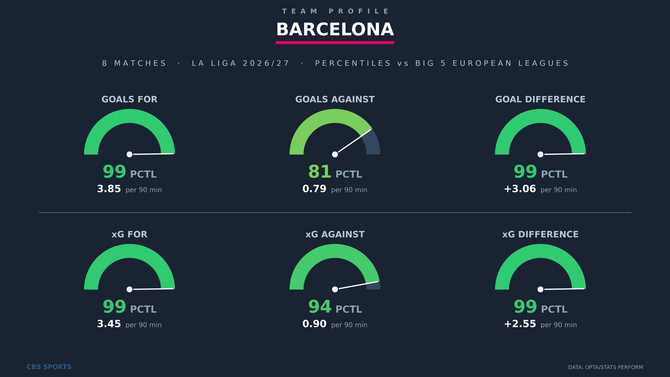
Saturday brought history for Barcelona, a 3-0 win over Getafe, making it nine wins from nine in all competitions, the first time in the illustrious history of this club that they have achieved that. Right now there is no more ferocious an attack in Europe than Hansi Flick's, averaging a staggering 3.85 goals per game without even that much overperformance on shooting. As you can see on the team profile below, the defense is not looking too shabby either.
Most encouraging at the weekend was how these numbers held up in spite of the absence of Raphinha, who did not travel to Istanbul as he nurses a thigh issue. The Brazilian is inarguably the player of the season so far with 14 goals and three assists in eight games. His replacement, Gabriel Jesus, barely missed a beat, however, and is averaging a goal every 41 minutes.
Like so many others from this summer, he looks a shrewd addition. Jesus and Adeyemi rounded out the supporting cast behind Lamine Yamal and Raphinha at relatively low cost. Much more was spent on Anthony Gordon and Rodri but both are excelling, the latter proving crucial in protecting a defense that still has not added that much-vaunted elite center back to partner Pau Cubarsi. This looks a significantly improved iteration of last season's Barcelona, one that has done all it can so far to prove itself capable of going multiple steps further in the Champions League.
The first question is what they have actually been able to prove. The Champions League routinely proves that, after its big three, La Liga does not have the depth of five or more years ago and it is not as if Barcelona have been taking on the best the division has to offer. Their 34 goals have been scored against teams ranked 15th, 12th, eighth, ninth, 16th, 13th and seventh in last season's table as well as promoted Racing Santander. Feyenoord at home was hardly the trickiest of Champions League openers.
Do Galatasaray offer a greater test? Well, maybe. When the mood takes Rams Park and the Gala players lift their game, plenty of Barcelona's contemporaries can attest that this is a nightmare fixture. Victor Osimhen at his best is a one-man counterattack who will love bursting into the space that Flick's defense so willingly leaves. Equally, Galatasaray could very simply play to their collective talent level and find themselves blown away, another side who don't really have the quality to match Europe's form team. It might be a while yet before we see a team who really can.
Add CBS Sports on Google