
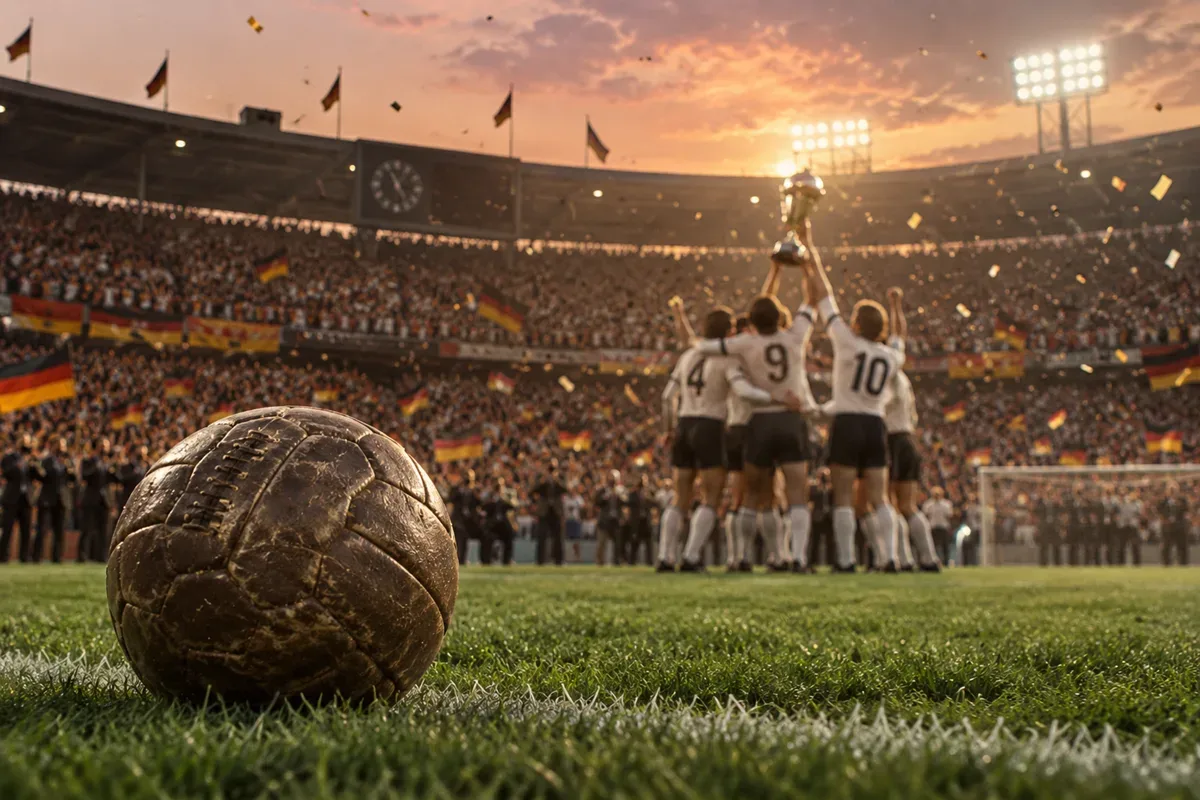
West Germany secured their place among international footballâÂÂs defining teams by winning the European Championship in 1972 and following it with the World Cup two years later.
Helmut SchönâÂÂs side achieved the double with a core built around Franz Beckenbauer, Sepp Maier, Paul Breitner and Gerd Müller. Yet the team that became world champions in Munich was not simply a copy of the one that had swept through Europe.
West Germany evolved. Günter Netzer drove the creative football of 1972, while Wolfgang Overath assumed the principal playmaking role at the 1974 World Cup. Schön adjusted his midfield, trusted different supporting players and found a way to win when the performances were less convincing.
The result was a two-year period that delivered the countryâÂÂs first European Championship and its second World Cup.
Embed from Getty ImagesWembley provided the first major statement
West Germany arrived at the decisive stages of the 1972 European Championship with a generation already shaped by previous World Cups.
Beckenbauer, Maier, Müller and Wolfgang Overath had all been involved as West Germany reached the 1966 World Cup final. Four years later, the national side finished third in Mexico.
Schön now had younger talent alongside that experienced core. Breitner and Uli Hoeness brought energy, while Borussia Mönchengladbach playmaker Netzer gave the midfield a different dimension.
The clearest sign of what was developing came against England in the European Championship quarter-finals.
At the time, the final tournament featured only four teams. West Germany therefore had to come through a two-legged quarter-final before travelling to Belgium for the semi-finals.
They won the first leg 3âÂÂ1 at Wembley on 29 April 1972. Hoeness opened the scoring before Netzer converted a penalty and Müller struck late. It was West GermanyâÂÂs first victory at Wembley. A 0âÂÂ0 draw in the return leg completed the job.
It was more than another qualifying result. West Germany had beaten one of EuropeâÂÂs major sides away from home while showing the technical control that would define their tournament.
West Germany took control of Euro 1972
Hosts Belgium stood between West Germany and the final.
Schön started Maier behind a defence containing Beckenbauer, Breitner, Hans-Georg Schwarzenbeck and Horst-Dieter Höttges. Netzer and Herbert Wimmer operated in midfield, with Hoeness supporting an attack featuring Müller, Jupp Heynckes and Erwin Kremers.
Müller scored twice in Antwerp as West Germany won the semi-final 2âÂÂ1. Belgium pulled one back through Odilon Polleunis late in the game, but SchönâÂÂs team had already established control.
The Soviet Union awaited in the final at Brusselsâ Heysel Stadium on 18 June.
West Germany won 3âÂÂ0.
Müller opened the scoring, and Wimmer made it 2âÂÂ0 after the interval. Müller then added his second of the match.
The striker finished the four-team finals with four goals after scoring twice against Belgium and twice against the Soviet Union. UEFA also records him as the leading scorer in qualifying, underlining how central he was throughout the campaign.
Yet MüllerâÂÂs finishing was only part of the picture.
Netzer could dictate the direction of an attack from midfield, while Beckenbauer stepped forward from his deeper role to influence possession. Wimmer provided balance alongside Netzer, and the movement around Müller prevented opponents from concentrating solely on the centre-forward.
Seven West German players were subsequently included in UEFAâÂÂs team of the tournament: Beckenbauer, Breitner, Hoeness, Netzer, Wimmer, Heynckes and Müller.
| Competition and stage | Opponent | Result |
|---|---|---|
| Euro 1972 quarter-final, first leg | England | Won 3âÂÂ1 |
| Euro 1972 quarter-final, second leg | England | Drew 0âÂÂ0 |
| Euro 1972 semi-final | Belgium | Won 2âÂÂ1 |
| Euro 1972 final | Soviet Union | Won 3âÂÂ0 |
| 1974 World Cup first group stage | Chile | Won 1âÂÂ0 |
| 1974 World Cup first group stage | Australia | Won 3âÂÂ0 |
| 1974 World Cup first group stage | East Germany | Lost 1âÂÂ0 |
| 1974 World Cup second group stage | Yugoslavia | Won 2âÂÂ0 |
| 1974 World Cup second group stage | Sweden | Won 4âÂÂ2 |
| 1974 World Cup second group stage | Poland | Won 1âÂÂ0 |
| 1974 World Cup final | Netherlands | Won 2âÂÂ1 |
Schön changed the midfield for the World Cup
Winning Euro 1972 did not leave West Germany with a settled formula for every tournament.
By the 1974 World Cup, Schön faced a significant choice between Netzer and Overath.
Netzer had been one of the outstanding players of the European Championship. Overath, however, had already appeared at the 1966 and 1970 World Cups and offered Schön another way to organise the midfield.
The coach chose Overath.
Netzer eventually played only a limited role at the tournament, appearing as a substitute against East Germany. FIFA records that Schön opted for Overath as his main playmaker and retained him as West Germany progressed towards the final.
Other roles developed too. Berti Vogts became an important figure in defence, while Rainer Bonhof and Bernd Hölzenbein contributed to a side that did not always possess the same fluency seen two years earlier.
The constants remained significant.
Maier provided security in goal. Beckenbauer captained the team and continued to shape possession from the back. Breitner offered attacking ambition from defence, while Müller remained the penalty-area specialist around whom much of the attacking threat revolved.
East Germany exposed the champions
West Germany hosted the 1974 World Cup as reigning European champions and opened with victories over Chile and Australia.
They beat Chile 1âÂÂ0 before defeating Australia 3âÂÂ0.
Then came a match unlike any other in their international history.
West Germany met East Germany in Hamburg on 22 June. It remains the only senior international meeting between the two national teams.
Jürgen Sparwasser scored the decisive goal as East Germany won 1âÂÂ0. The result left East Germany top of the first-round group and West Germany second.
The defeat damaged any assumption that the European champions would move smoothly through their home World Cup.
What followed showed a different strength.
Rather than reproduce the free-flowing football of Brussels two years earlier, West Germany became increasingly effective as the tournament progressed.
Three wins carried West Germany into the final
The 1974 format sent the surviving teams into another group phase rather than conventional quarter-finals and semi-finals.
West Germany opened the second stage by beating Yugoslavia 2âÂÂ0. They followed that with a 4âÂÂ2 victory over Sweden.
That left Poland as the final obstacle.
Both teams had won their opening two second-round matches. Their meeting in Frankfurt therefore effectively decided which side would advance to the World Cup final.
Heavy rain left the Waldstadion pitch severely waterlogged and delayed kick-off. Uli Hoeness later had a penalty saved by Jan Tomaszewski, but Müller eventually broke the deadlock during the second half.
West Germany won 1âÂÂ0 and reached the final in Munich.
The route demonstrated why the 1974 side should be viewed differently from its 1972 predecessor.
SchönâÂÂs team could still create and attack, but circumstances demanded greater patience. They had recovered from defeat against East Germany, dealt with the unusual second-round format and survived an extremely difficult match against Poland.
Embed from Getty ImagesThe Netherlands presented a different challenge
West Germany faced the Netherlands at MunichâÂÂs Olympiastadion on 7 July.
The Dutch had become the tournamentâÂÂs most influential attacking story. Rinus Michelsâ side moved players between positions, pressed aggressively and used Johan Cruyff as the focal point of an approach that became known as Total Football.
Their run to the final remains one of the most discussed campaigns in World Cup history, explored further in World in SportâÂÂs feature on the Netherlandsâ 1974 World Cup side.
The final immediately tested West Germany.
The Netherlands moved the ball from kick-off without allowing a West German player a touch. Cruyff drove into the penalty area and won a penalty.
Johan Neeskens converted it in the second minute.
West Germany were behind before they had touched the ball.
Yet they did not allow the start to decide the match.
Paul Breitner equalised from the penalty spot in the 25th minute. Then, shortly before half-time, Müller produced the goal that completed the turnaround.
Rainer Bonhof attacked down the right and delivered the ball into the area. Müller adjusted inside the box and finished past Jan Jongbloed.
FIFA records the goal in the 43rd minute. West Germany protected their 2âÂÂ1 advantage through the second half and became world champions for the second time.
Embed from Getty ImagesBeckenbauer and Müller gave the side its defining spine
Individual quality ran throughout the squad, but Beckenbauer and Müller represented its two most recognisable strengths.
Beckenbauer could defend, carry possession forward and influence the tempo without operating as a conventional midfielder. His role helped West Germany turn defence into attack without committing another player forward simply to start moves.
He captained the country to both major titles.
Müller supplied the finishing.
He scored all four of West GermanyâÂÂs goals during the final tournament at Euro 1972 and another four at the 1974 World Cup. His winner against the Netherlands took his World Cup career total to 14 goals, then the competition record.
The supporting cast mattered just as much.
Maier was ever-present in goal during both title-winning tournaments. Schwarzenbeck gave the defence balance alongside Beckenbauer. Breitner developed into one of the teamsâÂÂs most adventurous players, while Hoeness supplied direct running.
Netzer defined much of the 1972 sideâÂÂs creativity. Overath then demonstrated that West Germany could reorganise their midfield without losing the ability to win a major tournament.
That adaptability separates this period from a single great summer.
The 1972 side and 1974 side won in different ways
The temptation is to treat West Germany between 1972 and 1974 as one unchanged team.
The results tell a more interesting story.
The European champions produced some of their finest football with Netzer directing play and Müller finishing moves. Two years later, West Germany endured greater turbulence. They lost to East Germany, changed the emphasis in midfield and had to overcome the Netherlands after conceding almost immediately in the final.
Schön did not insist on recreating 1972.
He retained the strongest elements of the team and adapted everything around them.
West Germany would later win another World Cup in 1990, with Beckenbauer returning as the man in charge of the squad. World in Sport has also looked back at the West Germany team that won Italia âÂÂ90.
After reunification, Germany eventually lifted the trophy again in Brazil. The 2014 Germany World Cup side followed a very different tactical path, but the ability to combine individual quality with tournament adaptability remained familiar.
For the 1972âÂÂ74 generation, however, the achievement was compressed into just over two years.
European champions in Brussels. World champions in Munich.
The personnel shifted, and the performances changed, but West Germany found two different routes to the two biggest trophies available to a European national side.

World In Sport Forum
Continue the discussion
Join other fans in the World In Sport Forum and debate the biggest talking points from this article.