
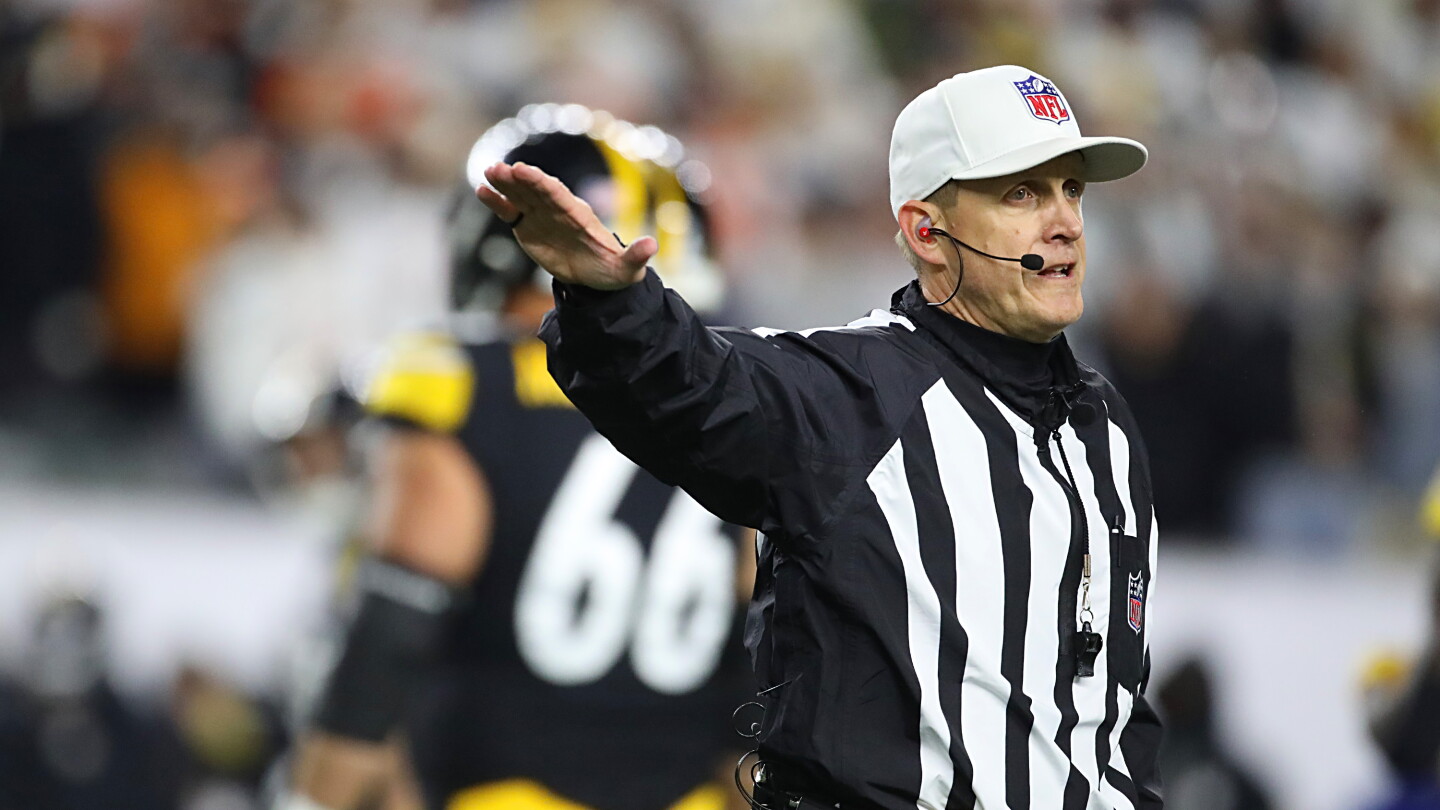
Friday’s nationwide ground stop didn’t affect any of the NFL teams that needed to travel from one place to the other for Week 10 games. It dramatically affected the officiating assignments.
But not because the officials assigned to work the various games couldn’t get to where they needed to be. The league decided to reshuffle the deck in order to avoid the mere possibility that the officials wouldn’t get to their assigned games.
It was a proactive approach by the notoriously reactive NFL. But it still may have been an overreaction. And it introduced the risk that something unusual could have occurred.
For the twelve games played on Sunday, the assigned referee worked only two of the games. One of those games was played on Sunday morning (New York time) in Germany, where travel undoubtedly occurred before Friday’s shutdown of the aviation system.
Sunday night’s game was due to be worked by Clete Blakeman as the referee, with umpire Scott Walker, down judge Andy Warner, line judge Kent Payne, field judge Karina Tovar, side judge James Coleman, back judge Jonah Monroe, replay official Chad Adams, and replay assistant Adam Choate.
Instead, from the official Game Book, this was the crew: referee Don Willard, umpire Terry Killens, down judge Dana McKenzie, line judge Jay Bilbo, field judge Jabir Walker, side judge Justin Larrew, back judge Dino Paganelli.
Chad Adams was still the replay official; however, all replay officials reportedly went to the league office and not their game sites.
Willard was not scheduled to work in Week 10; he ultimately served as the referee for two games. Killens was due to work the Jaguars-Titans game as a member of referee Alex Moore’s crew; like Willard, Killens worked Dolphins-Colts and Steelers-Bengals. McKenzie, like Killens, is a member of Moore’s crew, which was due to be in Nashville.
Bilbo is a member of referee Shawn Smith’s crew, which was due to work Panthers-Saints. Walker, who also worked two games, is a member of Land Clark’s crew, which was scheduled to work the Chargers-Ravens game on Monday night.
Larrew, the fourth two-games-in-one-day official, is assigned to referee Shawn Hochuli’s crew, which was scheduled to work the Chiefs-Falcons game. Paganelli is also a member of referee Shawn Smith’s crew, which was due to work Panthers-Saints.
Monday night’s game, by the way, will be handled by referee Adrian Hill. Hill’s crew was scheduled to work the Rams-Cardinals game on Sunday.
While we don’t have the time, the patience, or frankly the desire to prepare a full list of the crews that were supposed to handle the 11 domestic Sunday games and the crews that actually did, the fact that 10 of the 11 referees ended up elsewhere says it all.
The changes were dramatic.
Here’s the real question. Were they necessary? In lieu of performing major surgery to the officiating lineup for 11 Sunday games (and, apparently, the Monday night game), the NFL could have committed to getting every official where they needed to be, for the games they were scheduled to work.
Everyone else got to where they needed to be. The teams, the broadcasters, everyone. It presumably could have been done, if the NFL had decided to commit any and all resources to making it happen.
Which brings us to an inescapable conclusion. In order to avoid the hassle — and the expense — of ensuring that the officiating crews made it to their assigned locations before kickoff on Sunday, the league had no qualms about making massive, eleventh-hour changes to the assignments. Which included the unprecedented move of requiring four officials to work a game, to take a two-hour ride to another city, and to work another game.
For the details on working two games in one day, check out the story from Kalyn Kahler about the unprecedented doubleheader for four officials.
“It’s exhausting because you’re looking for something on every single play,” ESPN rules analyst and former NFL V.P. of replay Russell Yurk told Kahler regarding the difficulty of working two games in a day. “You’re analyzing every single play. You’re watching your players. You’re watching your keys, you’re making judgment calls, and it doesn’t really let up the entire game.”
Fox rules analyst and former NFL senior V.P. of officiating Dean Blandino called assigning officials to two games a “last resort.”
"[I]t would be like playing two football games back-to-back,” Blandino told Kahler. “There’s the physical aspect of running and the mental exhaustion after a game because you are doing a pre-snap routine for every snap, and then the eight-second play, and then a post-snap routine.
“The officials look like they are not exerting themselves the same way the players are, but they don’t get breaks. They don’t play one side of the ball. They are out there every snap and every kick. Then to say now I have to reset without any recovery time? That is a challenge.”
The league could have embraced the challenge (and the expense) of getting all officials where they needed to be. It surely would have been easier than completely disrupting the existing assignments, forcing officials to work games they hadn’t prepared to handle, and requiring NFL executive Ramon George (whom the league declined to make available for an interview with Kahler) to move the various pieces around in a way that made it all work, even if the “last resort” of using four officials for two games had to be used.
Given the wealth and power of the NFL (most if not all owners have a private jet, or jets), the league could have gotten everyone where they needed to be. Either it wanted the risk of a single snafu to be as small as possible (even if that meant blowing up the existing assignments) or it hoped to make the expense as small as possible.
It’s hard not to think cost was a factor. And the NFL is very fortunate that Sunday’s games went smoothly, after the major disruption to the officials’ itineraries.
Still, these games are too important for a rolling of dice or the pinching of pennies, relatively speaking. It would have been, in our view, far more prudent to open the checkbook and spend whatever was needed to get the officials to the places where the officials were originally assigned to be.