
At the General Managers Meetings earlier this month, Cardinals president of baseball operations Chaim Bloom was discussing the state of his club when his Brewers counterpart, Matt Arnold, walked by.
“I’d prefer to be in that position,” Bloom said with a smile, while motioning over to the newly crowned World Series champ, “wringing champagne out of my clothes like that guy.”
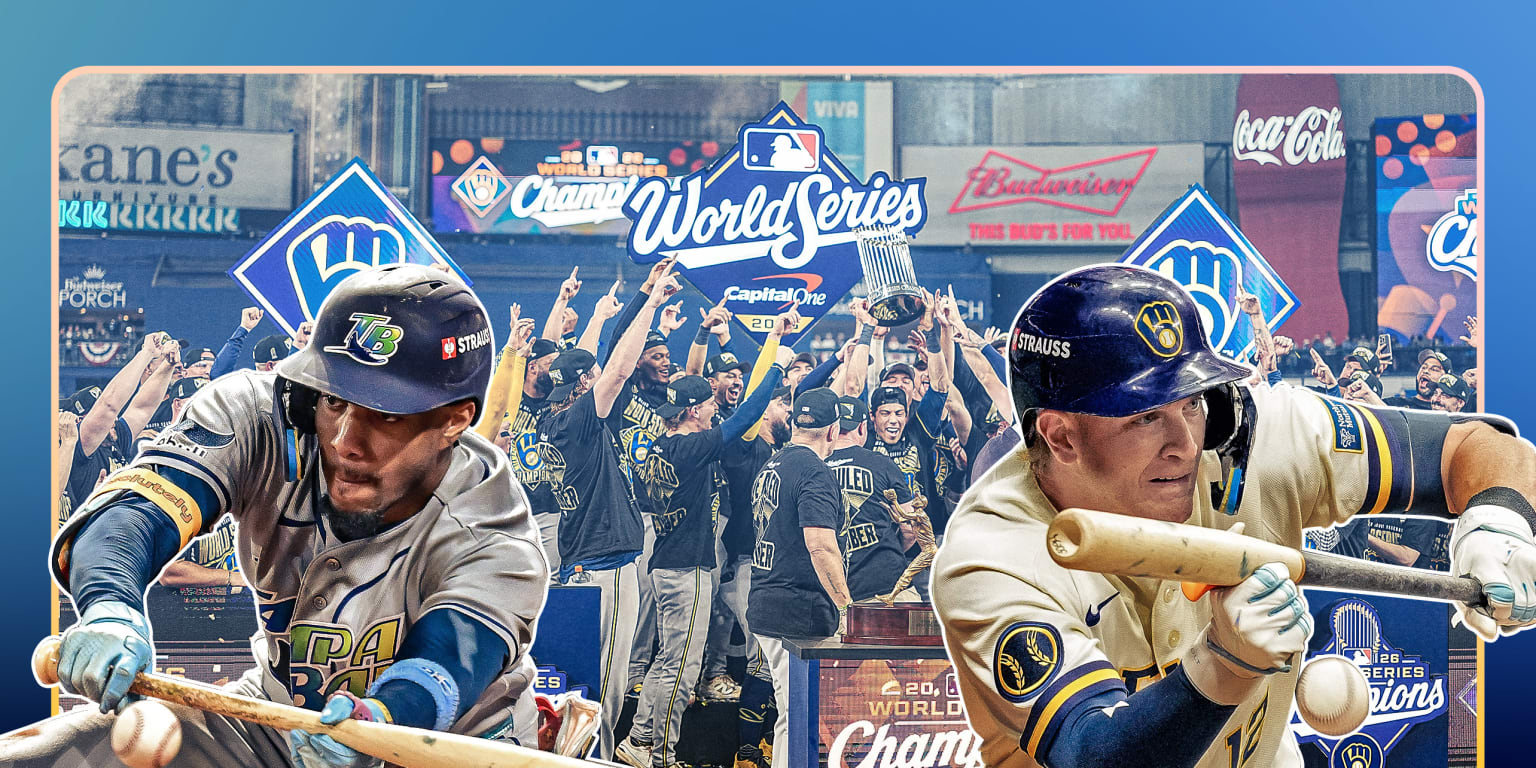
The trophy holders are always the source of envy this time of year. And because the Brewers, a rare small-market champ, went the distance with an offensive approach that was especially unconventional in a game so often oriented around power, that envy could lead to imitation.
Did the Brewers -- and for that matter, the AL pennant-winning Rays and a Guardians team that also reached the LCS round -- make small ball cool again?
Well, for now, it’s certainly worth saluting.
“It’s good baseball,” Royals GM J.J. Picollo said. “I was fortunate to be around during our ’14 and ’15 run in Kansas City, and it was similar. It’s one thing if you have a night where you go out and you hit three-run homers and score nine runs. Those nights are typically fairly easy. But most of the nights are going to be a one- or two-run spread, and you’ve got to figure out ways to win those games.”
There is always something to be gained from the sound defense and premium pitching that the Brewers possess. That’s true in any era.
But the Brewers were a throwback offensively, relying more on speed and precision than power.
You can’t argue with their success. They have finished each of the last two seasons with MLB’s best record, despite ranking 22nd and tied for 28th, respectively, in home runs among the 30 teams in those two years. In fact, the two World Series participants this year both ranked in the bottom 10 in MLB in homers but in the top three in bunt hits.
So yes, small ball is having a bit of a moment. And maybe other teams will take note.
“Whoever just won,” Marlins president of baseball operations Peter Bendix said sarcastically, “just go out and do what they just did.”
Except, wait a minute … isn’t this pretty much the exact conversation we had after those aforementioned, contact-driven Royals won it all in 2015?
And what was the offensive profile of the World Series champs in the years since?
REGULAR SEASON AB/HR RANK, WORLD SERIES CHAMPS (2016-25)
- 2016 Cubs: 13th
- 2017 Astros: 4th
- 2018 Red Sox: 11th
- 2019 Nationals: 13th
- 2020 Dodgers: 1st
- 2021 Braves: 2nd
- 2022 Astros: 4th
- 2023 Rangers: 6th
- 2024 Dodgers: 3rd
- 2025 Dodgers: 2nd
- 2026 Brewers: t-28th
As you can see, the Brewers were an extreme outlier. And for that matter, their October advancement fit the general trend we’ve observed with the long ball in the postseason, rather than going against it. The Brewers outhomered their opponent in every series of their postseason run! That fit the mold of a postseason in which 84% of games were won by the team that outhomered the other.
The 2026 Brewers hit a home run at a rate of one every 34 at-bats in October. There have been 10 teams just in the Wild Card era alone (since 1995) that won the World Series with a worse postseason home run rate than that.
WORST POSTSEASON AB/HR RATE, WORLD SERIES CHAMPS (1995-2026)
- 2014 Giants, 85.6
- 2001 Diamondbacks, 52.1
- 2013 Red Sox, 52
- 2000 Yankees, 50.1
- 1997 Marlins, 40.8
- 2003 Marlins, 43.2
- 2006 Cardinals, 39.2
- 2010 Giants, 38.6
- 2012 Giants, 38.4
- 2011 Cardinals, 34.2
- 2026 Brewers, 34
Where the Brewers were actually a home run anomaly was in their stinginess in not giving them up. They held their opponents to 0.31 homers per nine innings -- the best such rate by a World Series champion pitching staff since the 1985 Royals (0.29).
Suddenly, the Brewers’ approach doesn’t seem so easy to replicate, does it?
But that doesn’t mean we can’t broadly look at the deep runs by the Brewers, Rays and Guardians without appreciation for the offensive styles that got them to October in the first place.
“I think there’s something to be said for small-market baseball where you’re not going to be deep one through nine,” Picollo said. “If you have four or five really good hitters and the others can help you create runs in different ways by being athletic, that’s the way baseball games are won.”
Power always plays, but athleticism has arguably gained importance in this era of the pitch timer, both because of the faster pace and the accompanying changes that have incentivized stolen bases. And as pitcher velocity has risen, young athletes who have faced extreme velocity from young ages and possess the bat speed to keep up with it are being rewarded more than their older counterparts.
In the 2026 season, hitters aged 20-25 had a higher batting average (.247) than those aged 30-35 (.238). While the aged 20-25 sample was only four points below the overall average for that age group (.251) in the pitch tracking era (since 2008), the aged 30-35 output was 14 points below its norm and the lowest average on record for that age group.
So in that sense, youth served the Brewers, Rays and Guardians well. They all ranked in the lower half in MLB in average batter age in 2026 -- the Rays at 27.8 (14th), Brewers at 27.4 (12th) and Guardians at 27.0 (ninth).
If there is a lesson to be learned from the World Series champs’ offensive style, it’s less about the broad strokes and more about their strokes themselves. It’s in the swing decisions and swing styles that ran counter to the industry trends.
A few notes:
- The 2026 Brewers only swung at 44.1% of all pitches thrown to them -- the lowest mark in MLB.
- The Brewers only pulled 33.5% of their hits -- the third-lowest rate of any team in the pitch tracking era (since 2008).
- They ranked fifth in MLB this year in average bat speed (72.6 mph) but dead last in percentage of batted balls in the air (51.9%).
- Their average intercept point, or where a batter’s bat comes nearest to the ball on a swing, was the second deepest in MLB, at 29.1 inches from the batter’s center of mass.
If we were to try to interpret a lesson from any of this, it’s that the Brewers -- and, for that matter, the Rays -- found success in literally going the opposite way at a time when pulling the ball in the air with authority has been emphasized (and financially rewarded). The Brewers and Rays ranked first and second in MLB in their percentage of batted balls that went to the opposite field.
The problem with reading too much into these results is that, in the game of adjustments that is baseball, there are always, as Arnold himself put it, “ebbs and flows” to what works for a given team at a given time.
“We’ve had different constructs for our offense for a long time,” Arnold said. “I think this looks a certain way right now, but it doesn’t mean it’s going to look that way a year from now. … I mean, I love homers. I would like to hit more homers. We just got to our offense in a different way [in 2026]. I don’t know if that’s gonna be the long-term trend or not.”
While the Brewers found a championship formula with their more contact-driven offensive profile, we would be remiss not to note that one of the season’s greatest regular season success stories -- the surging White Sox -- was oriented around power. The South Siders had the Majors’ fifth-worst strikeout rate (24.1%) but fifth-best homer rate (25.7 AB/HR). They struck themselves out of October, but their 24-game leap in the win column was attributable to their offensive aggression.
White Sox general manager Chris Getz said the club is aiming to improve its contact as an organization without sacrificing too much of the slug-related strengths that carried it in 2026. He hinted at changes to the way the team relays analytical information to its players.
“Making the feedback loops as clean and concise as possible,” Getz said. “If you’re supporting the players in that fashion and they’re getting really good, accurate information, that’s when you see the increase in production. When players go from one team to another and all of a sudden have these jumps [in production], it’s not necessarily because that team has something you don’t. It’s just that everyone is on the same page, and it creates more conviction for that particular player.”
Milwaukee was certainly an example of that with its handling of NLCS MVP Jake Bauers, who parlayed his breakout with the Brew Crew into a four-year, $58 million contract with the Red Sox.
Again, though, “do as the Brewers do,” is so much easier said than done. And what worked in 2026 might not work as well in 2027.