Are you excited for NFL Week 12? Last week, only one game closed with a spread of less than three points (and that was just barely, as the Panthers were 2.5-point favorites with juice over the Ravens). This week, we're in for closer contests. There are seven games from Wednesday to Monday in national windows. Two of them have spread within a field goal, and only one (Eagles vs. Cowboys) has a spread greater than 4.5 points. How lucky are we!
Every Tuesday of the NFL season, I'll turn the page from the previous week to the upcoming one with seven things I think. These aren't full-scale predictions. They aren't concrete takeaways from the past week of NFL action, either; those are fired off Sunday or Monday. Instead, these are the uncertain topics. They are things that might be true, but it'll probably take the next few games to find out. And at the bottom, you'll find a few extra half-thoughts ... just those little inklings I'm unable to shake.
This week, I'll start by previewing one of those island games (Chiefs at Bills, obviously), wonder what Micah Parsons brings to an already testy Packers' defense, and try to learn something from the rise and fall of the Colts (2025-26). Here we go!
Jump to:
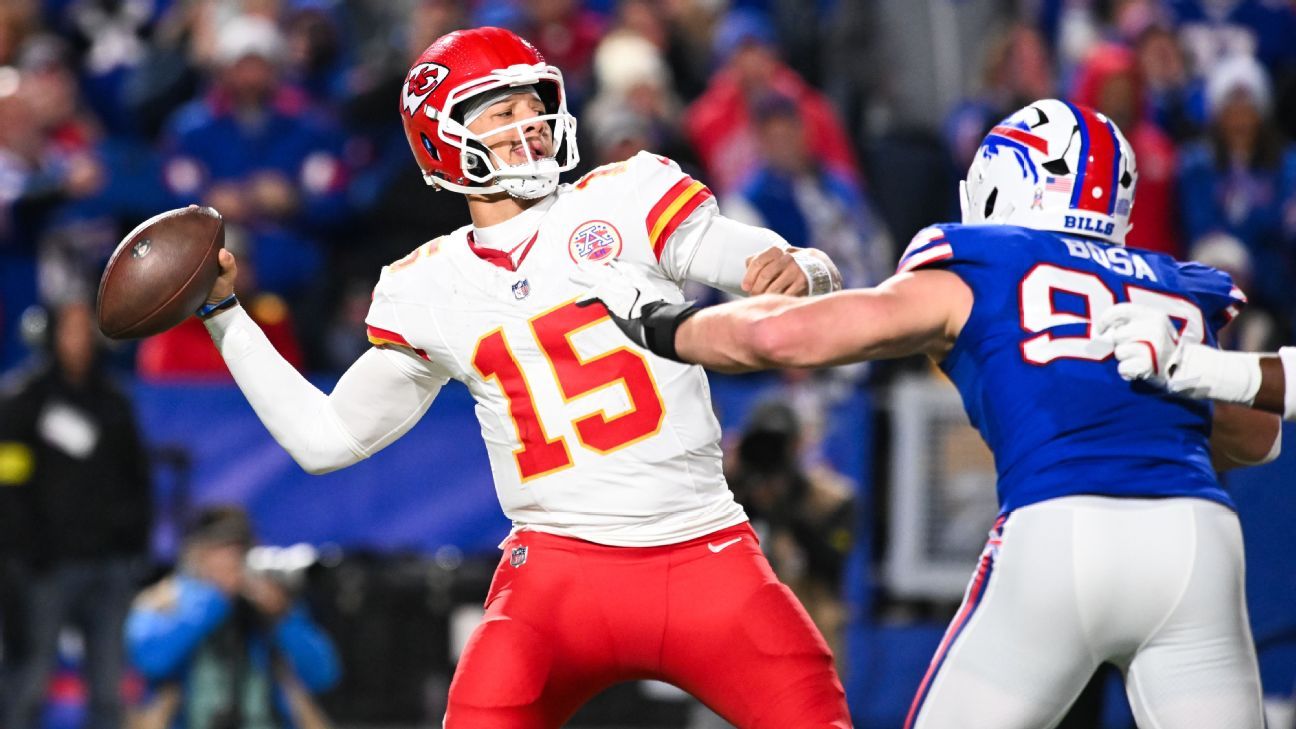
Chiefs-Bills is a much-needed test
49ers found offensive blueprint for Vikings
Lessons to be learned from Colts' fall
Giants could win a playoff game
Lions have the best offense in football
Parsons return means more Packers blitzes
Quinn is saving his job with Commanders
Let's revisit five inklings



I think ... Thursday night will be a much-needed test for both the Bills and Chiefs
The 8-2 Chiefs and 9-1 Bills have two of the best records and two of the best offenses in football as they approach a critical late-season head-to-head matchup that might decide the No. 1 seed in the AFC. What year is this? Every year in recent history?
Seriously. The Chiefs and Bills last played on Nov. 2, 2025. The Chiefs were 5-3, the Bills were 5-2, and they both had top-five offenses by advanced metrics -- success rate, EPA per drive, points per drive, everything. Before that, it was Nov. 17, 2024. The Chiefs were 9-0, the Bills were 8-2, and they both had offenses ranked in the top eight by advanced metrics. Before that, they played on Dec. 10, 2023. The Chiefs were 8-4, the Bills were 6-6 (they'd end the year 11-6 in the No. 2 seed), and you guessed it -- they each had a top-10 offense.
The nice thing about these consistent regular-season bouts is we know that they both matter and don't matter. Winning this game can position either team nicely for a first-round bye or home-field advantage in a playoff rematch. Those are real advantages. But we also know that these two teams and two quarterbacks are so good that one loss won't derail their seasons or preclude them from postseason success. In that 2023 season, the Bills won the regular-season matchup and got a home game in the divisional round against the Chiefs for their trouble. The Chiefs won that game and went on to win the Super Bowl.
If this game has postseason consequences but isn't particularly disqualifying for either franchise, then what makes this 2026 contest different from the first 10 games these two quarterbacks have played against each other? This particular moment is an interesting one for both franchises because of who they've recently played.
Let's start with the Bills, the lone one-loss team in the AFC. The Bills are obviously awesome again. The offensive line hasn't missed a beat despite losing David Edwards in free agency and enduring some injuries through the first three months of the season. The addition of receiver DJ Moore has been exactly as hoped for (when he has been on the field). And Jim Leonhard's defensive scheme change has facilitated breakouts for edge rusher Greg Rousseau and defensive tackle Deone Walker.
But the defensive riddle is a little difficult to solve given the strength of competition. Through the first six weeks of the season, the Bills faced the following quarterbacks: C.J. Stroud, Jared Goff, Justin Herbert, Drake Maye, Matthew Stafford and Kirk Cousins. Entering their Week 7 bye, they were 31st in defensive EPA per drive and 30th in defensive success rate. No defense -- not the Cowboys, the Titans, any team -- was giving up more points per drive than the Bills' defense.
Leonhard was reaching for solutions, and he started to find them entering the bye week. The Bills were in single-high coverages on 61% of their snaps in Week 6 against the Raiders after going single-high 45% of the time in the five previous weeks. In all of the Bills' first five games, they played quarters on at least 23% of opponent dropbacks; in each of the past five games, they've never played quarters more than 17% of the time.
These solutions look effective. Let me amend that. These solutions look like an immeasurable revolution of defense. The Bills have not given up a touchdown drive in three straight games -- that's 43 consecutive drives, going back to Week 8 vs. the Ravens -- for the first time in franchise history.
Here's the issue. The following quarterbacks have taken snaps against the Bills in their four-game stretch since the bye. Dolphins backup Kyle McCord (37 dropbacks), Jets backup Cade Klubnik (26), Vikings backup Carson Wentz (25), Ravens third-stringer Joe Fagnano (25), Jets starter Geno Smith (22), Vikings third-stringer Max Brosmer (seven), Ravens backup Tyler Huntley (five) and Ravens starter Lamar Jackson (one).
Two things are simultaneously true. First, the Bills defense has, without question, improved through October and into November. Second, the Bills' have not been sufficiently tested to measure the size of that improvement. Are they the 25th-best defense? The 12th? We could be anywhere in that range of outcomes. We don't have the necessary data to know.
Assuming (knock on wood) Chiefs quarterback Patrick Mahomes plays a full game against the Bills' defense, we will gain a critical datapoint in our measure of the Bills as a top-tier AFC contender. They are obviously capable of winning a Super Bowl this season -- they've been capable for several seasons now, and as long as Josh Allen is playing quarterback, they will remain so. But we still don't know if the defense will carry its own water during January football, and their performance against the Chiefs and Mahomes will give us their first real litmus test to that end.
On the other side of the ball, the Chiefs' offense is undergoing a smaller but still significant revolution of its own. Early in the season, it was the running game. The free agent acquisition of Kenneth Walker III and commitment to an under-center rushing attack brought newfound balance and explosiveness to a Chiefs offense in desperate need of both.
But as the season has gone along, the Chiefs have begun tilting their offense back to a pass-heavy approach, just as the Bills have tinkered with their coverages. In Weeks 1-7, the Chiefs were fifth in pass rate over expectation at plus-1.5%, per NFL Next Gen Stats. Since Week 8, they're second to only the Bengals at plus-6.2%.
And it's not just that they've become more pass-happy; they're also getting the ball downfield more often. Mahomes has averaged over 8 air yards per pass attempt in consecutive games for the first time since Weeks 2-3 of last season.
Week 10 against the Falcons was a bit more successful than Week 11 against the Cardinals. Mahomes completed two passes of 40-plus air yards against Atlanta, which is the first time he has done that in a game since 2022. But the larger impact of the addition of receiver Josh Downs and emergence of an under-center dropback game is beginning to become apparent. The Chiefs can push the ball downfield both in moderate ways (hitting intermediate throws) and extreme ways (pushing the ball deeper than deep).
This is a concerted, schematic shift. It is not the result of scramble-drill plays. On in-structure throws (dropbacks of four seconds or less, per Next Gen Stats), Mahomes is averaging 8.1 air yards per attempt in the past two weeks. He was at 5.1 -- the lowest among all starting quarterbacks -- in the nine previous weeks.
I wonder about three things when it comes to this sudden spike. The first is, of course, the small sample concern. Neither the Falcons' defense nor the Cardinals' defense is terrible, but neither is great, and two productive passing weeks against those opponents does not turn over a new leaf. The second is how much the addition of Downs has really impacted the change. He has played only 28 snaps over two weeks, but he does have nine targets at 9.3 air yards per target. Will that depth sustain when he gets a larger menu of snaps?
The third is perhaps the most interesting: Does this change when Walker comes back from a groin injury? The Chiefs could reasonably return to their previous mode of ball-control offense -- using all four downs, staying ahead of the sticks and making the numbers game work by throwing RPOs behind the line of scrimmage in attachment to the running game. If the Chiefs feel as if they largely got away with two weeks of downfield Cyrus Allen and Andrew Armstrong targets, and that relying on such plays is not a sustainable path to success ... I wouldn't agree, but I would understand where they were coming from.
Assuming Walker plays Thursday against the Bills, we will get our answer. The Chiefs did not need Downs to play much in Week 11 against the outmanned Cardinals but will need him in Week 12, and if he plays more, we might begin to get that answer as well. The best version of the Chiefs' offense is one that passes heavily and passes downfield while still fielding a dangerous rushing attack. (If that sounds like an impossible pie-in-the-sky goal, it's exactly what the 49ers are this season.) Kansas City looks as if it's on the cusp of that particular evolution, but I need to see it for a few more weeks. The Bills in Week 12, the Rams and their elite defense in Week 13 and the Bengals in Week 14 -- all on the road -- serve as a perfect proving ground for what this offense has become.


I think ... the 49ers might have given the Vikings' next opponents an offensive blueprint
On Sunday, we watched the single best game any offense has had against the Brian Flores-led Minnesota Vikings defense. And that's a fact. The 49ers averaged 0.28 EPA per play on offense -- the highest number the Vikings have surrendered in a game during Flores' tenure, which started in 2023 -- and were largely in first gear for much of the fourth quarter. That's a proper thrashing right there.
Other offenses have had some success against the Vikings defense this season -- the Packers in Week 1, the Lions in Week 9. But nobody put up numbers the way the 49ers did: 28 offensive points against a defense averaging 14.0 points allowed.
The secret sauce for the 49ers was nothing new. Quarterback Brock Purdy was ripping throws between the numbers with preposterous gumption. Purdy has never thrown with greater anticipation than he did Sunday night -- near Tua Tagovailoa-levels of trusting his receivers and throwing to spots between zones. The 49ers' pass catchers were nails with their timing and won seemingly every contested ball and big-hit throw. When an offense is operating this way, it feels almost indefensible -- and probably is.
— Good Clips (@MeshSitWheel) November 24, 2026
It's easy to dismiss the 49ers' performance as an elite offense doing something irreplicable to an otherwise elite defense. How many other teams employ a quarterback this precise and anticipatory and a coach this adept at creating voids in the middle of the field?
The short answer is none, but the long answer is more interesting. The 49ers refused to change their offensive stripes against Minnesota, and in doing so, challenged the Vikings' defense in a way most teams have been unable to.
The first challenge was in pass protection and route distribution. The 49ers entered this game leading the league in the percent of their dropbacks on which they got all five players out into pass protection -- 72.5%, the only team over 70%. But nobody gets all five eligible players out against Flores -- he sends too many pressures. And that also was true of the 49ers. They got five eligibles out on only 43% of their dropbacks, the lowest of any 49ers game since Week 1 of the 2021 season.
But they got at least four in the route 86% of the time, the third-highest mark for an offense in a game against the Flores defense this season. Most teams get receivers out in the concept on Flores to go deep -- he doesn't have enough coverage bodies, so let's flood him with routes and hit big plays -- but the 49ers did it to throw quick and underneath. In particular, the 49ers would use the gravity of their backs to yank underneath zone defenders, then throw in behind them.
Watch Vikings linebacker Blake Cashman (51) on this touchdown to tight end George Kittle in the first quarter. Because running back Christian McCaffrey is out quick and the corner is occupied with the vertical route from the receiver, Cashman has to gain width to respect the terrifying receiving threat of McCaffrey. There's no underneath presence discouraging Purdy from throwing this one-on-one to Kittle against Harrison Smith. It's a great throw and a great catch.
— Good Clips (@MeshSitWheel) November 24, 2026
When Flores blitzed the linebackers to protect them, Shanahan still yanked the dropping edge rushers out of the throwing window. Watch here as fullback Kyle Juszczyk and running back Kaelon Black both swing into the flat, and with them go edge Kyle Van Noy (17). Most teams facing Flores would keep Juszczyk in to chip and/or Black in to block, and Van Noy could drop right into the window on the in-breaker. Shanahan instead used the backs to pull the underneath zone defender and create a big void for an easy completion.
— Good Clips (@MeshSitWheel) November 24, 2026
Note that these plays are from very condensed formations -- formations where the outermost players from the 49ers are not very far from the center of the field. No team in the Next Gen Stats database has run a higher rate of condensed formations than the 2026 49ers; second place are the 2025 49ers. Since the trade acquisition of McCaffrey, the 49ers have increasingly become a super-condensed team, as those tight formations create room to the flat for throws to the back, and soft spots on in-breaking routes behind stressed linebackers.
In that the 49ers did what the 49ers always do, the larger lesson to be learned might be "don't kowtow to Flores, just run your stuff." But I think there's ideas here worth grafting into your offense. Teams with good receiving backs should look to get that player out fast into the flat quickly, forcing the Vikings' underneath zone droppers -- who are all tight to the ball -- to cover great distances to maintain leverage on those threats. The Vikings play the Falcons on Sunday, and Atlanta has been using plenty of condensed formations this season. Bijan Robinson can have the same gravity as McCaffrey, and Michael Penix Jr. is capable of making similar zippy throws over the middle as Purdy did -- he's just more easily fooled by coverages.
What about in two weeks, when the Vikings face the Panthers? Chuba Hubbard is one of the league's most reliable receiving backs, and the Panthers' offense has become quietly 49ers-ish with the influence of assistant head coach Darrell Bevell, who was last in Miami under Mike McDaniel (who sprouted from Shanahan tree). The Panthers run a lot of quick-game throws between the numbers, which is how Purdy feasted against Flores. On the season, Purdy is second in the league in passer rating on quick, in-breaking throws; Bryce Young is seventh. Both win with rapid releases, healthy anticipation and light feet in the pocket.
I am confident we will see the Falcons and the Panthers try to do what the 49ers did: condense the formation, use the back to widen coverage, through quick games to the voids. Whether or not it works is a different matter entirely. Purdy and Shanahan have mastered this craft over years and they benefitted from a few coverage busts in this game. The schematic trickle down might give offenses a better prayer against Flores, but the requisite down-to-down consistency to score touchdowns on all quick-game throws is a high bar to clear.

I think ... there are three lessons to be learned from the rise and fall of the Colts
The second-most embarrassing thing to happen to the Colts last week was their 26-3 loss to the Texans on Thursday night. The most embarrassing thing ensued Friday morning. They released quarterback Daniel Jones just two weeks after electing not to move him at the trade deadline. ESPN's Adam Schefter reported that the Ravens offered a fourth-rounder to the Colts for Jones and a fifth-round pick, with the conditions that the fifth-rounder would return to the Colts if the Ravens made the playoffs ... and the Colts denied the offer.
Many will quickly point out that a fourth-for-fifth swap is not that great of return. That's absolutely correct. Of course, at the time of the offer -- presumably after Week 9 -- the Ravens were 4-5 with a slim but still reasonable chance to make the postseason. That means the Ravens' trade package had a slim but reasonable chance to be a fourth straight up.
The exact value the Colts could have extracted is interesting -- perhaps there were better offers from other unknown teams -- but immaterial. It's not the size of the return that could have been that makes the past two weeks so damning. It's how easy the decision to trade him should have been.
For weeks, there has been no universe in which Jones played for the Colts in 2027 on his existing contract. None, zero. In 2027, Jones was due $33.5 million in non-guaranteed salary, and his caliber of play did not warrant that level of pay. At the time of the deadline, Jones had an EPA per dropback of minus-0.14 -- 33rd among 35 qualifying quarterbacks -- and was averaging 3.8 adjusted net yards per attempt (34th). After his Week 10 and 11 games against the Dolphins and Texans, respectively, he was at minus-0.17 EPA per dropback with 3.6 adjusted net yards per attempt. The idea that those games were so dramatically worse than his previous play that it necessitated the Colts to shift from not trading Jones to immediately releasing him is not reflective of reality. Jones has been brutal for much of the season, and if the Colts had any suitors at the deadline, they should have made the easy decision to move on.
Trading Jones would have technically saved the Colts cap space -- they would have been guaranteed the $2 million in cap space of his remaining base salary for 2026, whereas they get only offsets post-release if he signs somewhere else this season. But it's not that the $2 million in cap space or the fourth-round pick were so valuable. It's that trading Jones was the obvious choice.
It's important to contrast this painfully obvious choice with the other painful but not-so-obvious choices the Colts have made in recent months under second-year owner Carlie Irsay-Gordon. Not trading Jonathan Taylor, for example. Dealing Taylor for a second-round pick and change would have been the smartest option, but -- unlike Jones -- there are some universes in which Taylor is meaningful to the Colts' future efforts. Taylor is signed through the 2028 season, and if the Colts hit on a free agent quarterback or draft pick over that time, his presence as an effective running back will help insulate their new passer. Rebuilds always look long at the beginning but can be quickly accelerated with good personnel fortune.
Then there is last year's Sauce Gardner trade. The 2027 first-round pick that Indianapolis traded to the Jets looks worse and worse in hindsight, especially as the pick gets better and better. Trading two first-round picks and a young player for a cornerback was not the smartest move at the time, but it was at least defensible. The 8-2 Colts were a lightning strike of a team looking to sustain their red-hot start into a deep playoff run. They had a chance to acquire what they believed to be a game-changing young player at a premium position, and they took that swing. Then Jones and Gardner got hurt. These things happen.
These errors, which involved bigger picks and larger swings, hurt the Colts' future more than the Jones error. But the Jones error is such a frustrating button on the end of a long list of organizational missteps because, unlike the Taylor and Gardner trades, it was so easy to avoid. The Colts will not be able to get the bigger things right until they start getting the easy things right, and the past few weeks have proved that they're still at square one.
I have three team-building lessons for NFL teams to learn from the rapid rise and precipitous fall of the 2025-26 Colts.
1. Don't give general managers the chance to save their jobs. This sounds brutal, but I think it's good practice. General managers are responsible for the long-term health of the roster. Put any GM in a position of professional jeopardy, and he will abdicate that responsibility for the sake of short-term wins. The franchise will suffer in the aggregate.
When GM Chris Ballard -- fired after Week 6 this season -- traded for Gardner in 2025, he was spending future resources for the sake of a potential Super Bowl run. That's a decision many general managers have made, risky as it is. But the inclusion of Adonai Mitchell in the trade looms as he grows into a solid WR2 in New York. The contract extensions for Alec Pierce coming off a calf injury and Jones off an Achilles injury both look like enormous long-term mistakes for the sake of short-term competitiveness.
Irsay-Gordon was very public about her expectations that Ballard and head coach Shane Steichen win and win now. Ballard literally cannot do his actual job -- maintaining the long-term health of the roster -- well under those conditions. He was rightfully let go after a decade of underwhelming team success in Indianapolis -- one playoff win and three playoff games over 10 seasons, and nary a division title won over those 10 -- but the decision to extend his tenure long enough to dig the Colts into a large rebuilding hole is a failure of ownership.
2. Wait on quarterbacks after Achilles tears. Kirk Cousins, Deshaun Watson and Jones -- three quarterbacks with recent Achilles tears. In Cousins' first season off the tear (2024), he looked unplayable and inexplosive. But by the 2025 season in relief of Michael Penix Jr., the movement was better and the velocity had returned. Cousins' 2026 season looks about as you'd expect his age-38 season to look without a major injury -- there are still accuracy and deep ball limitations, but he's a functional starting quarterback.
Watson tore his Achilles in 2024 and again in January 2025, but we didn't see him in action until this season -- 18-plus months removed from the injury. Watson's play has been far from inspiring, but his movement has clearly been sufficient for him to have a dual-threat impact on the Browns' offense.
And then there's Jones, who is less than a year removed from his Achilles injury and wholly lacking in the athletic traits that have saved him for much of his career -- drive velocity and surprising mobility. If Jones is signed by a needy team like the Patriots next week and is forced into further 2026 action, I expect his film to be bad. But in 2027, another year removed from the injury and with a second offseason of recovery under his belt ... I wouldn't be surprised if the film is clearly improved.
3. Steichen is a really good offensive designer. Jones is obviously an athletic shell of himself, as his ball velocity and escapeability have both declined as the season has progressed. With that said, it was a miracle the Colts generated a historically productive offense with Jones under center in 2025, and it looks doubly a miracle in hindsight.
Steichen probably will be fired by the end of this season, and I imagine he will get head coach interviews in the 2027 cycle. I am always an advocate of taking a year off -- he has earned it -- but I remain a believer in him as an offensive playcaller. Ideally, Steichen ends up taking an offensive coordinator job (back in Los Angeles with Justin Herbert?) and does what he does best: build an offense. Good coach.

I think ... the Giants can win a playoff game
Let's all make sure we're correctly calibrating to the Giants here. Thirteen days ago, the Giants lost at home to the 2-5-1 Commanders. New York had the lead in the fourth quarter with multiple drives to salt the game away in a four-minute offense, and failed multiple times. The Commanders made the Giants pay. On Sunday, the Giants were in a similar situation against the Jaguars -- and Jacksonville came up just short.
The Giants' range of outcomes reaches all the way down to "embarrassing home loss to reeling divisional opponents." And it evidently stretches all the way up to "emphatic home win against top-tier AFC contender" following their 23-18 victory over the Jaguars. The Giants entered that game a bit of a silly team, and they left that game -- a game in which quarterback J.J. McCarthy completed less than 50% of his passes and in which they averaged only 3.7 yards per play on offense -- still a silly team.
But they are dangerous. Not because John Harbaugh is a good coach (though he is) and not because McCarthy has some gamer in him (he does, but he didn't even complete a pass over 15 air yards all game). The 6-3-1 Giants are dangerous because they are talented.
The Giants have a few field-tipping players on defense. The first is second-year edge rusher Abdul Carter, who took over against Jacksonville with 12 pressures, per Next Gen Stats. Six of those pressures were quick pressures -- under 2.5 seconds -- which makes Carter the only player with multiple games this season of six-plus quick pressures. Carter has 23 quick pressures on the season, tied for the third most in the league. Among edge rushers with at least 100 pass-rush snaps, Carter's 2.60 second time-to-pressure is fourth fastest.
— Good Clips (@MeshSitWheel) November 24, 2026
To produce quick disruption like that is game-wrecking stuff. Carter is similar in impact this season to Broncos edge Nik Bonitto (24 quick pressures, 2.60 second time-to-pressure), who is the premier speed edge and a perennial All-Pro-caliber player. To have stepped so firmly into Brian Burns' shoes after Burns' Week 3 ACL tear is a sign that Carter is blossoming into the star the Giants hoped for when they selected him No. 3 in the 2025 NFL draft.
Carter isn't the only defensive player producing at an All-Pro level. Cornerback Deonte Banks, 2023 first-rounder, who felt like a bust through the first three seasons, has turned the trajectory of his career on its head. Banks has been one of the league's preeminent man coverage cornerbacks this season, and was again Sunday. Banks was targeted 12 times and surrendered only four completions for 39 yards, snagging a pick and three total passes defensed. On the season, Banks is tied for the league lead in passes defensed (14) and is fifth in yards per target allowed in man coverage despite seeing more targets than any other corner in football.
If the Giants have a top-10 edge and a top-10 corner -- I'd argue, just on the back of 2026 performance, they do -- then they have the ability to shut down opposing teams. Those are premier players and premium spots that can force opposing teams to play left-handed. How well will Kirk Cousins handle Carter's pressure if the Vikings draw the Giants in the wild-card round? Can Banks force third-down throws away from Mike Evans if the 49ers play the Giants in January?
On offense, the Giants have more game-altering players. Healthy Malik Nabers doesn't quite have the game-takeover potential that Ja'Marr Chase or Jaxon Smith-Njigba do, but he feels as if he's in the next tier of uncoverability when he's fully on. The Giants' offensive line, anchored by perennial standout Andrew Thomas, who had one of his best games of the season against the Jaguars, has mashing potential against undersized defensive lines. I could see the Giants' rushing attack dictating the game to Flores' Vikings defense that has struggled with heavy sets or Nabers running roughshod through a Lions' secondary that lacks sticky corners.
Again, in reality, the Giants could legitimately lose to the Colts in Week 12 (somehow). Many of the players who touch the ball on offense -- McCarthy, Cam Skattebo -- are notoriously volatile players. The range of outcomes is very wide. But it includes a grimy win against a legitimate Super Bowl contender, as we saw first-hand Sunday. I'm not going to be surprised when the Giants make it to the divisional round, and you shouldn't be, either.

I think ... the Lions have the best offense in football
Before 49ers fans (or Bills fans or Chiefs fans) get all up in a tizzy, here are the numbers.
By the data, the Lions are comfortably a top offense. Though the 49ers' offense edges them in most major efficiency categories, it's not by much. We could easily shave the sample and mess with the filters and contort the Lions into a better offense. Since Week 5, the Lions lead the league in explosive play rate, not the 49ers. Here's another one: In the second half, they're first in success rate and first in EPA per play.
But in a 10-game sample, there are plenty of ways to slice the data to build just about any argument for this cluster of elite offenses. (We aren't even talking about the Cowboys and the Bengals here.) When I watch the 49ers, it's hard to figure out what stops them when they're fully healthy -- their only loss this season was a Week 7 Falcons game absent Mike Evans and Deebo Samuel Sr. It's easier to figure out with the Chiefs (lack of receiver talent, pass protection issues at tackle) and with the Bills (Josh Allen's risk-taking, similar pass protection problems).
When I watch the Lions, I can't figure out what's supposed to slow down this offense over the course of four quarters.
The Buccaneers should have had a strong outing against them in Week 11 -- coach Todd Bowles has always been good against Lions quarterback Jared Goff, who entered this game with a 0.08 EPA per dropback across his four games with the Lions against Bowles. He had 0.40 in Week 11 as the Lions became a shot-play team looking for big downfield chunks from receiver Jameson Williams (four receptions, 93 yards) and tight end Sam LaPorta (three receptions, 62 yards). Bowles blitzed Goff aggressively -- 37% of his dropbacks -- and Goff shredded it with improved pocket management. You won't mistake him for Allen anytime soon, but Goff looks as if he's moving a little more explosively this season. This 10-yard scamper he had Sunday was his second-longest run of the past three seasons.
— Good Clips (@MeshSitWheel) November 24, 2026
Against other teams, like the man-cover heavy Patriots in Week 10, the Lions can go matchup-hunting through the air. Jahmyr Gibbs led the team in targets (8), receptions (7), and receiving yards (99) while also pacing the offense with 22 carries and 153 yards. Gibbs was also the engine of the offense in the critical Week 8 game against the Vikings: 23 carries for 153 yards. Under Dan Campbell, Detroit has never been this good running the football -- yes, that includes all the Ben Johnson years. It is the best by success rate, yards per carry, EPA per rush and -- perhaps least surprisingly, given the single-headed backfield of Gibbs this season -- by explosive rush rate.
The Dolphins, who have a stingier defense than folks realize, produced the best effort against Detroit's offense all season in Week 9 with a 19-9 loss. They harassed Goff with quick pressures and kept a blanket over the deep passing attack to force incremental throws while creating negatives in the running game from light boxes. The Lions also went 1-for-4 in the red zone and 3-for-12 on third down. Situational ball can be a death knell for Detroit, as they lack a big-bodied receiver to win in tight areas. But that has been true for years, and given their fourth-down and gadget-play excellence, it's a smaller problem than it seems.
There's no reason to split the hairs between the Lions' and the 49ers' offenses. I can call the Lions the best offense in football, and then turn around and call the 49ers the best offense and still sleep like a baby at night. The 49ers feel a little bit more fragile because they're older and have already dealt with nagging injuries, but you could argue the Lions' depth is less tested and their floor is lower accordingly. I see it both ways.
Last week, I wrote that the Lions' defensive injuries might be too much to overcome in a competitive NFC playoff field, and I meant it. Even if the Lions have the best offense in football, it's hard to outscore three consecutive playoff-caliber teams when your defense has a serious lack of star personnel.
But the fact that the Lions can win in so many different modes offensively makes their sun run to a Super Bowl a little clearer. With Gibbs and this running game in such a healthy spot, the Lions can sit on the ball and exhaust a dangerous pass rush (as they did against the Vikings). With four top-shelf pass catchers at three different positions who can win in different ways and all take on serious volume, Detroit can strike at where you're weakest -- that's what it did against the Buccaneers once star outside cornerback Jacob Parrish left the game because of a back injury. The best offenses can both dictate and adapt, force the issue and morph to it. That's Detroit.
How they choose to attack the Bears' defense Thursday (1 p.m. ET, CBS) is a fascinating question. This game might be for the division -- if not, then the Week 17 rematch in Chicago might be. The Bears have become a fearsome four-man rush with the presence of All-Pro defensive tackle Jeffery Simmons on top of their already elite blitzing performance. Will Detroit try to run Chicago out of its blitz packages? Or will the Lions isolate and attack the Bears gettable corners? If the Lions' offense is what I think it is, it's capable of dumping 30-plus points on a Chicago defense that has barely suffered a scratch since the Simmons trade. Heat check game here.


I think ... Micah Parsons' return gives Jonathan Gannon a new wrinkle on blitzes
The Green Bay Packers' defense is one of the best in football. The Packers are also getting one of the best defensive players in football back for the first time this season, as Parsons is cleared to return for Wednesday's enormous NFC matchup with the Los Angeles Rams.
Are you hearing me? One of the league's best defenses -- eighth in EPA per play allowed, fourth in yards per play surrendered -- is getting Micah Parsons back on the field.
We spilled a lot of ink and filled a lot of airwaves this summer wondering what defensive coordinator Jonathan Gannon would do to manufacture defensive pressure without Parsons available in September and October. The answer is one of the best coaching performances of the season to this point. The Packers are blitzing 36% of the time -- the eighth-highest rate in football -- and generating pressure on over 40% of opposing dropbacks. That's second only to the Vikings, and get this -- the Packers (47) have generated more unblocked pressures than those Vikings (46). Gannon has been as deep in his bag as any coordinator in football.
Parsons has never played on a defense that blitzes this much, and it's probably his presence -- an elite edge rusher on base downs, no question -- that helps Gannon turn the heat up, not down. Parsons is not just a spectacular outside edge rusher, but one of the best interior pass rushers among traditional edge players. In 2025, Parsons' first season in Green Bay, he had 10 pressures on 78 snaps lined up as a defensive tackle -- that's a 19.6% pressure rate, third among all edge rushers with at least 60 snaps on the interior. In 2024, his last season with the Cowboys, he had nine pressures on another 78 interior snaps -- a 17% pressure rate.
When Parsons was first traded to Dallas, I wrote about the "spinner" role in Jeff Hafley's defense, and how Parsons would see stand-up alignments on the interior to make the Packers' third-down pressure packages go. You can see Parsons in a few of these alignments last season. Notice how absurdly quick he is at generating a soft corner with this two-way go over a guard.
— Good Clips (@MeshSitWheel) November 24, 2026
This is something that Parsons just does. There's no great explanation for it or technique to it; it's one of the things that makes him truly elite. Pound for pound, he is one of the strongest players in the league, and he can hang with guards 70-plus pounds his superior while also embarrassing them with quickness. If you were building a defense in the league to run unique packages and blitz heavily, I think you would take Parsons over any other defensive front player in football.
At least ... a healthy Parsons. As much as I believe he will add a new layer to the Packers' blitz packages, I don't think we will see it right away. He has been extremely careful in his return from his ACL and meniscus tear, and I don't think that caution will be thrown to the wind with a 40-plus-snap outing against the Rams on Wednesday. I would not be surprised to see Parsons worked carefully back into the lineup with 15-20 snaps -- mostly passing downs -- as he tests his conditioning and ability to play through contact. This is also in the Packers' best interest -- as we said above, they don't need him to be successful on defense. The most important thing is that he's healthy, fresh and full-go for the postseason push in December.
When Parsons gets up to speed, the majority of his snaps won't be in these defensive tackle alignments -- we're talking four or five such snaps a game. But these are the snaps that matter -- third-and-long, two-minute drills, all the clear pass situations -- and it's where Parsons can be most additive. By moving Parsons around and threatening to send additional rushers from depth, Gannon has as many buttons to press as any defensive coordinator in football. It should be easy to dictate protection rules with Parsons' alignment -- you can get him opposite any backup offensive line you want -- and then break them with pressure packages.
Of course, on base downs, Gannon might not be able to get as creative with his fronts. But that's the funny thing -- on early downs, the Packers' depth edge rushers have been kicking tail. Brenton Cox Jr., rookie Dani Dennis-Sutton and Lukas Van Ness are all top-15 edge rushers in early-down pass rush win rate. Green Bay doesn't need Parsons to unlock its base rush, nor does it need him to unlock its blitz packages. He is whipped cream on the pumpkin pie, gravy on the turkey.

I think ... Dan Quinn is saving his job
In the spirit of looking back on some old takes from the column (see below), let's remember a Commanders take I delivered after Week 5 this season: that Quinn was not going to be coaching the Commanders after this season. That take was delivered straight off a 27-27 tie with the New York Giants, which ended with the Commanders unintentionally running the clock down to zero when they were in game-ending, game-winning field goal range. Here's what I wrote at the time:
Quinn should not lose his job because Daniels short-circuited on a play he didn't fully understand. But you can't really come back from this. It's Quinn's third season as the head coach in Washington, and all the magic of Daniels' rookie year and that deep 2024 playoff run is forgotten. If Washington can't beat this version of the Giants -- up by 14, in the rain, facing a backup quarterback and with a hand-delivered victory at the end of overtime -- it's hard to imagine it'll beat enough teams to justify keeping the staff. Remember, Quinn made two coordinator changes last offseason. He's all out of cards to play to keep his seat for another year if things don't change very quickly.
The Commanders then went 2-2 against a respectable schedule -- losses were close against the 49ers and the Rams. Of course, close losses have another name in NFL parlance: losses. They're called losses.
Entering Monday's home game against the red-hot Bengals, the Commanders were 3-5-1 and in need of a statement win -- and they got it. But it was a roller coaster.
In the second half, it looked as if Quinn was going to get the job done and save his job in the process. The Commanders' defense used the rainy start as a greased track to get out hot against the Bengals' defense. Even as the rain slowed and stopped, they continued to harass quarterback Joe Burrow in the pocket and prevent explosives in the passing game such that drops and bad runs slowed down the Bengals' offense. Cincinnati entered this game with five straight games of 30-plus points, but left with only 20.
The Commanders' offense was doing its half of the job: eating clock and keeping Cincinnati's offense on the sideline. Washington's second-half time of possession was over 20 minutes as it incremented its way downfield. Commanders quarterback Jayden Daniels made nice intermediate throws in and out of structure -- he also had a throwback Daniels scramble. Rookie receiver Antonio Williams and free agent tight end Chig Okonkwo made big plays as the underrated Commanders' line carved out consistently clean pockets, especially down the stretch.
The lone issue: Quinn kept taking field goals -- a terrifying approach against a high-scoring offense such as Cincinnati's. He kicked a field goal on fourth-and-4 in the third quarter from the Bengals' 22-yard line -- the Next Gen Stats model and ESPN model both had that decision in a toss-up range, where kicking the field goal is as defensible as going for it on fourth down. He did it again on a fourth-and-goal from the Bengals' 7-yard line early in the fourth quarter. Again, Next Gen Stats and ESPN agreed -- this was a clear go with about a 2.5% edge in win probability.
Last, but surely not least. The Commanders were down 17-16 with 2:30 left in the fourth quarter facing a fourth-and-1 on the Bengals' 24-yard line. Pick up a first down and you can force the Bengals to start using timeouts. Pick up another first down, and you can probably salt the game down and kick a game-ending field goal to win 19-17.
Quinn opted to kick again. ESPN and Next Gen Stats were split here -- ESPN views it as a small edge (plus-0.9% win probability) to go for it; Next Gen Stats views it as a huge edge (plus-8.9%) win probability. As a result, the greatest fear of all was realized. The Bengals immediately got down the field in two plays: A deep pass to Mike Gesicki got them to Washington's 33 inside the two-minute warning.
Another end-of-game mistake could have been the death knell on Quinn's tenure in Washington. I was halfway to writing that column here. How could he possibly have left so many points on the board by attempting field goals inside the Bengals' 30?
Then a butterfly flapped its wings somewhere in the world. The Commanders dropped a second-down interception (awful) but secured a third-down sack to push Cincinnati's field goal deeper. Evan McPherson still drilled it, but the Commanders got the ball back with 39 seconds left.
Daniels then ripped two gorgeous digs to Williams (a sleeper Rookie of the Year candidate?). The Commanders made a concerted effort to get Williams the ball early and dialed up these two plays for him as the primary read. Look at the physicality and burst on the rookie. I love this young cat.
— Good Clips (@MeshSitWheel) November 24, 2026
Washington executed the end-of-game management it failed against New York. The Commanders rushed to the line -- watch the rookie receiver carry the ball to the referee -- got the spike down, and kicked the game-winner from point-blank range.
The Commanders are far from a perfect team, but their advanced numbers on both sides of the ball -- we barely got to talk about the defense, which has been settling in over the last month -- are improving as they continue to hang with better teams. If they end the season hot with wins, Quinn is going to hold onto this job into 2027. What a night for taking the points!
I once thought ...
Usually, the bottom of the column is reserved for things I might think. This week, there were a lot of key things that happened relative to past things I thought -- predictions I'd made or flags I'd planted that are starting to lean one way or the other. I wanted to revisit some things I once thought in this column and check on how they're doing here before Week 12.

I once thought (after Week 2) ... that the Jaguars trenches were going to be a problem come playoff time
This was before offensive tackle Anton Harrison's knee injury, but Sunday's loss to the Giants was a stiff reminder that the Jaguars' offensive line is a fine unit, not a needle-moving one. Against top-shelf pass rushes, the Jaguars need a better pressure plan than "throw it near Parker Washington 15 times." I'd like to see more of the backs targeted out of the backfield. Trevor Lawrence loves his deep passes, but sometimes you have to eat your veggies and check it down.

I once thought (after Week 6) ... that Jeffery Simmons was the Defensive Player of the Year
Hey-o! A trade to the Bears sure helps. Simmons now has five sacks in three games with the Bears and is up to nine sacks on the season, fourth among all defenders. If he keeps up his 1.66 sack/game rate with the Bears (it won't happen, but wouldn't it be funny?) he'll end the season with more than 20 sacks. More likely: He ends with around 14. The last defensive tackle to win the award -- Aaron Donald -- did so in 2020 with 13.5 sacks. If the Bears win the division and Simmons gets to that number, I think he'll do it.
I once thought (after Week 5) ... that Kyler Murray and the Vikings' offense was rounding into form
Nope!

I once thought (after Week 7) ... that Jonah Coleman was coming to save the Broncos' offense
I love this undersized back. Coleman had three touchdowns on 24 carries in the Broncos 38-24 win over the Raiders, to go with 11 yards on the ground and another 18 on four catches. Coleman is going to play in the league for a long, long time. He makes great decisions, sees the field well and knows how to move defenders with his tempo and feet, doesn't mess around in space and brings his hard hat in pass protection. The Broncos feel better to me right now than they have on offense at any point in the past two seasons.

I once thought (after Week 7) ... that Kevin Stefanski should win Coach of the Year
At this time, I was very impressed by how Stefanski had been winning with an imperfect quarterback in Michael Penix Jr. Since that time, the Falcons have stopped winning with an imperfect quarterback in Michael Penix Jr. Also, we've all decided that finally, just maybe, this is the year to give the award to Kyle Shanahan. Works for me!