
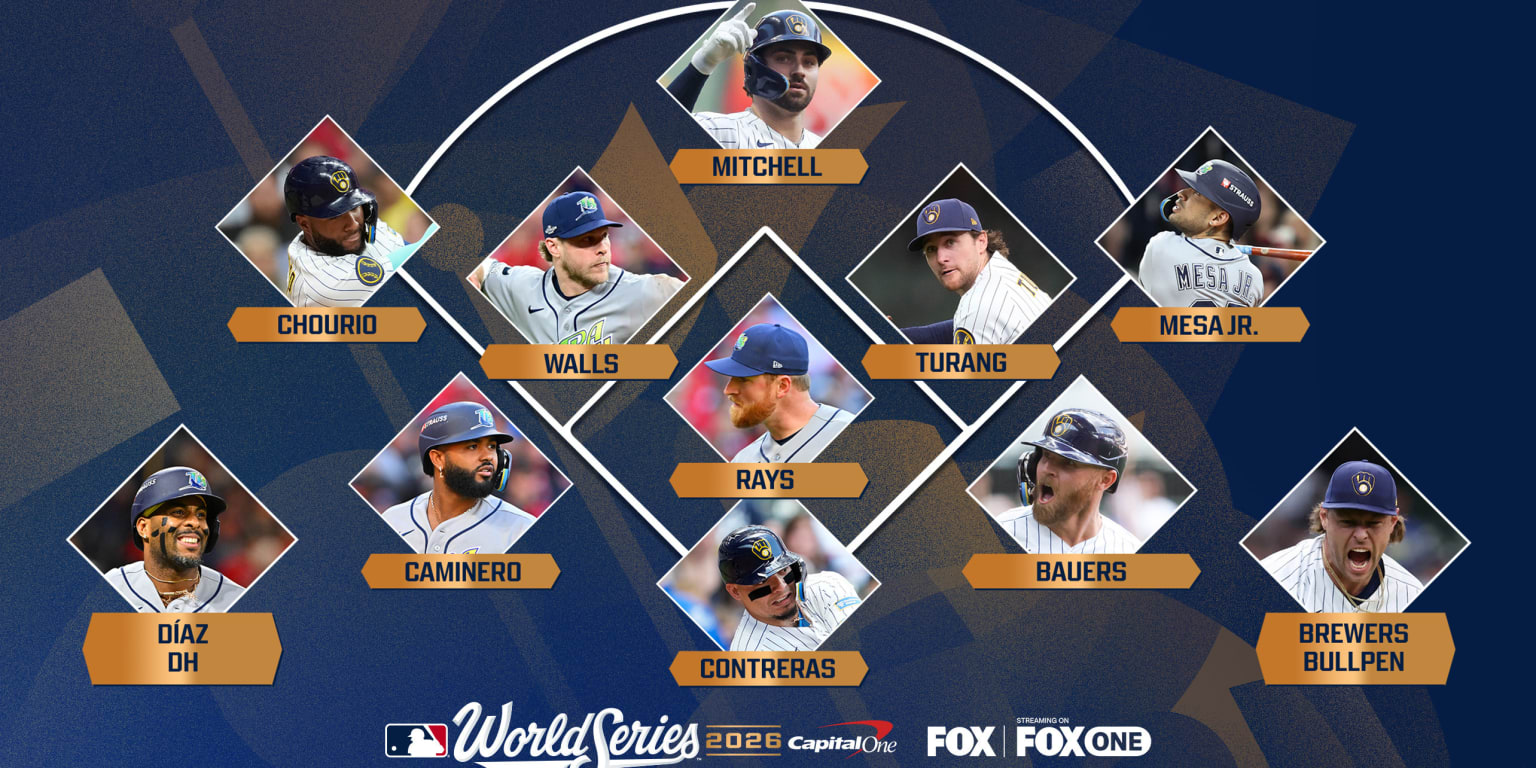
Welcome to a most fantastically interesting World Series, in which focusing on the size of the markets involved completely misses the forest for the trees. It’s a No. 1-vs.-No. 1 matchup, just the sixth time in the past 30 years that’s happened. It’s a pair of fanbases who have never won before, which marks the first time since 1980 (Royals vs. Phillies) that’s happened, and thus only the second time in more than a century, since the previous time had been 1920.
It’s a matchup of teams that have more than a few connections. Note that Tampa Bay’s top two starters, Drew Rasmussen and Freddy Peralta, each came up with Milwaukee, and were teammates on the 2020-21 Brewers. Note, also, that NLCS MVP Jake Bauers made his debut with Tampa Bay back in 2018, and that Brewers president of baseball operations Matt Arnold spent nine years in the Tampa Bay front office before moving to Wisconsin.
It's more than just that. Depending on how you view your baseball aesthetics, it's a delightfully throwback sort of on-field style. It’s not that these teams eschew analytical thinking -- exactly the opposite, really -- but no team struck out less than the Rays, each team finished in the top five in steals and the bottom 10 in homers, and the bunt hits leaderboard goes “Tampa Bay first, Milwaukee second.”
Throw in a pair of excellent defenses, and you know what you’re going to get here, which is excellent baseball played by a pair of teams that actually look a whole lot like one another. We know what else we're going to get, too: an incredibly interesting series. Which side has the edge?
Catcher
William Contreras, over the past five years, has a pretty solid argument to make as being the best all-around catcher in the National League. While his bat over the last two seasons (110 OPS+) isn’t quite what it was at his peak from 2022-24 (129 OPS+), it’s reliably solid, and then of course he’s been fantastic in eight playoff games, posting a 1.157 OPS with three homers. It’s hard to overstate how important the midseason acquisition of Liam Hicks (129 OPS+ in 41 games for Tampa Bay) was, really helping to lengthen a top-heavy lineup, though he hasn’t done much with the bat in the playoffs. Given relatively similar defensive value, we’ll give a small edge based on track record.
Advantage: Brewers
First base
It's a tale of two winding paths here, as Jonathan Aranda finally had his breakout last season, a decade after he signed as an amateur free agent with Tampa Bay, and of course Jake Bauers' long road to get to this point has been well-chronicled. Bauers has the offensive edge both in terms of power and getting on base, and neither are terribly strong defensive players, so given the mild 2026 regular-season advantage and also the superior performance in October, it’s hard not to choose Bauers on this. Great stories, both.
Advantage: Brewers
Second base
Brice Turang is the best all-around second baseman in the game, pairing excellent defense with a more recently found power stroke, popping 21 homers and driving in 100. The Rays have certainly found some ways to get value out of their second-base duo of Richie Palacios and Ben Williamson, but it’s a relatively below-average spot for Tampa Bay and, either way, we’re comparing to Milwaukee’s best-in-class superstar. This one is probably the biggest mismatch of any pairing on the list.
Advantage: Brewers
Shortstop
Here’s how you know how well-regarded Taylor Walls is on defense: The Rays continue to play him every day despite a near-total lack of offense from the position, as he’s posted all of a .381 OPS this month, and even that was juiced a little by the inexplicable three walks that Cleveland issued him in ALCS Game 6. It’s not just a small-sample thing, either, as Walls has been a routinely ineffective hitter for the entirety of his career.
There’s no doubt that Milwaukee’s Cooper Pratt is a stronger offensive force, though that’s been more good than great, with a league-average line as a rookie and a mostly singles-based approach in the playoffs. While he’s expected to be a quality shortstop as his career progresses, a number of important miscues in the postseason tilt this one to the more surehanded Walls.
Advantage: Rays
Third base
If there’s some argument that this series features more depth than true superstars, then that case falls apart a little at third, where Tampa Bay’s Junior Caminero posted his second consecutive 40-plus homer season on his way to, most likely, some high placement on AL MVP ballots. It’s true that prior to his ALCS Game 6 homer, his bat had been relatively quiet in October, but we’re also talking about all of eight games against some of the best pitching the sport has to offer. (The average fastball he’s seen? 96.8 mph.) There’s an obvious speed-and-defense edge for Milwaukee in David Hamilton and Joey Ortiz, but not quite so much that you’d take either or both over Caminero, or that it’s really close at all.
Advantage: Rays
Left field
This is actually the most fun comparison, because who do you like more, the 22-year-old power-and-defense superstar in Jackson Chourio -- the only player in history to have three 20-20 seasons through age-22 -- or the 25-year-old elite speed-and-contact guy in Chandler Simpson, who improved his defense to the point that both were named Gold Glove finalists last week? It’s yet another reminder that there’s more than one way to provide value, and certainly both teams are very pleased with their situations here. It’s hard, though, not to default to Chourio, who might already be a top-20 position player in the sport. If both can run and field, and only one has any power, then the advantage writes itself.
Advantage: Brewers
Center field
In Garrett Mitchell and Jonny DeLuca, you have two very strong defensive center fielders, though you’d probably give the slight edge here to DeLuca. (Cedric Mullins also carries a good glove, though this spot has belonged to DeLuca all month.) The question about their bats is what shape of production you prefer, in that Mitchell struck out considerably more than DeLuca, but he also had an on-base percentage 54 points higher, thanks in large part to a walk rate three times as high. While we’re not weighing postseason performance too much here, it’s worth noting that Mitchell has had some huge hits, while DeLuca mostly has not. This is about as razor-thin as we’ll see here, but even if Mitchell’s glove isn’t as good, it’s still good, and he gets on base. Edge, Milwaukee. A small one, anyway.
Advantage: Brewers
Right field
For everything that Sal Frelick has done for the Brewers over his four seasons with the team -- and he has done quite a bit -- this was not a terribly strong season for him, posting a career-worst 70 OPS+, and he’s managed only three singles and a few walks in the playoffs. That’s not to say that he can’t help the team win in other ways, because he can and does, but Tampa Bay’s Victor Mesa Jr. has been one of the team’s breakout stars, putting up not only a 127 OPS+ but also some truly elite defensive metrics, in just half a season. You’re already familiar, anyway, with his absolute cannon of a throwing arm. Mesa Jr. wasn’t on the Opening Day roster and didn’t even join the Rays for good until late May. He might just be one of the most important players in the World Series, though.
Advantage: Rays
Designated hitter
It would be hard to find two players who mean more to their respective teams than veterans Yandy Díaz (in his eighth season with Tampa Bay) and recently appointed Milwaukee captain Christian Yelich (in his ninth season as a Brewer). Neither plays the field much anymore, nor is either at or near their peak of offensive performance these days. But Díaz far outperformed Yelich during the regular season (124 OPS+ to 91 OPS+, where again, 100 is average), and that’s held true in the postseason, too, where Yelich has been held out of certain games against tough lefties in favor of Andrew Vaughn. At DH, literally the only thing that matters is “dangerous bat,” and that’s Díaz still, after all these years.
Advantage: Rays
Starting pitchers
If we’re talking about each team’s top three starters, which represent the bulk of a postseason rotation, then it’s Jacob Misiorowski, Logan Henderson and Robert Gasser for Milwaukee, and Drew Rasmussen, Freddy Peralta and Nick Martinez for Tampa Bay. Those six pitchers, so far in the playoffs, have combined for a 1.87 ERA. They’re not that good, obviously, with every underlying metric saying that the strikeout rate has been just average, and that they’ve been bailed out to some extent by excellent defense and relief pitching.
Still: When Misiorowski -- the presumptive NL Cy Young winner, the most dominant per-batter pitcher of the moment -- has the highest postseason ERA of these six, you know how strong each team is here. You really can’t look at full-season stats, either, because it goes without saying that the Tampa Bay version of Peralta is a very different pitcher than New York version we saw prior to the Trade Deadline. Misiorowski is the best of the six, but is he that much better than Rasmussen right now, himself an ace? Maybe not.
These are two strengths, but we like Tampa Bay ever so slightly more for one reason: depth. No Milwaukee starter, not even the top ones, has managed to get past five innings in the playoffs so far, which puts a lot of pressure on the bullpens. (There’s a particularly interesting angle here if Tampa Bay’s high-contact, flat-swing hitters can foul off enough Misiorowski pitches to wear him out, as has already happened to him this month.) If you look past the top three, you’d probably take Tampa Bay’s Griffin Jax and Ian Seymour to get outs a little more than Milwaukee’s Shane Drohan and Dustin May.
They’re both good, obviously. They’re World Series starting rotations. We’d give the ever-so-slight edge to Tampa Bay in a best of seven.
Advantage: Rays
Relief pitchers
If Milwaukee’s starters have been more good than great this month, then their relievers have more than picked up the slack, as you’ve almost certainly heard the note that in 40 2/3 postseason innings, the Brewers' bullpen has allowed all of six earned runs. While most of the focus there lands on Aaron Ashby or closer Trevor Megill, realize that JoJo Romero has a 47% strikeout rate this month, and that Abner Uribe, Antonio Senzatela, Megill and Ashby are all averaging more than 98 mph on their heaters this month. In fact, it is the second-hardest-throwing bullpen of the pitch tracking era (since 2008) -- at 98 mph even -- and the hardest that doesn’t include Mason Miller.
It makes, then, for an ironic matchup against a Tampa Bay bullpen that is A) also very good but B) does not throw hard, comparatively, at just 93.2 mph. (That goes down slightly, if you don't include Peralta’s impressive appearance in ALCS Game 4.) Much depends on the status of Bryan Baker, their All-Star closer, who was used so heavily against Cleveland that his fastball, which averaged 96.3 mph during the regular season, sunk below 93 mph in ALCS Game 6.
He was still good, of course. All the Rays are. It’s just hard not to go with Milwaukee, given their superior depth and full rest.
Advantage: Brewers
Prediction
It should be clear by now that this is an incredibly tightly matched series between two mirror-image teams, the best in their respective leagues, and you could as easily claim “rust or rest” for Milwaukee after their layoff, no matter which narrative you’d like to go with. Milwaukee has the biggest-name pitcher in Misiorowski; Tampa Bay has clearly the biggest star hitter in Caminero; and both sides play strong defense and win in ways that aren’t just waiting for the homer.
We like that Milwaukee has the home-field advantage, and the bullpen edge, and also that their lineup just seems a little deeper; in the second half of the season, no team -- not the Dodgers, not the Cubs, not anyone -- got more production from the No. 6 through 9 spots in their lineup than Milwaukee. That’s in part because of the middle infield, where the Brewers were third best, while Tampa Bay was third weakest. There’s at least some question about what shape Baker will be in, though three days of rest before the World Series ought to help.
It won’t be a cakewalk, because there’s too much talent and similarity on both sides for that. But every small edge matters, and Milwaukee has enough of them that we expect the second World Series title in city history, and the first for the Brewers franchise. Get ready to slide, Bernie.
Brewers in seven.