

Aston Villa won the UEFA Europa League in 2026, the club’s first title in 44 years, while their manager, Unai Emery, won it five times in his career. He is in good company with Carlo Ancelotti, Jose Mourinho and Giovanni Trapattoni, who also won five European titles. Emery stands out as an Europa League expert, winning three consecutive tournaments with Sevilla from 2013 to 2016. In the 2018/19 season, he managed Arsenal and lost the final, while he won the Europa League with Villarreal in the 2020/21 season.
Embed from Getty ImagesBeyond his tactical intelligence, Emery’s true genius lies in his ability to maintain elite performance despite financial constraints. Sevilla, Villarreal and Aston Villa are not super-clubs with huge transfer budgets. His current rebuild of Aston Villa’s squad is a masterclass in calculated risks rather than reckless spending. By leveraging his network in the football industry and demanding multi-dimensional players, Emery has built a sustainable transfer strategy that lets him punch above his financial weight. This article focuses on Emery’s role in the transfer strategy, squad rebuild and estimates how far Aston Villa can go this season.
From Monchi to Olabe: Changing Aston Villa’s transfer strategy
While managers often struggle to compete in the domestic league and European tournaments at the same time, Emery stands out as an expert at this balance. One of the most important partnerships that brought success was between Emery and sporting director Monchi at Sevilla from 2013 to 2016. In 2023, they teamed up again at Aston Villa. Ramón Monchi elaborated on his approach to success:
“I don’t believe there is any secret to my work,” […] “There are no magic formulas; otherwise I would have sold them already. There are no identical clubs in the world; they all have their own character. In Spain, I was often asked what my secret was, and I always gave a fairly unoriginal answer: working hard.”
At Sevilla, Monchi watched 10 games every weekend and had 20 scouts travelling the world to identify high-potential players and emerging talents. Monchi kept detailed reports of 250 transfer targets in different positions, and after signing players, Emery developed them.
Embed from Getty ImagesIn September 2025, several factors affected Monchi’s departure from Aston Villa, including financial regulations. That resulted in a turbulent transfer window and a poor start to the 2025 Premier League campaign. Monchi was replaced by Roberto Olabe, who had a 30-year-long partnership with Emery. They played together in the 1990s and worked together at Almería. Roberto Olabe is known worldwide for his successful years at Real Sociedad, where he created a structured pathway for young talented players and managers. He gave Martín Zubimendi the chance to become a key player before moving on to Arsenal in the Premier League. Olabe mentored Xabi Alonso when he managed Real Sociedad B, before his invincible season at Bayer Leverkusen. As sporting director at Real Sociedad, Olabe famously signed Alexander Isak, Mikel Merino and Martin Ødegaard, who now play for Liverpool and Arsenal.
The main difference between Monchi and Olabe is that Villa’s transfer approach previously focused on ”winning right now” rather than developing young players with high resale value. Aston Villa’s co-owner Nassef Sawiris was clear about the new project and Olabe’s objectives:
“He [Roberto Olabe] has built a reputation as someone who can spot talent that can be developed. We look forward to supporting him to achieve the ambitions we have for V Sports and Aston Villa.”
Roberto Olabe is ambitious, no matter the club. He wants challenges and always wants to compete for big titles. By signing high-quality players who don’t get regular playing time and emerging talents, Aston Villa is building a sustainable model to compete in the Champions League. Olabe elaborated on his motivation and what brought him to Aston Villa:
”It’s true that in every single project, I try to combine the talent and the lead. I love the talent, but I love to try to be champions, try to be one of the best, maybe in Spain, maybe in South America. If I were in South America, I was thinking Copa Libertadores. If I were in Spain, I was thinking to win a cup or to play Champions League.”
Embed from Getty ImagesOlabe and Emery already won the Europa League together last season and qualified for the Champions League. Let’s analyse Villa’s key signings and Emery’s rebuild.
Aston Villa’s rebuild: Combining High-Quality Underperformers with Emerging Talents
George Hemmings – Emerging Talent, from the Aston Villa Academy
Aston Villa’s own talent George Hemmings is 19 years old and stands out with the ability to play comfortably with both feet. Hemmings is unpredictable in attack 1v1 against full-backs. He mostly plays on the left as a versatile winger who can cut inside and shoot, and is also comfortable playing on the right to stretch the pitch and cross with his right foot. Emery made him a starter in several games, but his performances have been inconsistent, which reflects that he is still young. Hemmings is a rotational player with potential to become a future first-team player.
Rating: 3/5
Ibrahim Mbaye – Emerging Talent, from Paris Saint-Germain
A transfer fee around £47.1m and a five-year contract make the 18-year-old Frenchman one of the most important signings as a winger. He is explosive enough to beat most defenders in the League. Combined with great ball control and 1v1 attacking ability, he can help Villa create big chances, something they desperately need. With improved tactical awareness, he could definitely be an important player in the future. The question is how long he will accept being a rotational player and whether his patience will be crucial to his long-term success under Emery.
Rating: 3/5
Johan Manzambi – Emerging Talent, from Freiburg
A transfer fee around £51m and a five-year contract mean Villa secured a younger version of Nicolas Jackson. The 20-year-old is a constant attacking threat and, like Jackson, uses quick body feints to bypass defenders or shoot from unexpected angles in tight spaces. In the World Cup, the Swiss showed he belongs on the biggest stage and could be a future key player.
Rating: 4/5
Alejandro Garnacho – High-Quality Underperformer, from Chelsea
Unai Emery is known for transforming underperformers into their prime, where Victor Lindelöf is a good example. The rise, fall and comeback is similar to another former Manchester United player, Marcus Rashford. Despite a reasonably successful loan season, Emery decided not to sign Rashford permanently. Garnacho is only 22 years old, despite his glory days at Manchester United. He is wildly inconsistent. His floor is too low, and he will probably move on to other adventures after the season.
Rating: 2/5
Aaron Wan-Bissaka – High-Quality Underperformer, from West Ham
A loan deal over the season gives Emery the option to rotate at fullback position. Wan-Bissaka has experience from Manchester United and was West Ham’s best player in the 2024-25 season. West Ham was relegated to the Championship and needs to lower wage spending. Emery can secure a low-risk, high-quality option that immediately upgrades the squad, without long-term commitment.
Rating: 4/5
Matteo Ruggeri – High-Quality Underperformer, from Atletico Madrid
A transfer fee around £17.1m and a five-year contract for the 24-year-old isn’t a huge fee but a risky move. Statistically, Ruggeri looks fantastic with seven assists last season, showing exceptional crossing ability and strong in aerial duels. But his performances are inconsistent, with masterclasses against elite wingers, then unfocused against lower-table La Liga teams. He sometimes struggles with positioning and lacks the recovery pace in transitions, which is crucial in the Premier League. Ian Maatsen has had decent performances, and time will tell if the left flank will be Villa’s weakness this season.
Rating: 3/5
Nicolas Jackson – High-Quality Underperformer, from Chelsea
A transfer fee around £65m and a five-year contract mean Emery trusts Jackson and knows him well from their time at Villarreal. Jackson recently played at super-clubs such as Bayern Munich and Atletico Madrid, but never earned the trust of the manager. Emery will give Jackson the confidence he needs to be Villa’s super striker this season.
Rating: 5/5
Embed from Getty ImagesLet’s dive into Aston Villa’s performance so far, how far they can go this season, and if they can disrupt the super-clubs.
Predictive analytics – Insights into Aston Villa’s Probability of success
Unai Emery’s style of play is controlled, pragmatic in defence and patient offensively. He uses a 4-2-3-1 in attack. A 4-4-2 is often used in defence, mostly a mid-block with a high defensive line and sometimes pressing high. Pau Torres was brought from Villarreal and is a key player defensively. In offence, the players’ fluid movements mean wingers often invert and create overloads centrally, sometimes in established possession with Double 10s. This means the offensive central midfielder, Emiliano Buendia, teams up with one of the inverted wingers, John McGinn, Alysson, George Hemmings or Johan Manzambi, to attack the box through central areas of the pitch. Emery has used his tactical system successfully in various club contexts and has had a good start to the 2026/27 campaign.
Aston Villa have had a perfect start to their Champions League campaign, winning all 3 of their opening matches. They are currently second in the league phase table with 9 points, only beaten by Paris Saint-Germain on goal difference. Despite losing their first games against top teams Arsenal and Brighton, Villa have been stable and recently won against Manchester City, who lead the Premier League.
Embed from Getty ImagesHow far can Aston Villa go this season?
Predictive analytics is increasingly used within the football industry to analyse historical and current match data to estimate the probability of future outcomes. Instead of simply reporting past scores or current league standings, a predictive model looks for statistical relationships between variables, such as recent team form, goal differences, expected goals and injuries. Predictive analytics always estimates probability, not certainty and is a useful complement to other performance indicators.
Expected Points (xPts) is based on Opta’s model and Expected Goals (xG) in 10,000 match simulations to predict performance level. That reflects how often a team wins, draws, or loses. The Expected Premier League table compares Premier League clubs’ current and expected position, where Aston Villa ranks just below their current position. Emery struggles with injuries to key players, especially ball-winning midfielders Amadou Onana, Leon Goretzka and two fullbacks, Matteo Ruggeri and Aaron Wan-Bissaka. Aston Villa suffered defensively, which resulted in the worst Expected Goals Difference (xGD) of -4.35 in their last five games. Expected Goals Difference (xGD) measures the quality of chances a team creates versus the chances they concede. In this case, Aston Villa concedes too many scoring chances and fails to create good scoring opportunities.
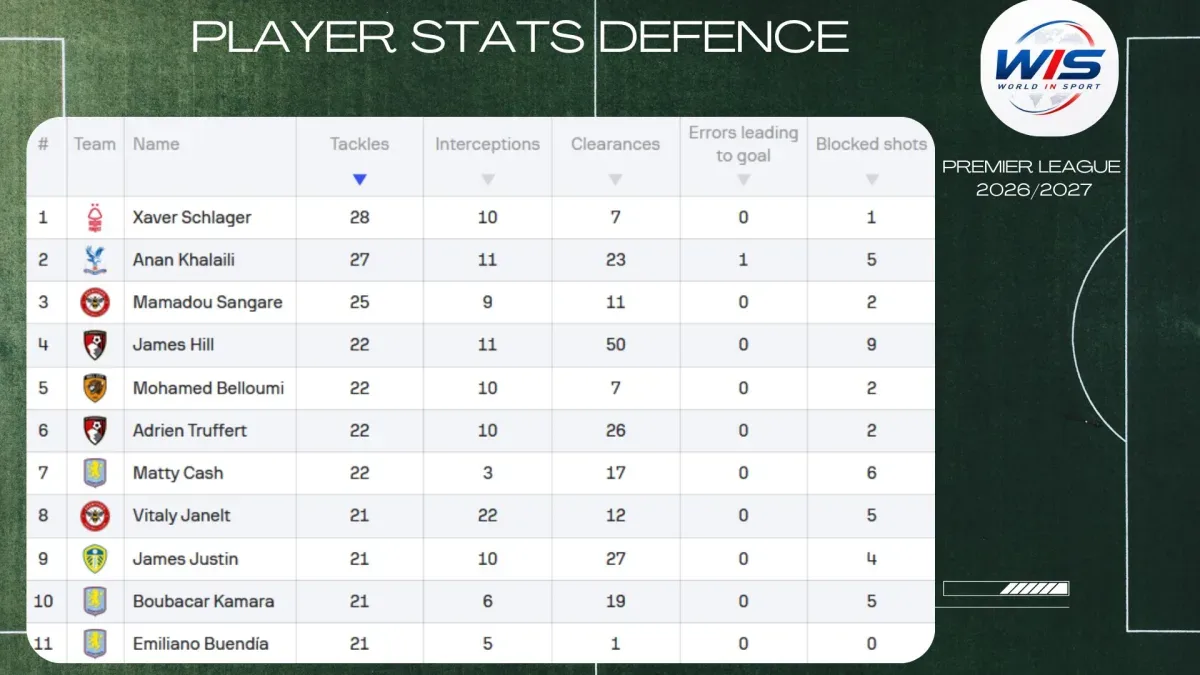
Having players like Matty Cash, Emi Buendía and Boubacar Kamara rated in the top 11 for total defensive actions (tackles, interceptions and clearances) usually indicates a team doesn’t have the ball and instead defends deep in their own half. Emi Buendía is an attacking midfielder, and being rated in the top 11 for defensive actions means Aston Villa’s midfield is bypassed too easily. Aston Villa is ranked second worst regarding winning the ball in the last third, meaning high up the pitch around the opponent’s penalty area. Instead of creating chances in the final third, Buendía is being dragged deep into his own half to help a struggling defence. As a result, the team has underperformed regarding Expected Goals (xG) and big chances created, ranking 17th. They are worst in the league regarding shots on goal per game and struggle with creative output. Aston Villa created only 14 big chances and is rated second-worst in the Premier League.
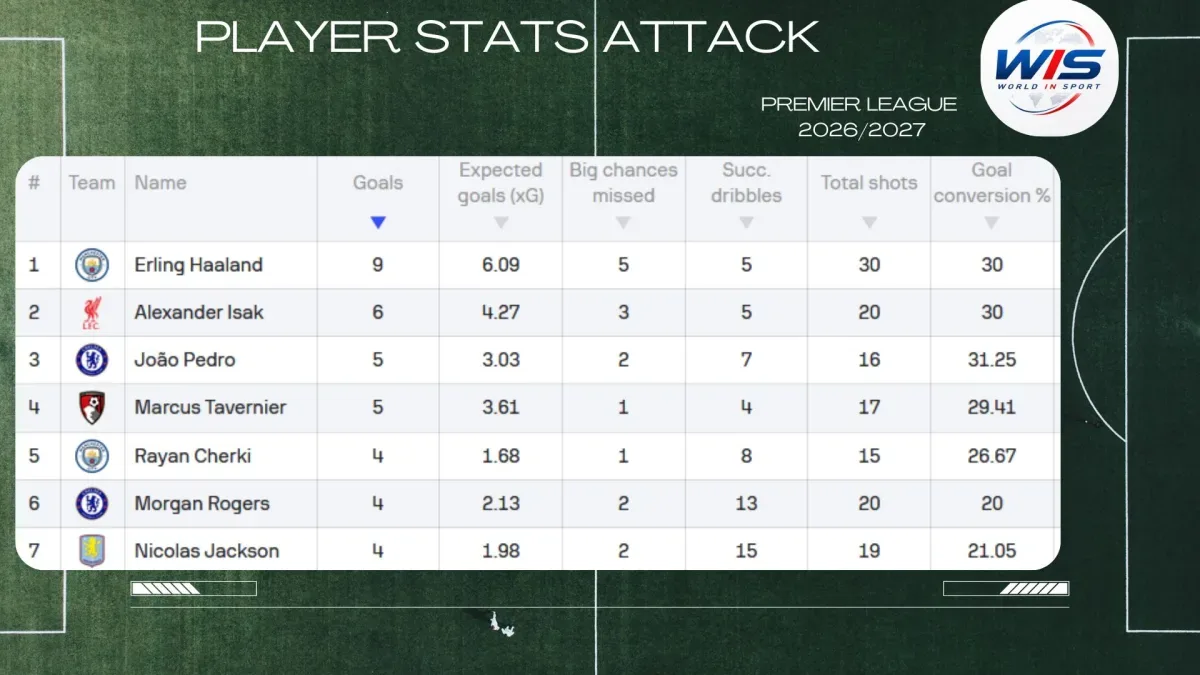
Nicolas Jackson is a key attacking player and qualifies for the top 7 in the Premier League with four goals and is best performing with 15 successful dribbles. While Jackson helped the team elevate the attack, the Premier League’s trend of man-marking challenged Villa’s offence. Opponents’ man-marking of Villa’s midfielders forced Emery to add more variations offensively, resulting in more vertical play directly to Jackson. Several of these vertical passes come from the new goalkeeper Zion Suzuki, who stands out with excellent vision and passing ability. Among the most important tactical trends in 2026, besides man-marking and possession-oriented goalkeepers, was the playmaking centre-back. Suzuki often engages in build-up play with quick passes to centre-back Victor Lindelöf, who is performing best at Aston Villa with 91 per cent accurate passes per match. He is also the second-best regarding accurate long balls.
In the end, these predictions are helpful to estimate a probability, not a certainty, and Aston Villa will most likely reach a top 6 position. With fewer injuries, Villa’s defence will strengthen and with increased squad depth, players can rotate more. This is crucial to compete in domestic and European competitions at the same time. Emery is also tactically flexible enough to adapt and find solutions to ongoing tactical trends – such as using Suzuki and Lindelöf to bypass the man-marking system. Emery is also an expert at European tournaments, which is useful in the Champions League. More importantly, beyond tactics, the psychological factor will be crucial. If Emery can fully elevate his underperformers into consistent high performers, he can once again disrupt the traditional super-clubs.
What do you think about Aston Villa’s new signings and chances this season?

World In Sport Forum
Continue the discussion
Join other fans in the World In Sport Forum and debate the biggest talking points from this article.