
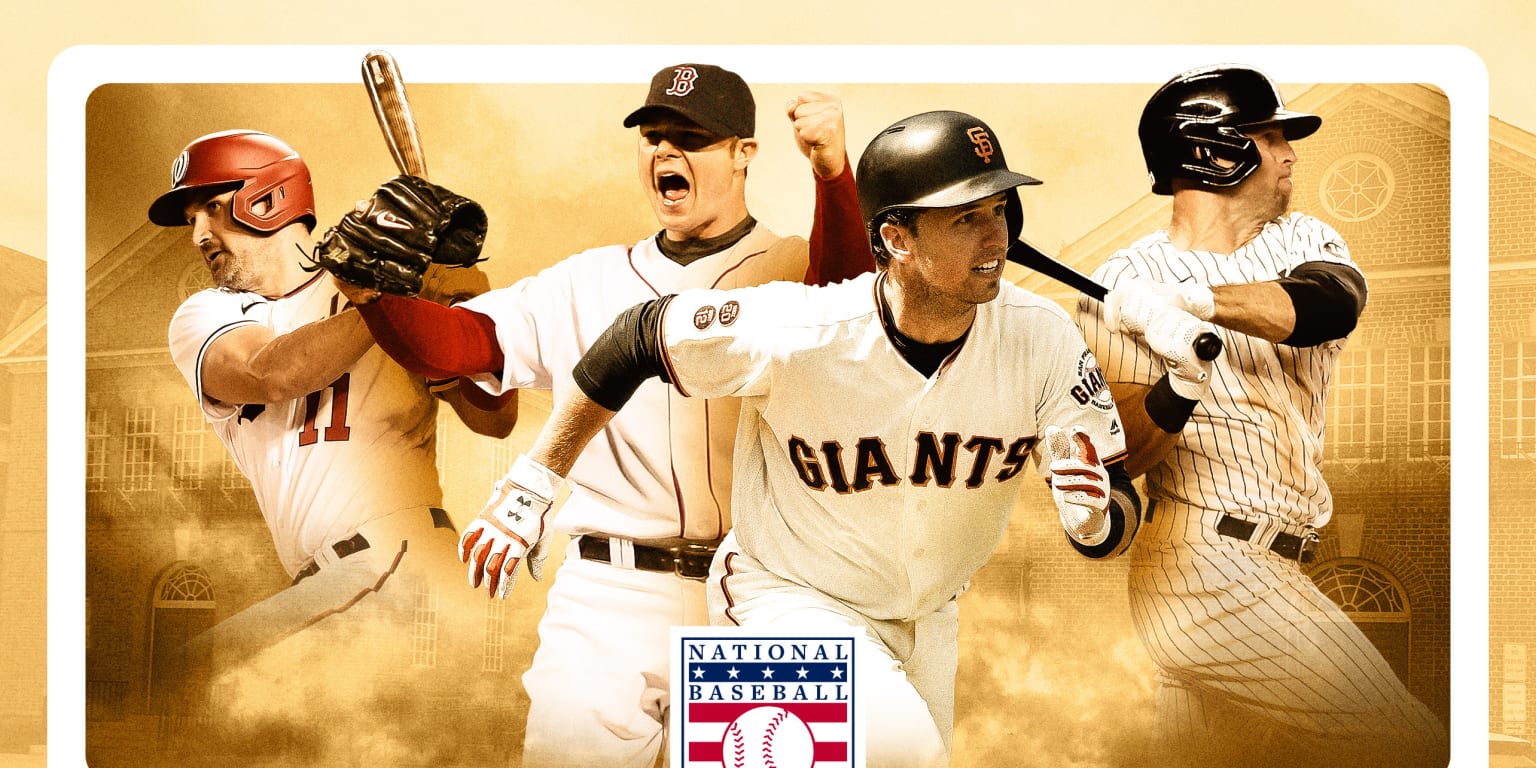
Since 2014, there have been 20 players elected to the Baseball Hall of Fame in their first year on the Baseball Writers’ Association of America ballot. Will anyone in this next class go straight from the ballot to the Hall?
The BBWAA unveiled its 2027 Hall of Fame ballot on Monday. It features 14 players making their ballot debut, a group headlined by three-time World Series champion and 2012 National League MVP Buster Posey.
2027 Hall of Fame coverage
• Here's the full 2027 Hall of Fame ballot
• Posey, Lester headline 14 ballot newcomers
• Hall of Fame case for: Arrieta | Gardner | Lester | Posey | Wright
• Everything you need to know about Baseball Hall of Fame voting
• Complete Hall of Fame coverage
Let’s use this space to appreciate all of the newcomers. Most of them are likely to go one and done by receiving less than 5% of the BBWAA vote, but that doesn’t make what they accomplished through at least 10 seasons in MLB any less impressive.
Here is a look at each first-timer on the 2027 Hall of Fame ballot, listed in descending order of career WAR per Baseball Reference.
BBWAA voters have until Dec. 31 to cast their ballots. The results will be announced Jan. 19 at 6 p.m. ET on MLB Network.
Buster Posey (45.0 WAR)
One of the best offensive catchers in baseball history, Posey achieved basically everything through 12 Major League seasons with the Giants. He was honored as the 2010 National League Rookie of the Year after hitting .305 with an .862 OPS in 108 games. His year got even better when the team won its first World Series championship since moving to San Francisco in 1958.
He bounced back from a devastating 2011 ankle injury to put together a remarkable season in 2012. His 7.6 WAR led all National League players, as did his .336 average, making Posey the first NL catcher to earn a batting title in 70 years. His 171 OPS+ tied for the third highest by a primary catcher in a single season during the Modern Era (since 1900).
It all added up to an MVP Award for Posey in 2012. He also earned his first of seven All-Star selections and his first of five Silver Slugger Awards that year, which concluded with another World Series title.
From 2012-17, Posey hit .311 with a .380 on-base percentage while playing the most physically demanding position in the sport. Among all players who played in at least 500 games during that span, those numbers rank fourth and ninth in MLB, respectively. He collected his third World Series ring with the Giants in 2014, and his work behind the plate was recognized with a Gold Glove in '16.
Posey had a couple of relatively mediocre years in 2018 and ‘19 before opting out of the shortened 2020 season. When he returned to the field in 2021, he appeared to still be in his prime at age 34 as he slashed .304/.390/.499 with a 140 OPS+ in 454 plate appearances for a Giants team that won a franchise-record 107 games. He looked like he had plenty left in the tank, but he decided instead to retire at the top of his game.
Posey finished his career with 1,500 hits, a .302 average and a .372 on-base percentage. His 129 OPS+ is tied with Hall of Famer Mickey Cochrane for fourth among primary catchers who played at least 1,000 games.
Brett Gardner (44.3 WAR)
Gardner made just one All-Star Team, earned one Gold Glove and rarely led his league in any statistical categories during his 14-year career with the Yankees.
But by WAR, the hard-nosed, speedy outfielder was one of the 15 best position players of the 2010s. He recorded at least 3.0 WAR in all but one of those years, and his 39.1 WAR during the decade was the 13th-highest in MLB, placing him just behind the likes of MVP-winning sluggers such as Josh Donaldson and Giancarlo Stanton.
A third-round Draft pick by the Yanks in 2005, Gardner came up to The Show in 2008. After winning the 2009 World Series, Gardner had his top season by WAR the following year. His 2010 stats included 97 runs, 47 stolen bases, a .383 on-base percentage and 7.4 WAR, which was seventh-best among all players that year. His defense in center and left field, which remained a plus for almost his entire career, played a big role in that total as well.
Gardner stole an AL-high 49 bases in 2011 and nabbed 274 bases during his time with New York. Only Hall of Famers Derek Jeter and Rickey Henderson had more stolen bases with the Yankees.
His only All-Star nod came in 2015 and was followed by that lone Gold Glove in ‘16. Although he was mostly a slap hitter, Gardner hit 21 homers in 2017 and topped out with 28 dingers in 2019, his age-35 season.
Jon Lester (43.4 WAR)
Lester’s career was already something special by the end of 2007, just his second season in the big leagues. He returned to baseball during the middle of the year after being diagnosed with and subsequently beating lymphoma. His year concluded with 5 2/3 scoreless innings and the win in the Game 4 clincher of the 2007 World Series versus the Rockies.
By 2008, the 24-year-old lefty was the Red Sox’s ace. He threw a no-hitter versus the Royals on May 19 that season and would go on to post a 3.64 ERA (120 ERA+) over nine seasons with Boston, which included another championship in 2013. Lester allowed only six earned runs over five starts (34 2/3 innings) during that postseason.
The left-handed workhorse made his third All-Star team in 2014 before Boston traded him to the A’s. He signed with the Cubs that offseason as a free agent and continued to be extremely reliable. From 2015-18, Lester pitched at least 180 innings every year, won 61 games, earned two more All-Star nods and, most famously, helped lead the Cubs to their long-awaited championship in 2016. He got Chicago to the Fall Classic after being named NLCS MVP against the Dodgers.
Once he wrapped up his career following stints in 2021 with the Nationals and Cardinals, Lester had 200 wins, a 3.66 ERA (117 ERA+) across 2,740 regular-season innings, 2,488 strikeouts and three World Series rings on his resume. In the Modern Era (since 1900), only four other left-handed pitchers have totaled that many wins, innings and K’s with at least a 117 career ERA+: Warren Spahn, Randy Johnson, Tom Glavine and Clayton Kershaw.
Ryan Zimmerman (40.1 WAR)
Today’s Washington Nationals came into existence in 2005. Zimmerman came right along with them as he was drafted fourth overall in June that year and debuted with the Nats on Sept. 1.
Over the next 16 seasons, Zimmerman would cement himself as “Mr. National.” He was a two-time All-Star, two-time Silver Slugger, a Gold Glove winner at third base in 2009 and part of the club’s lone World Series title team in 2019.
You could also call Zimmerman “Mr. Walk-Off,” as he is one of only 10 players with at least 11 walk-off home runs. Eight of the other nine players have been inducted in Cooperstown, and the only outlier is future Hall of Famer Albert Pujols. Likely his most memorable walk-off occurred against the Braves on March 30, 2008, in the first game at Nationals Park.
Zimmerman was at his peak in 2009 and ‘10. He combined 13.5 WAR in those two seasons, a .299/.375/.518 slash line, a 137 OPS+ and 130 extra-base hits. He hit at least 25 home runs in five different seasons, including a career-best 36 homers in 2017. He also picked up at least 30 doubles six times and had three 100-RBI seasons.
Even though injuries often hampered him in his 30s, and he opted out of the shortened 2020 season, Zimmerman’s 1,061 RBIs were the 15th-most in the Majors during his playing career.
Kyle Seager (37.0 WAR)
His nickname was “Corey’s Brother,” but Kyle enjoyed a stellar career all his own across 11 seasons with the Mariners. A third-round pick in the 2009 Draft, the elder Seager made it to the bigs in 2011 and quickly became a fixture at the hot corner in Seattle.
You can rely on his name being in the lineup almost every day; Seager played at least 154 games in all but one of his nine full seasons, and he played in all 60 games during the shortened 2020 season. Consistent power production came with that reliability, as Seager hit between 20 and 30 home runs every year from 2012-19. He then slugged a career-best 35 dingers with 101 RBIs in 2021 before announcing his retirement that winter.
Seager put together a 6.3-WAR season in 2014, the year of his lone All-Star selection and Gold Glove. He hit 25 homers and had a 127 OPS+ that summer. He followed that up with 5.3 WAR in 2015 and 6.9 WAR in ‘16. Only Mike Trout and Josh Donaldson had more WAR than Seager’s 18.5 over that three-year period.
As a Mariner lifer, Seager ranks among the franchise’s top five in runs, hits, extra-base hits and home runs. His 37.0 WAR trails only Ken Griffey Jr., Edgar Martinez, Ichiro Suzuki and Alex Rodriguez among Mariners position players.
Asdrúbal Cabrera (30.1 WAR)
Cabrera started to make a name for himself in the Majors in 2008 -- and not just because he turned an unassisted triple play in the middle of that season. From 2008-12 with Cleveland, Cabrera recorded at least 3.0 WAR in four of those five seasons. He was more known for his glove in those early years, but his bat really started to come to life in 2011, when he hit 25 home runs, had a 121 OPS+ and won a Silver Slugger Award. Up until that point, Cabrera had hit 18 homers through his first four Major League seasons.
Cabrera followed that up with his second All-Star selection in as many seasons and a 114 OPS+ in 2012. However, as his numbers started to slide on both sides of the ball, Cabrera was traded to the Nationals in 2014.
Cabrera played for seven different clubs between 2014-21, with his most productive stint coming with the Mets from 2016-18. He compiled a .279/.339/.464 slash line, 55 homers and a 117 OPS+ with New York. He began 2019 with the Rangers, but after being released in August, he returned to Washington and became an integral piece of the Nationals’ everyday lineup. Cabrera had a 147 OPS+ through 38 games with the Nats and helped them claim the first World Series title in club history.
Ervin Santana (27.0 WAR)
Santana was often reliable and at times great during his 16-season career. His best quality was his durability; the right-hander finished six seasons with at least 200 innings and three others with at least 175 innings. From his first full season in 2006 through '17, Santana's 2,249 2/3 innings were the sixth most in MLB. His overall performance during that time was only slightly better than league average (104 ERA+), but he turned in a few standout seasons.
In 2008 -- the year of his first All-Star selection -- Santana recorded a 3.49 ERA, 5.1 WAR and 214 strikeouts over 219 innings with the Angels. He finished with a sub-4.00 ERA while tossing more than 220 innings in 2010 and ‘11 as well. That latter season saw Santana throw a no-hitter in Cleveland on July 27.
After eight years with the Angels, Santana was traded to Kansas City in October 2012. He kept piling up quality innings as a Royal (3.24 ERA in 211 innings) before having a so-so season with the Braves in 2014.
Santana then enjoyed a bit of a career renaissance during his four seasons with the Twins. He joined the club prior to the 2015 season and produced a 3.32 ERA (130 ERA+) over nearly 400 innings from 2016-17. He also made his second All-Star team in 2017.
Jake Arrieta (22.7 WAR)
Arrieta’s career was at a crossroads in 2013. After four subpar seasons with the Orioles, he hoped that a midseason trade to the Cubs would offer a fresh start. Did it ever. With some mechanical and physical changes, Arrieta transformed into one of MLB’s top aces and put down one season that’s among the best in the game’s history.
Arrieta’s broke out in 2014, when he recorded a 2.53 ERA and a 0.99 WHIP in 156 2/3 innings. That was a preview of what was to come. In 2015, Arrieta posted a 1.77 ERA over 229 innings en route to earning the National League Cy Young Award. He allowed only four earned runs over his final 12 starts (88 1/3 innings), a stretch that included a 12-strikeout no-hitter against the Dodgers. His 215 ERA+ that year is tied for 15th among pitchers who have thrown at least 200 innings in a season in the Live Ball Era (since 1920).
Arrieta was stellar in 2016, a year in which he threw his second no-hitter and helped snap the Cubs’ 108-year championship drought. After another good year in ‘17, he joined the Phillies as a free agent ahead of the 2018 campaign and registered a 4.36 ERA across 64 starts in parts of three seasons. He split his final season in 2021 between the Padres and a reunion with the Cubs.
Although he had a relatively short peak, what Arrieta did in those few prime years will undoubtedly be remembered for generations on Chicago’s North Side.
Jay Bruce (19.7 WAR)
The lefty-swinging Bruce was one of the most consistent power hitters of his time. Want some proof? Through his first 10 seasons in the big leagues, he hit 20 or more home runs nine times. That’s something that only 28 players have accomplished in the Modern Era.
Bruce’s best years were with the Reds, who selected him 12th overall in the 2005 MLB Draft. He debuted in 2008 and hit 30 or more home runs each year from 2011-13. He netted two Silver Slugger Awards and two of his three All-Star nods during that period. He then hit 33 homers in 2016, which marked the end of his nine-year run with Cincinnati and the start of his time with the Mets following a midseason trade.
He hit 29 home runs in 103 games with New York in 2017 before he was traded to Cleveland that summer. He finished that season with a career-best 36 long balls. Bruce re-signed with the Mets that offseason before being included in a blockbuster trade between the Mets and Mariners in December 2018.
After stints with Seattle, Philadelphia and the Yankees, Bruce ended his 14-year career with 319 home runs, the eighth most among all players during his time in the league.
Pablo Sandoval (19.0 WAR)
Affectionately known as “Kung Fu Panda,” Sandoval was a central character in the Giants’ dynasty of the 2010s. During his first full season in 2009, the rotund third baseman batted .330, hit 25 home runs, tallied 4.3 WAR and finished seventh in the NL MVP voting.
After winning his first title with the Giants in 2010, Sandoval put together another banner year in 2011, highlighted by a strong .315/.357/.552 slash line with 52 extra-base hits in 117 games. Although a broken right hand forced him to miss six weeks that year, Sandoval’s career-best 6.0 WAR ranked fifth among NL position players.
Sandoval’s biggest contributions in 2012 came in October, when he posted a .364/.386/.712 slash line across 16 postseason games. He had a three-homer performance in Game 1 of the World Series against the Tigers and ended up hitting .500 (8-for-16) during San Francisco’s sweep of Detroit. Sandoval was named World Series MVP for his efforts.
Sandoval batted .366 during the 2014 postseason. That included three hits in World Series Game 7 against the Royals. He also caught the final out of that game, securing the Giants’ third title in five seasons.
Sandoval signed a five-year contract with the Red Sox as a free agent prior to the 2015 season, but after two-plus seasons dominated by injuries and underperformance, Sandoval was cut by Boston and ended up going back to San Francisco, where he played four more seasons. He spent parts of two seasons with the Braves at the end of his 14-year career.
Joakim Soria (18.6 WAR)
Soria racked up 229 saves while playing for nine teams over 14 big league seasons. He saved at least 15 games for four different clubs (Royals, Rangers, Tigers, White Sox), but his greatest years were his first five in the Majors while with Kansas City.
The right-hander recorded a 2.48 ERA and saved 17 games in 69 innings during his 2007 debut season. Over the next three years, Soria established himself as one of the top closers in MLB. From 2008-10, he pitched to a 1.84 ERA and a 1.01 WHIP across 186 innings. He converted 115 of his 124 save opportunities, earned two All-Star selections and exceeded 40 saves twice.
Although Soria wasn’t as effective in 2011, he still saved 28 games that season. His career reached an inflection point in 2012, when he underwent Tommy John surgery and missed the entire season. Soria moved on to the Rangers after signing with them as a free agent, and although he continued to put up solid numbers in the back half of his career, he couldn’t quite recreate his early success.
Starlin Castro (18.2 WAR)
At just 21 years old, Castro made history in his second MLB season in 2011. The Cubs shortstop led the National League that year with 207 hits, making him the youngest player to lead the Senior Circuit in hits. It was also the sixth-most hits from any player, age 21 or younger, in Major League history.
Castro’s consistently high batting average was the lead reason why he was a three-time All-Star by the end of his age-24 season in 2014. After one more season with Chicago, he was traded to the Yankees and saw an immediate uptick in his power production. After never topping 15 homers in any of his six seasons with the Cubs, Castro slugged 21 home runs in 2016 and 16 in ‘17, when he earned his fourth All-Star nod.
The Yankees then traded Castro to the Marlins in the deal that brought Giancarlo Stanton to the Bronx. In 2019, Castro’s second season with Miami, he bopped a career-best 22 home runs and played in all 162 games. He was extremely durable for the bulk of his career, playing in more than 150 games in seven of his first 10 seasons. Between 2011-19, Castro’s 1,345 games played were the fourth most in the bigs.
However, a hand injury marred his first season with the Nationals in 2020, and off-the-field issues in 2021 effectively ended his career after 12 seasons.
Wade Davis (10.3 WAR)
Davis was the best reliever on the Royals team that won the American League pennant in 2014 and the one that captured the World Series in ‘15. He was on the mound when Kansas City won the franchise’s first title in 30 years.
Over those two magnificent seasons, Davis recorded a 0.88 ERA and limited batters to a .427 OPS over 164 1/3 innings (postseason included).
He made the All-Star team in 2015 and again in '16, when he took over as the Royals’ full-time closer. He saved 27 games and posted a 1.87 ERA that year. He was traded to the Cubs that winter and then became an NL All-Star in his first year with Chicago. That featured a 2.30 ERA and 32 saves. His rate stats slipped while pitching for the Rockies in 2018, but his 43 saves were the most in the NL. Davis, Craig Kimbrel, Kenley Jansen and Edwin Díaz were the only four pitchers to notch at least 100 saves from 2016-18.
A third-round Draft pick by Tampa Bay in 2004, Davis made his big league debut five years later and was a serviceable starter for the first couple of seasons of his 13-year career. He finished fourth in the AL Rookie of the Year voting in 2010 after going 12-10 with a 4.07 ERA across 168 innings. He tossed 184 innings in 2011 before making all 54 of his appearances in 2012 out of the Rays’ bullpen.
He was part of a seven-player trade that landed him in Kansas City that winter. The Royals used Davis mostly as a starter in 2013, but they quickly discovered that his true calling was as a reliever. He retired after the 2021 season following a one-year reunion with Kansas City.
Andrew Miller (7.7 WAR)
Miller changed the game during his time. Instead of being a traditional one-inning reliever, he showed how valuable it was for any team to have a late-inning pitcher who could work multiple frames, and not necessarily including the ninth inning.
He debuted in the Majors less than three months after he was drafted by the Tigers with the sixth overall pick in 2006. His future then appeared to be as a starting pitcher, but his greatest successes would come as a shutdown reliever years later.
After posting a 5.70 ERA as a starter with the Tigers, Marlins and Red Sox, Miller was moved to the bullpen by Boston in 2012. One year later, he began a spectacular five-year stretch in which he was arguably the game’s best relief pitcher. From 2013-17, the left-hander recorded a 1.82 ERA over 297 appearances. Armed with a nearly unhittable slider and a mid-90s four-seamer, Miller struck out 469 batters over 291 2/3 innings and had a better than 5:1 strikeout-to-walk ratio during that span.
Miller was named the AL Reliever of the Year in 2015 after saving 36 games and having a 2.04 ERA with the Yankees. The next season, he earned his first of two All-Star selections, recorded a 1.45 ERA between the Yanks and Cleveland, and he had 123 K’s in 74 1/3 frames. He followed that with a 1.40 ERA over 10 appearances in Cleveland's run to the World Series. He was dominant again in ‘17, logging a 1.44 ERA over 62 2/3 innings.
Miller spent one more season with Cleveland before ending his 16-year career after three seasons with the Cardinals. He finished with a 4.03 career ERA, but it was just 2.95 as a reliever.