
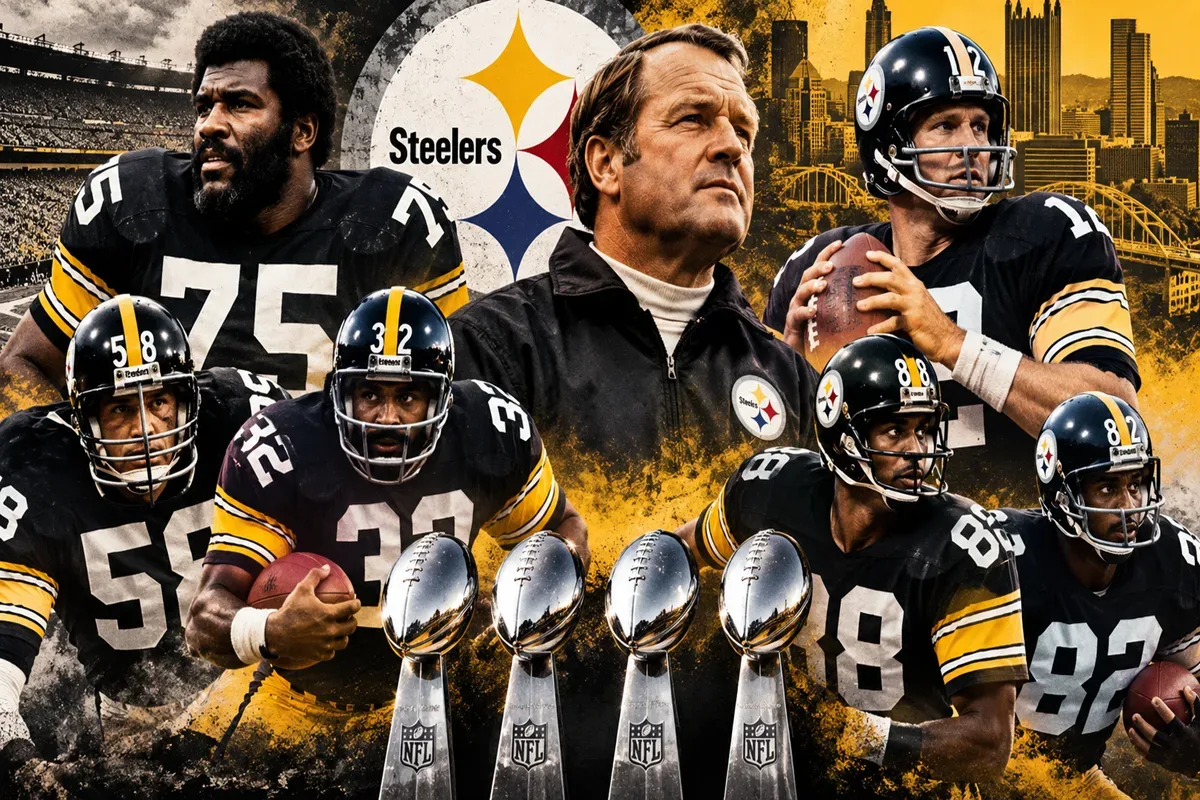
The Pittsburgh Steelers became the NFL’s defining team of the 1970s, winning four Super Bowls between 1974 and 1979. Their success was built through strong drafting, Chuck Noll’s coaching, the Steel Curtain defence, Franco Harris’s running and Terry Bradshaw’s development.
After playoff setbacks in 1976 and 1977, Pittsburgh evolved into a more balanced team. Bradshaw, Lynn Swann and John Stallworth strengthened the passing attack, allowing the Steelers to remain competitive as the league changed.
The Pittsburgh Steelers transformed themselves from a franchise without an NFL championship into the defining team of the 1970s.
Between the 1974 and 1979 seasons, Pittsburgh won four Super Bowls in six years. They became the first franchise to win three Super Bowls and then the first to reach four. They also became the first team to win back-to-back Super Bowls twice.
Yet the dynasty cannot be explained by championships alone. Pittsburgh combined elite drafting, patient coaching, a dominant defence, a powerful running game and an offence that became increasingly dangerous as Terry Bradshaw matured.
The Steel Curtain supplied the intimidating identity. Chuck Noll provided the structure. Joe Greene became the defensive cornerstone. Franco Harris gave the offence reliability, while Bradshaw, Lynn Swann and John Stallworth eventually turned a conservative attack into one capable of winning through the air.
The result was not simply one exceptional team. Pittsburgh evolved throughout six seasons while retaining enough of their core to keep winning.
For readers unfamiliar with the structure of the sport, World in Sport’s NFL positions explainer shows how defensive linemen, linebackers and defensive backs combine within a defence. The Steelers had exceptional players at all three levels.
Embed from Getty ImagesFrom struggling franchise to contender
Pittsburgh entered the NFL in 1933 but spent much of their early history outside championship contention.
Everything began to change after Noll became head coach in 1969.
The organisation committed to building through the draft rather than searching for short-term fixes. Joe Greene arrived with the fourth overall pick in 1969. Terry Bradshaw and Mel Blount followed in 1970. Jack Ham joined in 1971, while Franco Harris arrived in 1972.
That accumulation of talent mattered more than any single tactical innovation.
The Steelers won their first division championship in 1972. Harris then produced the Immaculate Reception against the Oakland Raiders, giving Pittsburgh their first postseason victory.
They were no longer an irrelevant franchise.
However, reaching the playoffs was different from controlling them. Pittsburgh still had to overcome established AFC opponents such as Oakland and Miami.
By 1974, the pieces were finally in place.
The 1974 draft changed everything
Few draft classes in NFL history have influenced one team as dramatically as Pittsburgh’s 1974 group.
The Steelers selected wide receiver Lynn Swann in the first round, linebacker Jack Lambert in the second, receiver John Stallworth in the fourth and centre Mike Webster in the fifth.
All four later entered the Pro Football Hall of Fame.
Pittsburgh also signed safety Donnie Shell as an undrafted rookie. He too eventually reached Canton.
The Pro Football Hall of Fame’s 1974 draft record confirms that Swann, Lambert, Stallworth and Webster became Hall of Famers. Shell is listed among the year’s undrafted Hall of Fame players.
Those additions strengthened virtually every area of an already improving roster.
It remains an extraordinary example of roster construction.
Pittsburgh did not simply draft four famous names in one year. They found foundational players who suited the team they were building.
Lambert brought range and aggression at middle linebacker. Swann and Stallworth eventually transformed the passing game. Webster became an enduring presence at centre. Shell developed into an important member of a formidable secondary.
The draft accelerated Pittsburgh’s transition from contender to champion.
1974: The first championship
The first Super Bowl season was far less straightforward than the later mythology might suggest.
Pittsburgh went 10-3-1, but uncertainty at quarterback followed them through much of the regular season. Joe Gilliam started the first six games before Noll turned to Bradshaw. Terry Hanratty also received a start before Bradshaw regained the job for good late in the season.
The rest of the team gave him room to develop.
Pittsburgh allowed only 189 regular-season points and leaned heavily on Harris and the running game. The defence generated turnovers and controlled opponents without asking the offence to win every game through the air.
The postseason showed what the team had become.
Pittsburgh beat Buffalo 32-14 before travelling to Oakland for the AFC Championship Game. The Steelers defeated the Raiders 24-13 and advanced to their first Super Bowl.
Minnesota awaited in Super Bowl IX.
The Vikings scored only six points.
Pittsburgh won 16-6 at Tulane Stadium in New Orleans, with Harris rushing for 158 yards and earning Super Bowl MVP honours.
The franchise that had spent decades without a championship finally had one.
More importantly, the Steelers had discovered a sustainable formula.
Why the Steel Curtain defence worked
The name Steel Curtain originally referred most directly to Pittsburgh’s defensive front, particularly Greene, L.C. Greenwood, Dwight White and Ernie Holmes.
Over time, however, the phrase became shorthand for the entire Pittsburgh defence.
That wider interpretation makes sense because the Steelers were far more than a dominant defensive line.
Greene controlled the interior. Greenwood created problems from defensive end. Lambert and Ham gave Pittsburgh exceptional linebackers behind them.
Then came the secondary.
Blount developed into one of the era’s defining cornerbacks. Shell strengthened the back end, while players such as Mike Wagner also made important contributions.
Each level supported the others.
Pressure from the defensive front reduced the time opposing quarterbacks had to throw. Strong linebacker play restricted the running game and underneath routes. Physical coverage made receivers work for space.
Modern fans following World in Sport’s NFL rules guide will recognise how differently pass coverage operates today. Before the NFL’s 1978 rule changes, defensive backs had greater freedom to make contact with receivers, and Blount became especially effective within that environment.
Pittsburgh’s greatness still went beyond physicality.
Their defenders understood assignments, tackled well, and repeatedly created favourable field position for the offence.
They could dominate a match even when Pittsburgh’s passing game struggled.
Embed from Getty Images1975: Champions again
If 1974 proved Pittsburgh could reach the summit, 1975 showed they could stay there.
The Steelers improved to 12-2 and won 11 consecutive games during the regular season.
Their defence remained one of the NFL’s strongest, while the offence became more stable around Bradshaw.
Pittsburgh defeated the Baltimore Colts 28-10 in the divisional round. Another meeting with Oakland followed.
The rivalry had become one of the central battles of the AFC.
Pittsburgh prevailed 16-10 and returned to the Super Bowl, where the Dallas Cowboys presented a different challenge.
Super Bowl X remained tight into the fourth quarter.
Swann produced one of the great receiving performances in Super Bowl history. His acrobatic catches stretched Dallas vertically and gave Bradshaw a target capable of changing the game with one play.
Their decisive connection came on a 64-yard touchdown.
Pittsburgh won 21-17.
Two championships in two years established the Steelers as the NFL’s leading power, but the next two seasons also demonstrated how fragile sustained dominance could be.
The six-season dynasty at a glance
| Season | Regular-season record | Postseason finish |
|---|---|---|
| 1974 | 10-3-1 | Won Super Bowl IX |
| 1975 | 12-2 | Won Super Bowl X |
| 1976 | 10-4 | Lost AFC Championship Game |
| 1977 | 9-5 | Lost divisional round |
| 1978 | 14-2 | Won Super Bowl XIII |
| 1979 | 12-4 | Won Super Bowl XIV |
The Steelers’ official history of the 1970s records all four championship runs along with the playoff defeats in 1976 and 1977. That two-year interruption is important when assessing the dynasty because Pittsburgh did not move uninterrupted from one title to the next.
They had to adapt.
1976: Perhaps the defence at its most dominant
Pittsburgh opened the 1976 season 1-4.
For a defending back-to-back champion, the start threatened to end the dynasty almost as quickly as it had begun.
Instead, the Steelers won their final nine regular-season games and captured another AFC Central title at 10-4.
The defence drove the recovery.
Pittsburgh conceded only 138 points across the 14-game season, fewer than 10 per match on average. During their season-ending nine-game winning streak, the Steelers allowed only 28 points and recorded five shutouts, all of them across the final eight games.
It was arguably the purest expression of the Steel Curtain identity.
Opponents struggled to establish the run. Passing situations allowed Pittsburgh’s front to attack quarterbacks, while the secondary capitalised on hurried decisions.
The Steelers then overwhelmed Baltimore 40-14 in the divisional round.
A third consecutive Super Bowl appeared possible.
Injuries changed the equation.
Harris and Rocky Bleier were unavailable for the AFC Championship Game against Oakland. Without their established backfield, Pittsburgh lost 24-7.
The defeat also illustrates an important point about the dynasty.
Defence was its foundation, but even an exceptional defence could not permanently compensate for injuries or an offence unable to control possession.
1977 exposed signs of vulnerability
Pittsburgh still won the AFC Central in 1977, but their 9-5 record reflected a less imposing season.
The defence conceded 243 points, a sharp rise from the 138 allowed a year earlier.
The Steelers remained talented enough to reach the postseason, but they no longer overwhelmed opponents every week.
Denver ended their season with a 34-21 divisional-round victory.
For the first time since the championship breakthrough, Pittsburgh had gone consecutive seasons without reaching the Super Bowl.
A lesser team might have interpreted that as the closing of its championship window.
Instead, the Steelers evolved.
That adjustment became crucial because professional football itself was changing. Passing was becoming increasingly important, and Pittsburgh possessed the players to take advantage.
Bradshaw no longer needed to function mainly as the quarterback of a defence-led team.
He could become one of its principal weapons.
1978: Bradshaw and the offence take control
The NFL expanded its regular season from 14 to 16 games in 1978.
Pittsburgh responded with a 14-2 record, the best of the Noll era to that point.
The Steel Curtain remained formidable. The Steelers allowed 195 points, the fewest in the league.
The bigger development came on offence.
Bradshaw threw 28 touchdown passes during the regular season. Swann and Stallworth offered two elite downfield receivers, while Harris remained a major presence in the running game.
This changed how opponents had to approach Pittsburgh.
Earlier championship teams could win while protecting the quarterback and relying on defence, field position and rushing volume.
The 1978 Steelers could attack vertically.
Denver lost 33-10 in the divisional round before Pittsburgh dismantled Houston 34-5 in the AFC Championship Game.
That set up another Super Bowl against Dallas.
Super Bowl XIII became one of the defining games of the dynasty because Pittsburgh could not simply suffocate the opposition.
Dallas scored 31 points.
The Steelers scored 35.
Bradshaw threw four touchdown passes as Pittsburgh demonstrated that their championship identity had expanded beyond the Steel Curtain.
They were the first franchise to win three Super Bowls.
Embed from Getty Images1979: One final championship statement
Defending the title again required another adjustment.
Pittsburgh went 12-4 in 1979. The defence was still strong, but it no longer produced the historically low scoring totals of 1976 or 1978.
The offence compensated.
The Steelers scored 416 regular-season points, the highest total in the league.
That balance made the final championship team different from the first.
In 1974, Pittsburgh’s defence protected an unsettled quarterback situation.
By 1979, Bradshaw was an established championship quarterback with Swann and Stallworth threatening defences downfield.
Pittsburgh beat Miami 34-14 in the divisional round and Houston 27-13 for the AFC title.
The Los Angeles Rams then pushed them hard in Super Bowl XIV.
Los Angeles entered the fourth quarter ahead 19-17.
Pittsburgh responded through the passing game that had developed alongside its famous defence. Bradshaw connected with Stallworth for a 73-yard touchdown that restored the lead.
The Steelers eventually won 31-19.
Four championships had arrived within six seasons.
No previous NFL franchise had won four Super Bowls.
Chuck Noll’s greatest achievement was development
The easiest way to explain the dynasty is to list the Hall of Fame players.
That does not fully explain why they succeeded together.
Noll created an environment in which development mattered.
Pittsburgh’s roster was overwhelmingly constructed rather than assembled through headline acquisitions. The organisation identified players who fitted its approach, coached them and gave them defined roles.
Noll also allowed the team to change.
The offence of 1974 did not look like the offence of 1979. Bradshaw developed from an inconsistent quarterback who briefly lost his starting position into the central figure of a championship passing attack.
Swann and Stallworth matured beside him.
Webster developed into the foundation of the offensive line.
Lambert quickly became the centre of the defence.
The Steelers did not abandon their identity as they evolved. They added layers to it.
That distinction separated Pittsburgh from teams built around one exceptional season.
Greene was the cornerstone of the Steel Curtain
Several Steelers could claim to represent the dynasty, but Greene came closest to embodying its transformation.
He arrived with Noll in 1969 and became the central figure of the rebuilt defence.
His influence was both tactical and cultural.
As a defensive tackle, Greene could disrupt plays from the middle rather than simply occupying blockers. His presence made life easier for Pittsburgh’s defensive ends and linebackers.
He was also there before the championships.
That matters.
Bradshaw, Harris, Lambert, Swann and Stallworth joined a developing organisation. Greene experienced the transition from the 1-13 team of Noll’s first season to four-time Super Bowl champions.
His career therefore traces almost the entire rise.
The Steel Curtain nickname may describe a unit, but Greene was its foundation.
Why the dynasty still stands apart
Championship totals alone never tell the full story of a dynasty.
Pittsburgh’s six-season run included two years without a Super Bowl appearance. The Steelers endured quarterback uncertainty, major injuries, changes to the league’s passing environment and playoff defeats.
They survived because the roster was deeper than one tactical idea.
When the passing game needed time to mature, the defence carried more responsibility.
As the NFL changed its rules to encourage the passing game, Bradshaw, Swann and Stallworth gave Pittsburgh the ability to stretch the field.
When the Steelers needed to control games, Harris remained available to carry the running attack.
That flexibility explains why the 1974 and 1979 champions could feel distinctly different while still belonging to the same dynasty.
The first championship team brought the Steel Curtain to the Super Bowl stage.
The final championship team proved Pittsburgh were much more than the Steel Curtain.
Four Super Bowls in six seasons created the headline. The deeper achievement was keeping a championship core together long enough for that core to change with the league around it.

World In Sport Forum
Continue the discussion
Join other fans in the World In Sport Forum and debate the biggest talking points from this article.