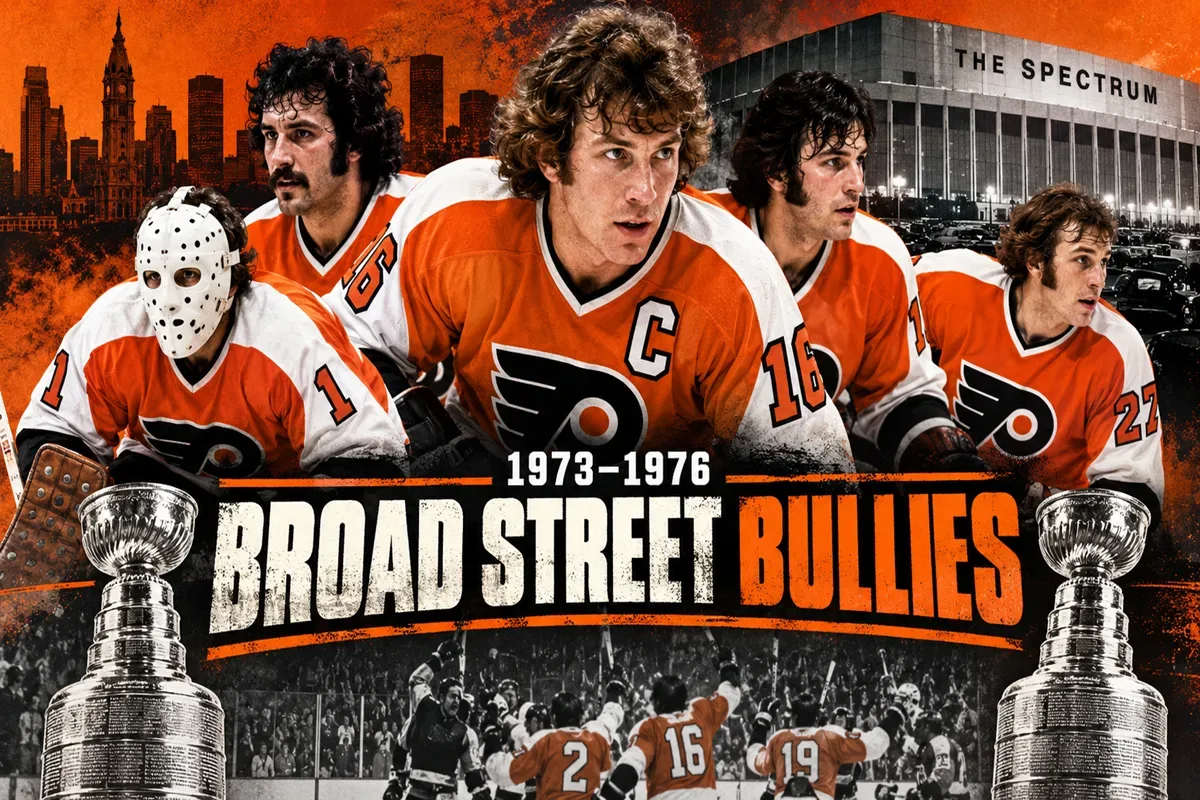
The Philadelphia Flyers became one of the NHL’s defining teams between 1973 and 1976. They won consecutive Stanley Cups, reached three straight Finals and built an identity that remains inseparable from the franchise more than half a century later.
They became known as the Broad Street Bullies, a name that captured their aggression but only partly explained their success.
Philadelphia could intimidate opponents. They also had an outstanding captain in Bobby Clarke, elite goaltending from Bernie Parent, scoring across several lines and a coach in Fred Shero who demanded structure as well as physical commitment.
The results were substantial. The Flyers collected 112 points in 1973/74, 113 in 1974/75 and a franchise-record 118 in 1975/76. They won the Stanley Cup in the first two seasons before the Montreal Canadiens stopped their attempt at a third consecutive championship.
For readers exploring other teams that shaped their eras, World in Sport’s Classic Teams archive covers championship sides from across sport.
The wider NHL coverage follows the league’s history and modern competition.
Embed from Getty ImagesHow the Broad Street Bullies emerged
The Flyers had entered the NHL in 1967 as part of the league’s six-team expansion.
Early results were modest. Philadelphia reached the playoffs in their first season but still needed an identity that could separate them from the established NHL powers.
That began to develop under Shero.
Physical hockey became central to the Flyers’ approach. Opponents could expect pressure along the boards, aggressive forechecking and players willing to fight when games became confrontational.
The reputation soon acquired a name.
The Philadelphia Bulletin used “The Broad Street Bullies” in a headline on 3 January 1973. Broad Street was home to the Spectrum, while the “Bullies” description reflected the increasingly confrontational character of the team.
Yet focusing only on fighting risks missing the quality developing underneath it.
Clarke had already become one of the NHL’s leading centres. He won the Hart Trophy as league MVP in 1972/73 and combined scoring with relentless defensive work, face-off strength and leadership. He would win the award again in 1974/75 and 1975/76.
Bill Barber added speed and goals from the wing. Rick MacLeish gave Philadelphia another dangerous centre. Gary Dornhoefer, Ross Lonsberry, Bob Kelly and Don Saleski supplied depth and physical pressure.
Dave Schultz represented the most uncompromising part of the team’s identity, but he was not simply surrounded by other enforcers.
Philadelphia were building a complete contender.
The decisive addition came before the 1973/74 season.
Parent returned to Philadelphia in June 1973 after spells with Toronto Maple Leafs and the Philadelphia Blazers of the World Hockey Association. The Flyers sent Doug Favell and a first-round draft choice to Toronto, receiving Parent and a second-round pick.
It transformed their ceiling.
Three seasons at the top
Across these three years, Philadelphia never finished with fewer than 112 points and never failed to reach the Stanley Cup Final. The official NHL season records show how sustained that level became.
| Season | Regular-season record | Points | Playoff result |
|---|---|---|---|
| 1973/74 | 50-16-12 | 112 | Won Stanley Cup, beat Boston 4-2 |
| 1974/75 | 51-18-11 | 113 | Won Stanley Cup, beat Buffalo 4-2 |
| 1975/76 | 51-13-16 | 118 | Lost Stanley Cup Final, Montreal won 4-0 |
The records also challenge the idea that intimidation alone carried the Flyers.
This was a team capable of winning in different ways.
The 1973/74 Flyers make history
Philadelphia entered 1973/74 ready to move from dangerous contender to championship team.
Parent immediately supplied the elite goaltending they had been missing. He recorded 47 victories, a 1.89 goals-against average and 12 shutouts during the regular season. The Flyers finished 50-16-12 for 112 points.
Clarke led the team with 87 points from 35 goals and 52 assists. Philadelphia also had four 30-goal scorers.
That attacking depth mattered because the Flyers were never dependent on a single method of winning.
They could grind games down. They could pressure opponents into mistakes. They could also score.
Philadelphia swept the Atlanta Flames in four games in the opening playoff round before facing the New York Rangers.
The Rangers represented an important test. No club from the NHL’s 1967 expansion group had previously eliminated an Original Six side in a playoff series.
Philadelphia won in seven games.
That sent the Flyers into the Stanley Cup Final against the Boston Bruins. A team featuring some of the league’s most established stars and one that had finished one point ahead of Philadelphia during the regular season.
Boston also held a significant psychological advantage.
Philadelphia had not won at Boston Garden since November 1967. Their subsequent visits before the 1974 Final had brought 16 defeats and two ties.
The pattern finally changed in Game 2.
Clarke scored twice, including the overtime winner, as Philadelphia took a road victory that altered the series.
From there, the Flyers increasingly made the Final their kind of contest.
They returned to the Spectrum with a 3-2 series lead for Game 6. MacLeish scored a first-period power-play goal. Parent stopped all 30 Boston shots.
Philadelphia won 1-0.
They had become the first of the NHL’s 1967 expansion clubs to win the Stanley Cup. Parent received the Conn Smythe Trophy after going 12-5 with a 2.02 goals-against average during the postseason.
The NHL’s championship record documents Philadelphia’s path through Atlanta, New York and Boston.
Embed from Getty ImagesBernie Parent provided the foundation
The Broad Street Bullies nickname naturally directs attention towards the skaters.
Parent was arguably the indispensable player.
Philadelphia could take risks because an elite goaltender stood behind them. Parent’s positioning and consistency gave Shero a foundation that aggression alone could never provide.
He won the Vezina Trophy in both championship seasons. More importantly, he produced his best work when the Stanley Cup was at stake.
The 1974 clincher against Boston was a shutout.
One year later, he did it again.
He became the first player to win consecutive Conn Smythe Trophies and the first goaltender to post shutouts in consecutive Stanley Cup-clinching games.
That level of goaltending changes how the Bullies should be remembered.
Philadelphia were feared because of their physical play. They became champions because that physicality operated alongside exceptional performance in the crease.
The 1974/75 team became even harder to beat
Defending the championship brought a different challenge.
Philadelphia now had a target on them every night.
They responded by going 51-18-11 and collecting 113 points.
Their reputation for physical hockey also intensified.
The Flyers accumulated 1,967 penalty minutes, comfortably the highest total in the NHL. Schultz accounted for 472 of them. That remains the NHL single-season record for an individual player.
Those numbers explain why opponents viewed trips to Philadelphia differently.
The Spectrum could become hostile quickly. The Flyers wanted opponents thinking about the next collision as well as the next pass.
However, the aggression worked because Philadelphia had enough skill to punish teams that became distracted by it.
Reggie Leach strengthened that element after arriving from the California Golden Seals in a May 1974 trade. He joined Clarke and Barber to form the LCB line, which would become one of the defining combinations of the era.
Clarke won his second Hart Trophy in 1975.
Parent again gave the Flyers elite goaltending.
Philadelphia then swept Toronto Maple Leafs to begin the playoffs.
The New York Islanders presented a far more dangerous problem.
Philadelphia won the first three games of their semi-final and appeared to have control. The Islanders then won three straight to force Game 7, threatening to overturn a 3-0 series deficit for the second consecutive round.
The Flyers stopped the comeback emphatically.
Dornhoefer scored after only 19 seconds before MacLeish completed a hat-trick in a 4-1 victory at the Spectrum.
Buffalo Sabres waited in the Stanley Cup Final.
This was the first Final contested by two clubs created during the NHL’s expansion era.
Buffalo recovered from losing the opening two games and levelled the series at 2-2. Philadelphia then won Game 5 at home.
Game 6 became another showcase for Parent.
Bob Kelly scored 11 seconds into the third period. Bill Clement later added another goal. Parent stopped everything Buffalo sent towards him.
The Flyers won 2-0 and retained the Stanley Cup.
Parent recorded four shutouts during the 1975 playoffs and finished with a 1.89 goals-against average. He again won the Conn Smythe Trophy.
Philadelphia had moved beyond proving that 1974 was possible.
They had confirmed it was repeatable.
Why Philadelphia were more than a fighting team
The penalty totals became the most visible statistic of the Broad Street Bullies era.
They should not become the only one.
Philadelphia’s intimidation worked within a broader system.
Clarke drove the centre of the ice. Barber supplied goals from the left. Leach developed into a devastating finisher from the right. MacLeish gave Shero another high-level attacking option, while the supporting forwards could forecheck relentlessly.
The defence also mattered.
Jimmy Watson became a regular All-Star. Joe Watson, André Dupont and Ed Van Impe gave the Flyers size and resilience around their own net.
Most importantly, the roster understood its identity.
Physical pressure was not separate from the hockey. Philadelphia used contact to reduce space, disrupt puck movement and make opponents alter decisions.
That approach came with obvious costs.
The Flyers spent extraordinary amounts of time in the penalty box. Their fighting and intimidation also ensured they became one of the most polarising teams in NHL history.
Modern hockey operates under different rules, officiating standards and expectations.
World in Sport’s guide to NHL rules, penalties and scoring explains how the present game is structured.
Judging the 1970s Flyers only by modern tactical standards would therefore remove part of the historical context.
Within their own era, Philadelphia found a competitive advantage and surrounded it with elite players.
The 1975/76 Flyers reach their offensive peak
Philadelphia entered 1975/76 chasing something even bigger: a third consecutive Stanley Cup.
Their regular season suggested they were capable of achieving it.
The Flyers finished 51-13-16 and collected 118 points, which remains the highest total in franchise history. They scored 348 goals, the most in the NHL.
Their leading players produced remarkable numbers.
Clarke recorded 119 points and won his third Hart Trophy. Barber scored 50 goals and finished with 112 points.
Leach went further.
He scored 61 regular-season goals, still a Flyers single-season record and finished with 91 points. Philadelphia had eight players with at least 20 goals.
This was not merely a team surviving through intimidation.
It had become one of the league’s most potent attacks.
The problem was that Parent could not reproduce his previous workload.
A neck injury required surgery and limited him to only 11 regular-season appearances. Wayne Stephenson therefore took over the majority of the goaltending duties.
Philadelphia still kept winning.
Beating the Soviet Red Army
One game during that season carried significance far beyond the NHL standings.
CSKA Moscow, commonly known in North America as the Soviet Red Army team, visited the Spectrum on 11 January 1976 during a tour against NHL opposition.
The Soviet side had already beaten New York Rangers 7-3, drawn 3-3 with Montreal and defeated Boston 5-2.
Philadelphia were their final opponent.
The contrast in styles made the occasion particularly compelling. CSKA represented a highly organised passing system built through extensive collective training. Philadelphia represented the reigning NHL champions and a far more direct, physical North American style.
The Flyers won 4-1.
The match also contained one of its most controversial moments when Van Impe hit Soviet forward Valeri Kharlamov. No penalty followed. CSKA left the ice before returning after a 17-minute interruption.
The Flyers’ official account of the Soviet Red Army game records the circumstances surrounding one of the era’s most memorable international club contests.
For Philadelphia, the result reinforced something their two Stanley Cups had already demonstrated.
The Bullies could play.
Embed from Getty ImagesMontreal end the pursuit of a third Cup
Philadelphia’s third consecutive playoff run proved more difficult.
Toronto pushed the Flyers to seven games in the quarter-finals. Philadelphia recovered to win Game 7 7-3.
They then defeated Boston 4-1 in the semi-finals.
Another Stanley Cup Final awaited.
This time the opponent was Montreal.
The Canadiens were beginning a period of dominance of their own. They had finished the regular season 58-11-11 for 127 points, nine more than Philadelphia.
The Flyers could not extend the Final.
Montreal swept the series 4-0 and completed the championship with a 5-3 victory at the Spectrum on 16 May 1976. The result denied Philadelphia a third successive Stanley Cup and began the Canadiens’ own run of four consecutive championships.
World in Sport has examined that next phase in Montreal Canadiens 1975–79: Four Straight Stanley Cups.
There was one extraordinary Philadelphia achievement even in defeat.
Leach scored 19 goals during the playoffs, setting an NHL single-postseason record. He received the Conn Smythe Trophy despite playing for the losing finalists.
He remains the only skater from a losing team to win the award.
It was an appropriate final statement from this particular three-year run.
Even when Philadelphia lost the championship, one of their players still produced the postseason’s outstanding individual performance.
The legacy of the Broad Street Bullies
The 1976 defeat ended Philadelphia’s reign as Stanley Cup champions, but it did not immediately end their place among the NHL’s elite.
The Flyers reached at least the Stanley Cup semi-finals in six consecutive seasons from 1973 through 1978.
The 1973–76 period remains the centre of that history.
Two Stanley Cups tell part of the story. Three consecutive Finals tell more. The emergence of Clarke, Parent, Barber and Leach explains why the achievements cannot be reduced to violence.
The fighting mattered. So did the forechecking, depth, scoring and goaltending.
Shero assembled those elements into a team that opponents could neither ignore nor comfortably imitate.
Philadelphia also changed expectations for the NHL’s newer franchises. Only seven seasons after entering the league, the Flyers had broken through the established order and lifted the Stanley Cup.
A year later, they did it again.
By 1976, Montreal had found the answer and a new dynasty was beginning.
The Broad Street Bullies had already secured their place in NHL history.

World In Sport Forum
Continue the discussion
Join other fans in the World In Sport Forum and debate the biggest talking points from this article.