
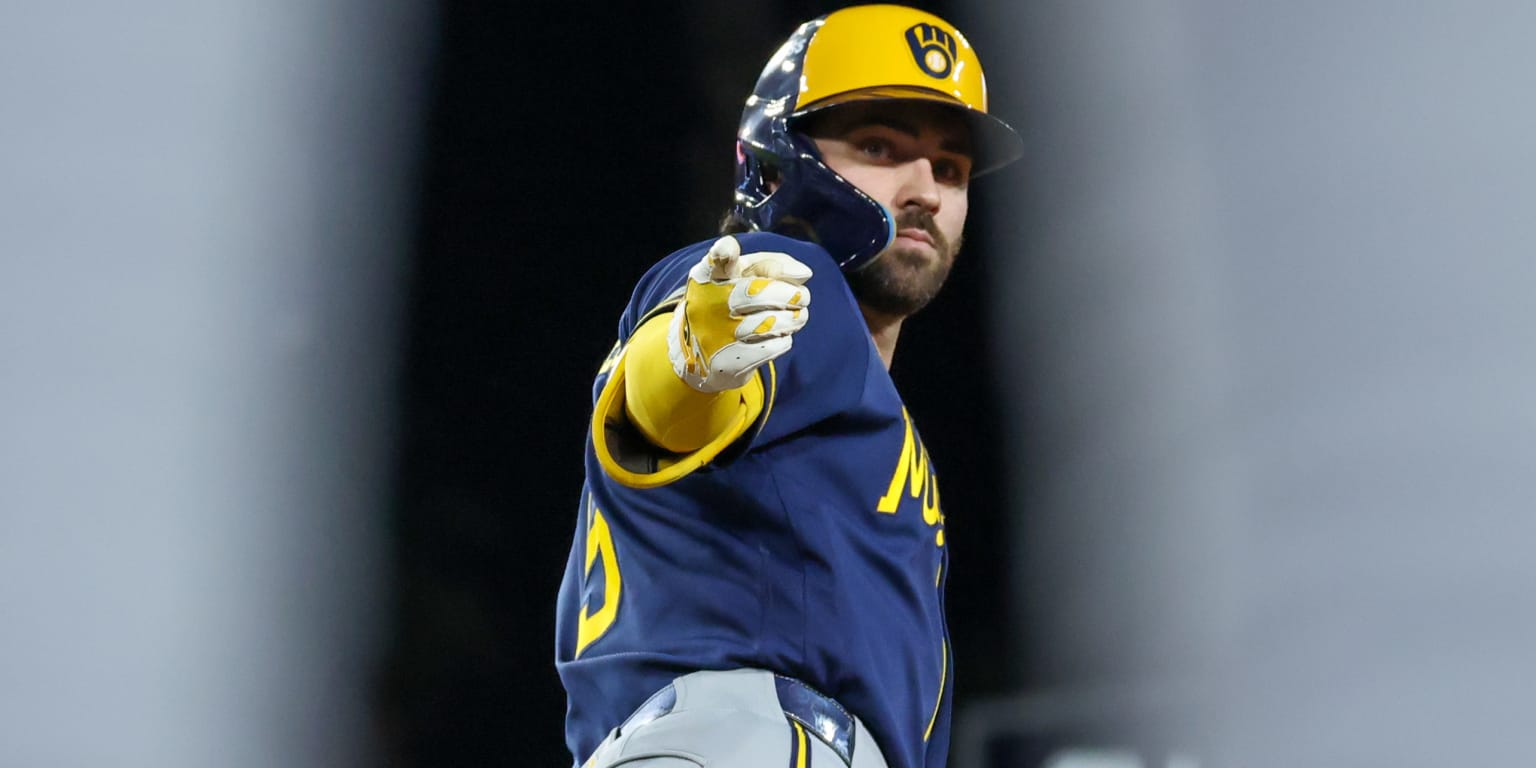
MILWAUKEE – As his dad sees it, Garrett Mitchell was waiting for his moment in Game 4 of the National League Championship Series since he was 9 years old and diagnosed with Type 1 Diabetes.
Ever since, there have been people who doubted that Mitchell could stay healthy enough, long enough, to handle the rigors of center field for a season that stretches 162 games, and, for the pennant-winning Brewers, well beyond. But he’s played more games this year than his first four years combined, and he was plenty healthy enough on Thursday night to deliver the tiebreaking solo home run that sent the Brewers from four runs down in the early innings to a victory and a trip to the World Series.
“Growing up, he’s always one that his chip, his edge, his grit, was proving people wrong,” said Antony Mitchell, Garrett’s dad. “I told him, ‘It’s time to make the big shift.' That’s what he’s doing right now.”
Mitchell had two hits in the NLCS, a 4-0 Brewers sweep of the two-time defending World Series champion Dodgers. He made them count. In Game 3 on Wednesday, he followed Jake Bauers’ go-ahead, 11-pitch, two-run homer with a solo shot for the third set of back-to-back homers for left-handed hitters off a left-handed pitcher in postseason history. Babe Ruth and Lou Gehrig were the first in 1928. Kyle Schwarber and Bryce Harper were the second earlier this month.
A night later, Mitchell connected off a lefty again. The Brewers had trailed, 4-0, after slumping superstar Shohei Ohtani came to life with a three-run home run. No team had ever come back from a deficit that large to complete a postseason series sweep. Until these Brewers.
They chipped away with two runs in the fourth inning on NLCS MVP Jake Bauers’ double, then scored again in the fifth on David Hamilton’s RBI single and Bauers’ bases-loaded walk for a 4-4 tie.
In the sixth, the Dodgers brought in a fresh left-handed reliever in Tanner Scott. He had not allowed a home run to a left-handed hitter all year, regular season and postseason. At the bat rack, right-handed hitter Andrew Vaughn stood ready to pinch-hit if called upon.
“I just heard an explosion go off,” Vaughn said. “The ball was crushed. What a sweet swing.”
Naturally, Mitchell said he was just trying to have a good at-bat, especially after falling behind, 0-2. He looked at three straight balls out of the strike zone, then got a fastball as center-cut as they come. Mitchell hit it out. The Brewers had the lead. For the sixth time in their seven victories in eight games so far this postseason, they came from behind to win.
“We’re savages, man,” Mitchell said. “We go down four runs early there, and nobody panics. This is what we’ve been doing. I’m just so proud of our team.”
Imagine how proud dad was, up in the stands. He could tell the game was slowing down for his son by the way he carried himself, pitch to pitch. And how proud the Brewers’ amateur scouting director, Tod Johnson, was feeling as he watched it unfold.
“I’ll be honest: He’s probably not a Brewer if he doesn’t have diabetes,” Johnson said. “He fell [to 20th overall] because of concerns about that. Then he battled through different injuries that are not necessarily related to that. But [before the Draft], we did a lot of work on it.”
It helped that Brewers president of baseball operations Matt Arnold had history with Rays outfielder Sam Fuld, a diabetic and one of Mitchell’s role models as a young ballplayer.
“To do something like he did on this stage is a message for everybody that if you put your mind to it, you can do it,” Arnold said. “He’s overcome so much.”
They all know well what it took Mitchell to get to that moment. He wears a pod that delivers insulin and is connected to his cell phone, which Mitchell checks periodically throughout the day and during games. On several occasions this season, Mitchell’s blood sugar got out of whack and he had to miss games. With his increased workload, he had to train himself to eat more, and at the right times, to be available as often as possible.
Along the way, he has met many young diabetic kids playing sports, offering advice and support.
“He has managed himself for many years, and here he is, an example to kids that anything is possible,” Antony Mitchell said. “It’s a disease, and you have to learn to manage it. It’s not easy. He makes things look easy sometimes, but he works really hard to make it all work. These were special moments.
“He loves kids, he loves this game, he loves his team. Here they are, celebrating. We’re going to the World Series. This is so fantastic.”