
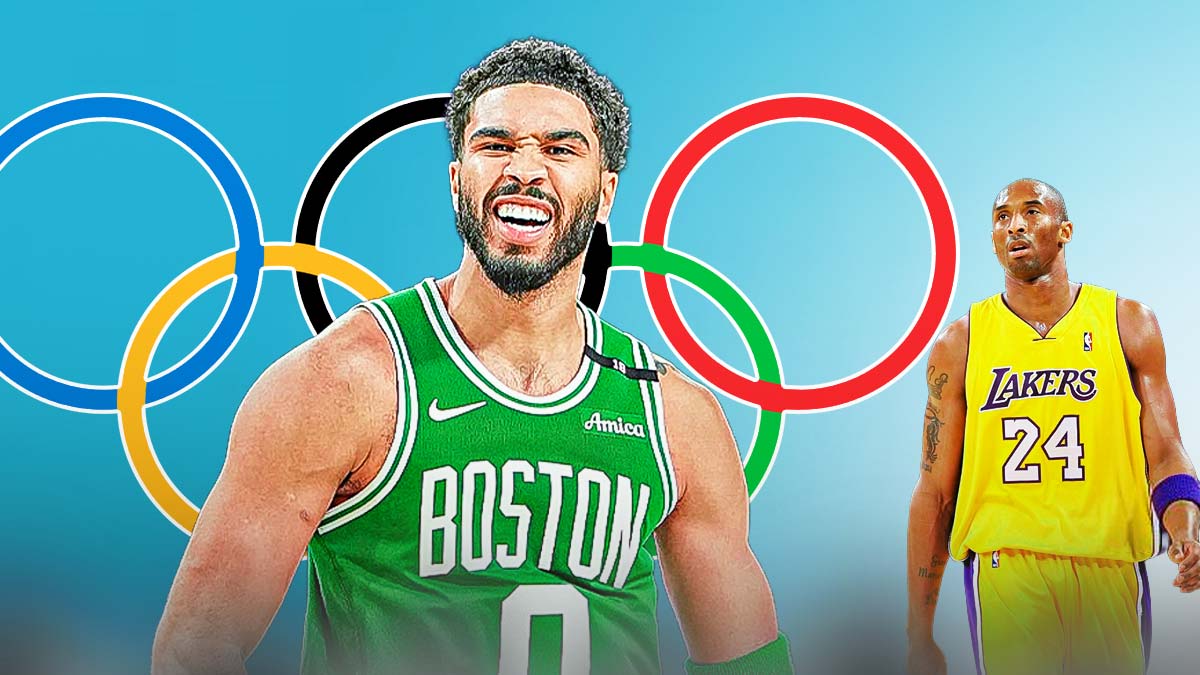
By the end of the first quarter, Jayson Tatum had a better idea of what his coach meant. Before the team boarded the bus, his coach told him that a player’s return would complicate the lineup and asked him to be patient. Tatum had just won an NBA championship. He was coming off a first-team All-NBA season. He still expected to get into the game. Instead, he sat through the opening quarter and started to wonder how long he’d be sitting there.
In his Boardroom cover story with Speedy Morman, Tatum revisited that Olympic benching, the Achilles tear that upended his next postseason, and the text he sent Kobe Bryant before Game 7 in Miami. All three stories turn on a question that gets harder to answer once a player becomes a star. Where do you put all that competitive energy when there’s only so much you can do?
What Tatum could give from the Olympic bench
“I was confused for sure,” Tatum told Morman. Part of the frustration was straightforward. He thought he could help, and he wanted the chance to do it. His summer up to that point had given him every reason to believe he would have a role. Along with the title and the All-NBA nod, he’d landed on the cover of 2K. He’d gone from playing for a championship to joining a roster so deep that he could spend an entire Olympic game watching it.
Tatum could still decide how he carried himself around the team. He told Morman he wanted to be a good teammate, even as he struggled to make sense of why he was sitting. They had already put seven weeks of their summer into the shared pursuit of a gold medal. He wanted those weeks to count. There were 11 other players on the roster, as Tatum pointed out, and he understood how much they had given up to be there.
That part of his answer deserves as much attention as the confusion. It’s easy to ask a player to put the team first when he has a clear part in what the team does. Tatum had to figure out what that looked like in a game where he never got off the bench. He can tell the story now, admit how much it bothered him, and still talk about the gold medal as something he wanted for the group.
How Tatum got through the first weeks after his Achilles tear
Before Game 4 against the Knicks in the 2025 playoffs, Tatum was thinking about the trip back to Boston. The Celtics trailed 2-1, and he saw a chance to win in New York and head home with an even series. Then he tore his Achilles. When he told the story to Morman, he lingered on what happened away from the court. He’d wake in the middle of the night, see the boot on his foot, and have to take in what happened all over again.
Tatum said it took him three weeks to accept the injury. From there, he gave himself a smaller assignment. “Man, try to feel better today than you did yesterday,” he recalled telling himself. The way he describes that stretch, accepting the tear gave him somewhere to start. He could check how he felt that morning, go through the day, and do the same thing when he woke up again.
As a teenager in St. Louis, Tatum used to get up around 5:30 to work out before school. He figured a player in New York already had an hour on him, and he wanted to close whatever gap he could. That detail takes on a different meaning next to the image of him waking up in a boot. Back then, the question was how much ground he could make up on somebody else. After the tear, yesterday was close enough to measure against.
Why Tatum texted Kobe Bryant before Game 7
Article Continues BelowBoston had to win on the road in Miami to reach Tatum’s first NBA Finals in 2022. He still considers that Game 7 probably the most important game he’d played to that point. Before tipoff, he texted Bryant, who had already died. When Morman asked how recently he’d sent Kobe a message, Tatum said that Game 7 was the last time.
The explanation was simple. Tatum wanted something that could get him in the right frame of mind to play. Boston won. When Morman asked whether the text had worked, Tatum had his answer. “We won. It worked.”
That postseason helped Tatum decide he belonged among the NBA’s superstars. He remembered going up against Kevin Durant, Kyrie Irving, Giannis Antetokounmpo, and Jimmy Butler during Boston’s run. At 24, he’d seen enough over several rounds to know how he matched up when the games mattered. The text belongs to the hours before he had that answer, when the Celtics still needed one more win to make the Finals and he was looking for something to settle himself before the game.
By the time Boston won a championship, Tatum had spent years hearing that he and his teammates couldn’t finish the job. He’d tried using that doubt as fuel. Winning showed him how quickly the same debate could move on to whether they could do it again. He told Morman he thought about the people who’d believed in the team through all those seasons.
There’s a glimpse of those people in Tatum’s account of the trophy picture that drew Kobe comparisons online. He remembers being at his locker after the champagne, trying to catch his breath. Cameras were everywhere. His oldest son, Deuce, was right there. Tatum told Morman that whenever Deuce has a problem, his first instinct is to think his dad can help. “He genuinely thinks I’m a superhero,” Tatum said. That’s the part of fatherhood he takes the most pride in.