
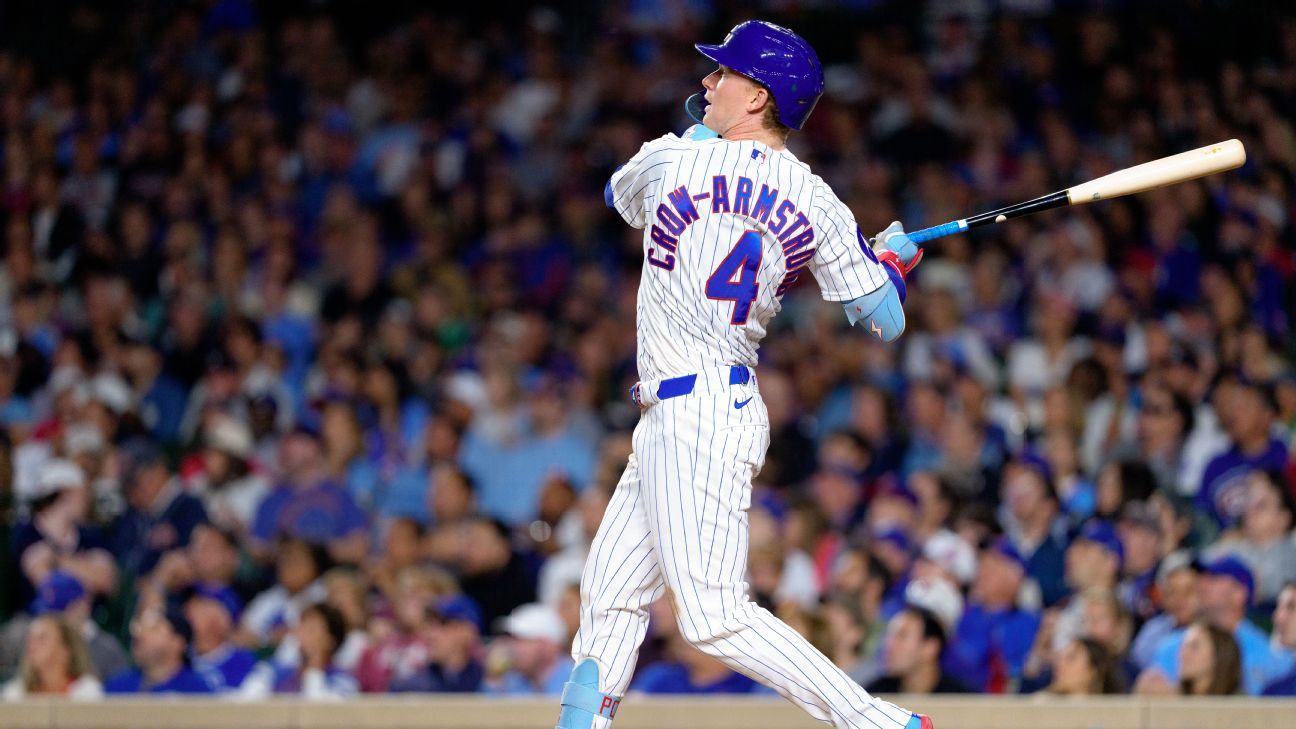
It's easy to forget that Pete Crow-Armstrong was having a quiet first six weeks of the 2026 MLB season after signing a six-year, $115 million contract extension a few months earlier. The moment that turned the Chicago Cubs center fielder into a runaway favorite for National League MVP honors didn't come until mid-May -- in a matchup against the Atlanta Braves and former Cy Young winner Chris Sale.
Crow-Armstrong's defense, as usual, had been outstanding. But while batting ninth in the order during the early portion of the year, he had yet to find his groove at the plate and was batting just .238 with a .679 OPS.
Cubs hitting coach John Mallee attempted a "we have nothing to lose moment" against the nasty left-hander. The Cubs decided to move the lefty-hitting Crow-Armstrong closer to the plate.
"You're either going to get hit or the ball's going forward," Mallee recalled saying to Crow-Armstrong going into the game. "There's only two options because you're standing on top of the plate now."
It was similar to what former Cubs star Anthony Rizzo tried years earlier under Mallee's tutelage. Back then, when Mallee expressed concern for Rizzo's health -- as his hit by pitch totals increased -- the former All-Star first baseman famously reminded Mallee that he had survived cancer so he wasn't much afraid of a baseball. Crow-Armstrong decided he was up for the challenge after talking to Rizzo about it. He wanted to get on base more. Getting hit was one way.
Crow-Armstrong didn't get hit, but he did go 1-for-2 off Sale that day. He turned on a 97 mph pitch for a single in the second then grounded out on a 3-1 count in the fifth. They were not headline generating plays, but they were the genesis for the months filled with such moments ahead.
"All of a sudden he started to narrow down against lefties," Mallee explained. "Then when we got him into the leadoff spot. I think he felt more involved in the offense. He was more into it and that's Pete. He's so competitive. When the s--- hits the fan, he wants to be in the fight. He ain't the guy on the sidelines."
"It's like a light switch went on"
Crow-Armstrong had made a commitment to getting on base more months before facing Sale and then getting moved to the top of the order. As one of the faster players in the league, he knew he couldn't use his speed if he wasn't making contact. His 41.7% chase rate in 2025 had to come down. He said as much in spring training -- but finding plate discipline as a free-swinging player is a delicate balance.
"It started with just learning how to evaluate his misses," Mallee said.
The Cubs hitting coach challenged Crow-Armstrong with a tactic that, in theory, takes chasing out of the equation before a hitter even steps into the batter's box. He told him to stay on the fastball and make the pitcher throw three strikes with his breaking stuff.
Mallee said Crow-Armstrong took to it "immediately," and Mallee noticed his newfound discipline at the plate.
"Wait a minute, he used to swing at those," Mallee thought at the time.
The walks started to come. In March and April 2025, Crow-Armstrong took six free passes. In 2026 during that timeframe, that climbed to nine, including four in the final six games of April. "Then we started putting pitchers in buckets," Mallee explained. "Lefties that throw from angles, guys that throw straight over the top, guys that have high, riding four-seams. So we tried to bucket these guys and then he remembered the approach he took off of that type of pitcher, maybe not that same guy, but that type of pitcher.
"It's like a light switch went on and he changed into a different person."
"He's like a piece of clay"
Crow-Armstrong didn't earn his first MVP award solely because of plate discipline, but his willingness to lay off bad pitches meant eventually he would see more good ones. That would lead to more damage.
In that vein, the wiry 24-year-old always displayed more power than his frame would suggest as it wasn't pure muscle that led him to 45 home runs. His coaches often describe him as "twitchy" at the plate with a natural ability to pull the ball in the air.
But timing was an issue at the beginning of the season. In the first 31 days of the season -- March 26 to April 27 -- Crow-Armstrong hit just one home run. He and Mallee huddled on it and decided a previous leg kick, which had been removed from his approach, might be an option to get him "started earlier." So they added that back in mid-May, right around the time of that game against Sale and the Braves. Mallee wanted him on the move in the box sooner to get his timing down. The leg kick worked in a big way.
"All of a sudden, his center of mass was moving sooner forward -- and much slower -- rather than shorter and later," Mallee explained. "That was a huge deal."
Crow-Armstrong also lowered his back elbow during drills to eliminate some slack in his swing.
"He said, 'I'm rolling with it,'" Mallee recalled. "And he took it right into the game. Right from the cage that day, right into the game, and then never looked back."
The results of all of it -- the plate discipline and the mechanical changes -- were immediate and lasting. In 119 games from the Chris Sale matchup to the end of the season, Crow-Armstrong slashed .294/.393/.638 which included 41 home runs, 31 stolen bases and 70 walks. His MVP season took shape.
"You just throw all these ideas at Pete, and then he's so athletic, he's like a piece of clay," Mallee said. "You just tell him to do something and he does it. Athleticism controls your body and space, right?"
But that doesn't mean Crow-Armstrong isn't working on his skills. Far from it. His work in the cage during the season is only matched by his offseason routine.
"There is no one more focused than him inside the gym"
Kyle Henmi has trained Crow-Armstrong since 2020, the year he was drafted. As the founder of Dawg Pound Athletics, which is located in the Los Angeles area, he has worked closely with the soon-to-be crowned MVP, understanding early on he had a special athlete.
"The first time I met him, I remember we were doing box jumps," Henmi recalled in a phone interview. "And I set up the box 24 inches, a standard height to start warming up with. And he did his first jump and this dude just floated all the way up to the top.
"I took a step back and I was like, 'What the...' I was like, wow, that's a little different."
And so began their current seven-year relationship. Henmi has been part and parcel to Crow-Armstrong's development off the field, citing him as one of the hardest workers he has ever trained. Most great athletes he has worked with share the two gifts: natural ability and work ethic. Henmi says Crow-Armstrong "got after it" right away.
"He is fiery," Henmi said. "He will get on people's asses. He'll push people. He wants to be pushed. He likes to be yelled at. He's always screaming at the gym, 'Come on, motherf‐‐‐er motherf---er let's go.' And then we're throwing med balls at each other like, 'Hit me harder. That's all you got?'"
That description fits Crow-Armstrong's on-field demeanor as well -- though he has reeled in some of that instant aggression he feels after a negative moment. Throwing bats and helmets were more the exception than the norm this season -- a reverse from the past.
Mallee called it the "sixth tool," learning the mental side of the game. Crow-Armstrong himself has spoken often about not needing to be "on" every minute of the game. To let his mind relax when it's warranted.
Henmi describes a similar situation in workouts -- from chitchat about plans that night to intense, focused training. Mostly, that inherent aggression Crow-Armstrong feels is rewarded in the gym as it pushes him to the limits.
"There is no one more focused than him inside the gym," Henmi said. "It's an amazing thing to coach him because when I'm going over exercises, I can look into his eyes and he's literally just eyeballing every little minute detail that I'm doing and talking about."
Henmi's goal for Crow-Armstrong was never to bulk him up. At 6-foot, 184 pounds, what he lacks in muscle, he makes up for in "rotational force," according to the trainer. That's where his power comes from. Beginning in the minor leagues, Crow-Armstrong kept flashing his home run potential, but it emerged in a big way in 2025 when he hit 31 home runs before blasting past that total this year.
"I need to make you strong, but I don't need to make you as strong as someone like Shohei [Ohtani] or Pete Alonso or someone like that," Henmi explained. "I need you to be strong enough, but I want to keep doing all the jumping, all the plyometrics. I want to keep you snappy."
Henmi admits to getting "choked" up discussing his most prominent client. The duo began a journey which neither could have imagined would end with a surprising, runaway win for league MVP in just his second full season in the big leagues -- or perhaps one of them did imagine it.
"I remember him talking to me one day at the gym about him being a Hall of Famer," Henmi recalled. "And you can hear guys talk about themselves like that, but there was something different when he said that to me about how in 20 years when I'm in the Hall of Fame. And you could hear it in his voice, he truly means that.
"And he truly knows that if he continues to work hard, if he continues to stay humble, if he continues to do what he's doing, nothing's going to stop him."