
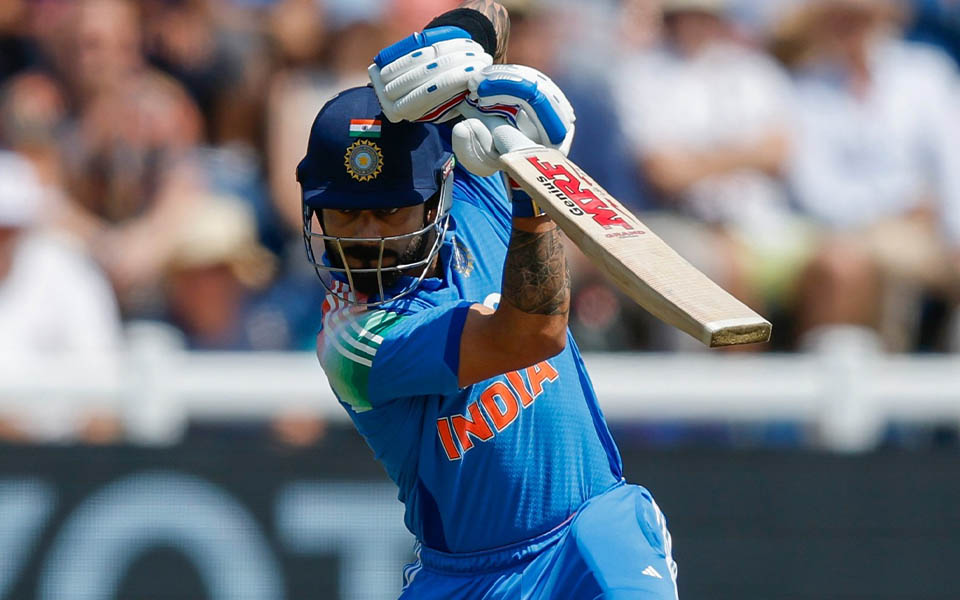
The India batter opens up about his mindset shift and willingness to take calculated risks in modern ODI cricket.
Virat Kohli has committed to a fresh mindset as India prepares for their opening ODI against West Indies on September 27 at the Greenfield International Stadium in Thiruvananthapuram. The India batter has made a conscious decision to embrace greater freedom in his batting and move away from the restrictive role expectations that have defined much of his career. This shift comes as India refocus their efforts on 50-over cricket with the West Indies series forming a key part of their broader ODI strategy.
The 37-year-old batter, who has played 314 ODIs and scored 14,941 runs in 302 innings at an average of 58.59, explained how his role in the team has traditionally centred on stabilising innings rather than aggressive batting.
"What's changed is, firstly, I promised myself that I'm going to play more freely. I'm not going to worry about the expectations that people might have around me. My role had always been, for a long period of time, that I'm going to stabilise things," Kohli said on JioStar.
Kohli's shift towards playing with greater freedom
Kohli acknowledged that his previous approach often meant accepting a defined role within the team structure, even when he possessed the skills to play more aggressively. He recognised that the demands of modern cricket sometimes pushed him into a mindset where he felt constrained by the situation and his assigned responsibilities.
"I know I can play, I know I can hit shots. But the demands are such that if it's a tricky situation and you're playing on a tricky pitch, you eventually get into a space where you're like, I can hit, but I've been given a role," Kohli said.
Balancing aggression with building an innings
Kohli is now making a deliberate effort to balance building an innings with taking calculated risks that can add significant runs to India's total. He has identified specific situations where he can accelerate without compromising the team's stability, particularly when he has established himself at the crease.
"This time, I'm making a conscious effort that if I'm set to make a difference in the game, where you can get 30–40 extra runs, I want to stay in a space where, if I'm choosing not to take a risk, it's because I'm setting up eventually to get to a point where I say, okay, now press the accelerator down," Kohli said.
The modern ODI format has evolved significantly, with teams increasingly targeting higher totals in favourable conditions. Kohli recognises this shift and believes India must be prepared to match or exceed the aggressive scoring rates of opposition teams when conditions permit.
"Now, the game is changing in a way that, especially if the conditions are fast-paced and good, and other teams are looking to push you towards 340–350, we should be able to get 350–360 as well. I'm very willing to take risks now because I know that if I make runs there, we'll get 350–360 easily. And if I do that and play longer, then I can hit more at the end," Kohli said.
Adapting to modern ODI demands
Kohli's willingness to embrace this freer approach has been reinforced by his confidence in the quality of players around him. He believes that having strong teammates who can handle pressure situations has allowed him to express himself more fully without fear of jeopardising the team's position.
"So, I had to unlock a little bit of that freedom in my own mind. That's also helped me in the IPL as well. I was able to play with that same freedom because I'm not thinking that if I get out, the situation might get difficult for us," Kohli said.
"I have faith in the fact that there are other players around me who are very good and who will be able to handle the situation. I need to express myself fully and find a way to be consistent doing that. That's exciting as well at this stage of my career," he added.
India's ODI schedule extends beyond the West Indies series, with five ODIs in New Zealand and three against Sri Lanka scheduled for later in 2026, followed by three ODIs against Zimbabwe in early 2027. These matches will provide Kohli and the team with opportunities to implement and refine this new approach as they build towards the World Cup.