
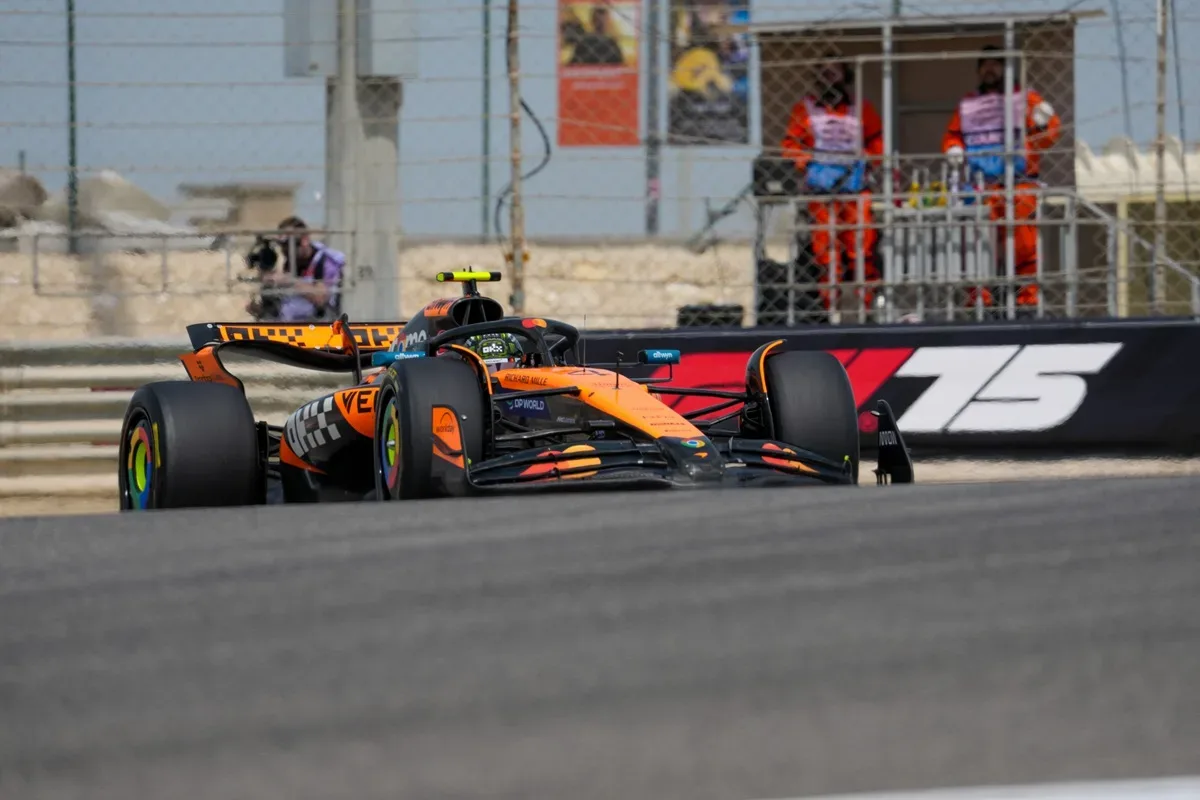
Although it isn’t mathematically impossible, Lando Norris’s chances of winning back-to-back Drivers’ Championships diminished after Baku.
Severe engine and car issues hindered him throughout the weekend, and Alpine’s Franco Colapinto carelessly took Norris out after a safety car restart.
The British driver has undoubtedly been one of the best-performing drivers on the grid this season. That’s when he’s in a car that performs basic functions, which hasn’t been often in 2026.
Missed free practice sessions, constant mechanical and electrical problems or even a car that couldn’t start a race. It’s been a difficult year despite race wins and podiums.
The McLaren driver sits 136 points behind the championship leader, Kimi Antonelli. Without the setbacks, how close could Norris have been to battling for a consecutive title?
A season shadowed by disdain and problems
Australia
The season opener in Australia were the true beginning of this generation of F1 cars. Well, it would’ve been for Norris if he hadn’t missed over a whole hour of practice between FP1 and FP2 after numerous issues with his car.
Power unit problems, gearbox issues, battery deployment not functioning as expected; Norris was on the back foot going into qualifying.
Issues couldn’t get worse for an opening weekend; the reigning world champion’s front wing then became dislodged on his final qualifying run.
Ultimately, hindering the hopes of a solid position for the race start.
McLaren had no pace, and Norris brought home a barely functional machine in P5.
China
The most embarrassing weekend in the history of the McLaren Formula One Team.
A double DNS for the race. Electronic issues prevented both Norris and Oscar Piastri from competing in the Grand Prix.
Norris again had deployment issues throughout the sessions and needed to replace his first of three PU-CEs. It was permanently damaged and replaced following the DNS.
Japan
The Brit faced half a practice session in the garage on three separate occasions. He completed the least number of practice laps and was on the back foot all weekend.
The previously replaced PU-CE failed to power up, meaning that it had to be withdrawn from the car. Norris was on his third and final assigned PU-CE in the third race of the season.
This issue saw him spend 35 minutes in the garage in FP3 and limited running on the new unit.
Straight Line Mode issues in FP1 caused him to miss 20 minutes before matters worsened, with a hydraulic leak leaving Norris in the garage for the remaining 5 minutes of FP1 and nearly 40 minutes of FP2.
This lack of running, of course, affected Norris’ performance over the weekend. He had deployment issues again and was slower in a straight line than most drivers due to the lack of running.
Norris finished the race 5th while his teammate finished second and had the pace to win the race until a late safety car put him under pressure from the faster Mercedes of Antonelli.
In a hypothetical scenario, the first three Asia-Pacific saw Norris lose at a minimum 8 points, with potential for 15 or more in Japan due to a lack of running.
Miami
After a flawless sprint qualifying and sprint session, converting his pole into a win. The issues again plagued the number one car.
Deployment issues plagued the MCL40 again in qualifying for the Grand Prix. The battery never fully charged for Norris’ final lap in Q3, and the boost failed to deploy at the activation points.
Norris qualified fourth but certainly could’ve challenged for pole without the issues.
In the Grand Prix, the world champion was relentless after taking second and chasing Antonelli.
Norris’ race engineer and McLaren’s lead strategist, Randy Singh, failed to execute a well-planned pit stop, putting Norris behind Antonelli again.
The rear wing then began to fall off the back of the McLaren, ending Norris’ pursuit of a race win that was within his grasp.
Canada
McLaren had a competitive car for qualifying but sacrificed race pace to start higher up the grid.
Both Norris and Piastri suffered front lock-ups and high tyre degradation.
Norris had an overheating issue from debris getting stuck in his radiator. A few laps later, his gearbox gave out, and the subdued Brit sounded fed up with a stop-start season.
Monaco
Another power unit issue for the world champion in FP2, which needed to be changed for a fourth time in six races.
Another electrical issue ended his FP2 session early. The car shut off. He missed 45 minutes of the session on the toughest track on the calendar.
In the race, the worst-case scenario occurred. On lap 32, the number one car began to misfire, and two laps later, the PU-CE shut off, causing Norris to retire.
The PU-CE was Norris’ second, which was recovered from Japan, but this time it was damaged beyond repair. The British driver was on his third and final PU-CE with over 3/4 of a season left.
Austria
Another hydraulic leak caused Norris to spend 45 minutes in the garage for FP1, losing valuable time on one of his stronger tracks.
He showed some great race pace but was ultimately let down by his team again.
Multiple brake issues from the set-up and the team underfueling the car left the number one car in no man’s land for the majority of the race.
Norris came home in 7th place despite showing pace that could’ve seen him achieve a podium on his strongest track. A track he’s had multiple podiums and a win at.
Embed from Getty ImagesGreat Britain
Norris fans would hope McLaren learnt from their mistakes in Austria with underfueling the car.
Yet this was not the case; McLaren again underfueled their world champion’s MCL40 in the sprint race, costing Norris a win which he certainly had the pace to achieve.
In the race, the rear wing on the number one car failed on lap 25, and the issue wasn’t resolved until lap 41.
The loss of performance saw Norris’ podium charge fall flat, and the race finished under a safety car due to an FIA mishap. Leaving no opportunity for Norris to battle for a chance to get back into the top three.
Belgium
Another disrupted free practice session for the McLaren driver, who suffered a steering issue and the car going into false neutral often.
Norris then suffered a 10-place grid penalty for having to replace the PU-CE again despite qualifying in third.
McLaren again diminished their drivers’ chances of winning with rash strategy calls. That saw Norris miss the VSC window as the team wanted to keep him and Piastri on the same strategy. This is despite both drivers being on completely different race runs.
Italy
Power and braking issues ruined Norris’ chances of a strong starting position. Those issues were on top of McLaren’s severe lack of speed in a straight line due to a weak drag reduction kit.
During the race, the brake issues continued, causing him to overrun the turn-one chicane.
The shifts on his gearbox wreaked havoc during the final few laps, seeing the car fall into false neutral again while racing his teammate.
Madrid
The previously mentioned gearbox issue from Italy was ignored by Lando’s team. That was until FP2; the gearbox completely failed, taking Norris out of the entire session.
Despite the issues, Norris proved he was an elite driver and world champion. Putting his number one car on pole despite the missed hour. He had adapted to the new track perfectly.
Yet his hard work would be wasted after another strategy blunder by McLaren.
Norris was ridiculously quick compared to anyone else on the grid. He’d established a healthy lead until a Stroll stopped with an issue with his Aston Martin.
McLaren didn’t calculate the window for a potential VSC or SC, which ultimately cost Norris the race when the VSC was thrown after Norris passed the pit in line.
The reigning champion would go on to finish third. Some strange comments from Andrea Stella, the team principal, left a sour taste in fans’ mouths.
The Italian suggested Norris was too fast to sort out a strategy. Pinning blame on the driver who drove a stellar weekend despite another issue with his car.
Baku
Drag reduction and a fuel injection issue, along with a failed upgrade package, ruined the weekend.
The new floor upgrade fell apart within the first few moments on track, which cost Norris 30 minutes of track time.
There was also an issue with a loose bargeboard that was tied to the car with zip ties.
The fuel injection issue was the ultimate kryptonite for the weekend. Norris lost up to 15 km/h of speed on the straights, leaving him a sitting duck.
His qualifying was lacklustre after the issue, and in the race, cars flew past him. The weekend couldn’t end soon enough. Colapinto wiped Norris out after a poorly executed safety-car restart, finishing the miserable weekend for the Brit.
How many points has Norris potentially lost?
Looking at the issues across the races, Norris could’ve lost up to 100 points at least.
Two potential victories were lost to strategic errors, podium hopes dashed with mechanical issues or underfueling.
Strong results were lost with DNFs and failure to start a race in China, where Norris showed strong pace.
His championship defence hasn’t been easy, but if he gained the points lost, he’d be 20 points behind Antonelli.
For more F1 news and stories, click here.

World In Sport Forum
Continue the discussion
Join other fans in the World In Sport Forum and debate the biggest talking points from this article.