
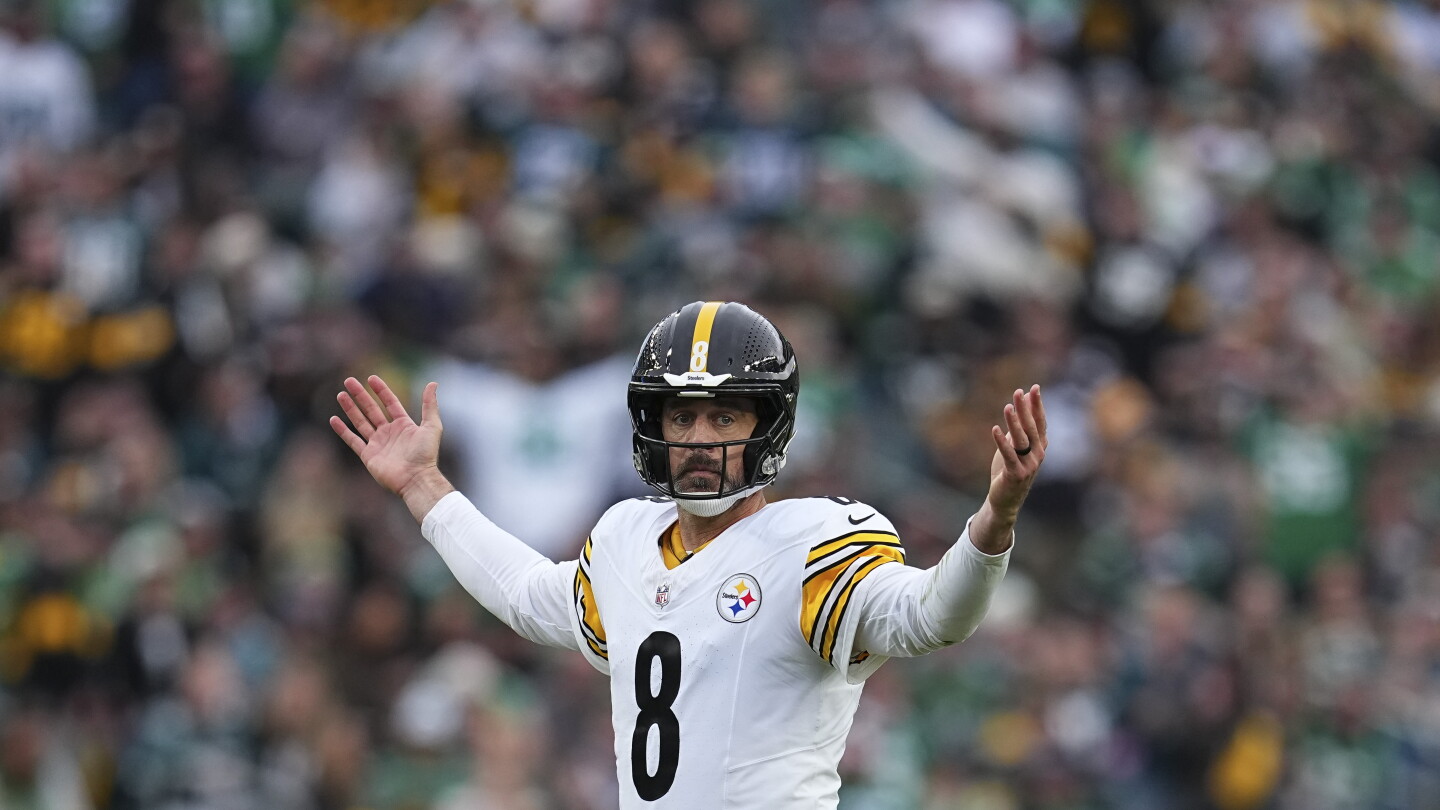
If you were traveling on Wednesday or otherwise not plugged in for one of the most rollicking, unpredictable days in years if not ever, you’re in luck.
We’ve reconstructed the full timeline as to the events regarding now-former Steelers quarterback Aaron Rodgers.
It actually started on Monday, when coach Mike McCarthy was asked whether he has considered using one of the team’s other three quarterbacks when the offense is struggling. McCarthy, whose body language in hindsight suggests he was dreading the question, said without equivocation, “Aaron Rodgers is our quarterback.”
On Tuesday, Rodgers took his usual reps at practice. He conducted his usual midweek press conference. Unbeknownst to most of the media or the general public, the Steelers were changing their play-calling procedures to have quarterbacks coach Tom Arth, and not McCarthy, communicate the calls to Rodgers through the speaker in his helmet.
Then came Tuesday night. At 11:10 p.m. ET, the Steelers issued a statement — not from coach Mike McCarthy or G.M. Omar Khan or owner Art Rooney II but from team spokesman Burt Lauten — that Mason Rudolph will start on Friday against the Broncos and Rodgers will be inactive.
The news forced the Broncos to make a quick pivot in their preparations from Rodgers to Rudolph. As one source put it, the Broncos weren’t sure whether it was a good thing or a bad thing.
It was definitely a bad thing, all things considered, for the Steelers.
By Wednesday morning, reports emerged that it was a coach’s decision. At 8:00 a.m. ET, McCarthy informed the team of the decision.
Rodgers wasn’t there. As it turns out, he was excused.
Enter Pat McAfee. He teased a surprise guest at 1:40 p.m. ET. As expected, it was Rodgers.
Rodgers took a flamethrower to McCarthy, airing out dirty laundry that created a major mess for his now-former team. He exposed the fact that, at halftime of the Week 11 loss to the Eagles, McCarthy broke down the locker-room gathering by saying, “1-2-3 Packers.”
Rodgers also said McCarthy was falling asleep during some meetings and missing other meetings, expressing (in passive-aggressive fashion) concern for McCarthy’s health.
But Rodgers also said it was nothing new, and that McCarthy had done the same things in Green Bay, when they worked there together a decade ago.
Rodgers also made it clear he wouldn’t stay with the Steelers. After his session with McAfee and company, Dulac reported that the Steelers were expected to release Rodgers. By the official close of business, they’d waived him.
A question lingers as to whether the Steelers will try to deny Rodgers the balance of his $22 million salary. It won’t be easy; they’ll need to both void the guarantees and wipe out his eligibility for termination pay (in the form of his remaining salary) under the Collective Bargaining Agreement.
McCarthy met with reporters on Wednesday, after all hell had broken loose. He admitted to the “1-2-3 Packers” comment, calling it an “[e]mbarrassing moment.”
McCarthy also said that Rodgers was benched after issuing an “ultimatum” that was “clearly outside of his job description.”
ESPNFL thereafter reported that McCarthy “has the full support” of the organization, and that the team is “not planning to make any immediate changes.” The key word may be “immediate"; with few viable options only two days before a Black Friday game against the Broncos, changes could come later.
The overriding takeaway is that someone with the Steelers knew or should have known that McCarthy and Rodgers couldn’t co-exist. Because, obviously, they didn’t co-exist.
If, as Rodgers claims, McCarthy believed Rodgers got him fired in Green Bay, McCarthy shouldn’t have wanted a reunion with Rodgers. And if, as Rodgers claims, McCarthy was doing the same kinds of things in Green Bay that he did in Pittsburgh, Rodgers shouldn’t have wanted a reunion with McCarthy.
The reunion has now ended abruptly, with seven games left in the 2026 regular season. It remains to be seen whether Rodgers wants to play with another team, or whether another team wants him. Any team that signs him risks being on the receiving end of a future gripe session from Rodgers in which he lists all the things that team and/or the coach did wrong — without ever acknowledging his own role in the reality that it didn’t work out.
The good news, if there is any, is this: If Rodgers never plays again, his final NFL pass will have been a touchdown.
Which is a better outcome than if he’d retired after the 2025 season. His final pass that year was a pick-six in the playoffs.