
The Guardians made history in Game 5 of the American League Division Series on Saturday night, beyond becoming the 11th team to lose the first two games of a best-of-five postseason series and then come back to win.
Cleveland pitchers struck out 21 batters, the most in a nine-inning postseason or regular-season game in MLB history. And as Gavin Williams and company recorded strikeout after strikeout, we couldn't help but think ahead to the next round. A matchup with the contact-savvy Rays awaits, the team with the fewest strikeouts and lowest swing-and-miss rate in the Majors.
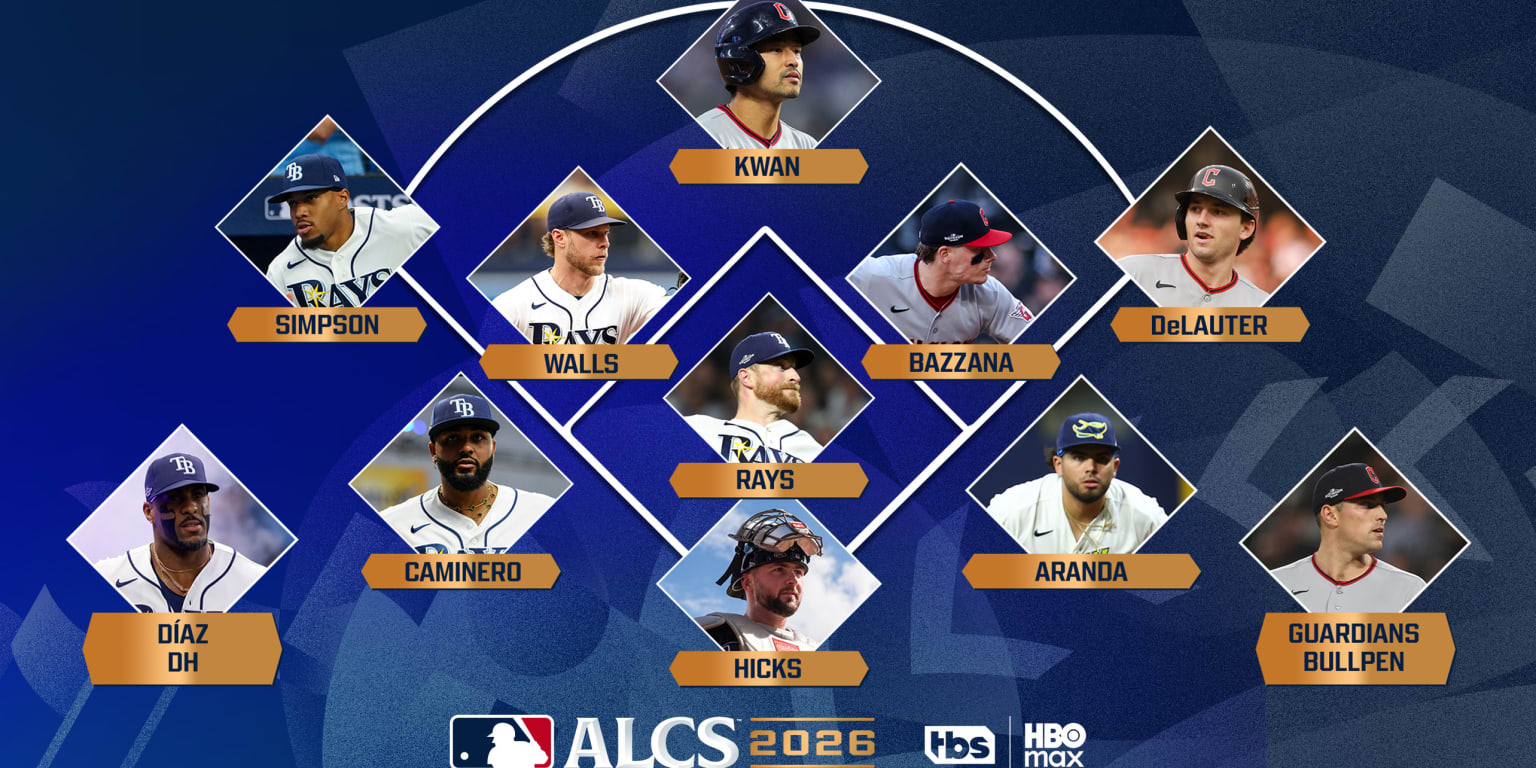
It is one of the many fascinating subplots to the 2026 American League Championship Series, which begins Monday night inside a packed Tropicana Field.
Here's a position-by-position breakdown of the ALCS ahead of the best-of-seven series.
Catcher
Liam Hicks posted an .819 OPS in 41 games with the Rays after being acquired from the Marlins at the Trade Deadline. That's the second-highest OPS of any Tampa Bay hitter from Aug. 4 through the end of the regular season, behind only Victor Mesa Jr. (.987). Hicks is a seamless fit in the Rays' contact-oriented offense; only three qualified players posted lower swing-and-miss rates in 2026.
Cleveland's defensive-minded duo of Patrick Bailey and Austin Hedges hasn't been quite as strong this year; by Statcast's fielding run value metric, Bailey (+7) and Hedges (-2) are each having the least-valuable defensive season of their career. Since the Deadline, these two clubs have received equally valuable defensive contributions from their catchers. Even though Bailey in particular is swinging a hot bat -- he went 5-for-15 in the ALDS -- Hicks gives the Rays' the clear edge.
Advantage: Rays
First base
Another position, another substantial advantage for the Rays. Jonathan Aranda (121 OPS+) didn't quite replicate his All-Star campaign in 2025 (145 OPS+), but he was still plenty good in '26. Aranda launched a career-high 22 home runs and already won Tampa Bay a postseason game with his bat. His solo home run off Gerrit Cole in Game 1 of the ALDS accounted for the only run in a tone-setting 1-0 victory.
Only three teams have received weaker production from their first baseman this season than the Guardians. Cleveland swung a deal for former Ray Nathaniel Lowe at the Trade Deadline in hopes of fixing things, but it hasn't quite worked out that way. The eight-year veteran posted a 126 OPS+ in 83 games with the Reds, compared to a 83 OPS+ in 43 games with the Guardians. Platoon option David Fry struck out in his only at-bat in the ALDS but remains an option against left-handed pitching.
Advantage: Rays
Second base
An All-Star as a rookie, Travis Bazzana posted a 110 OPS+ on the back of a strong September that saw him bash six home runs with a .613 slugging percentage and a .978 OPS. Bazzana faced five left-handed pitchers in the ALDS, so he should be in line for a more favorable matchup (at least from a platoon standpoint) against a Rays pitching staff that is heavy with right-handers.
The Rays rolled with left-handed-hitting Richie Palacios as the keystone starter for all three games of the ALDS, and he delivered with a two-run single off Yankees ace Cam Schlittler in Game 2. Ben Williamson is the logical platoon bat against left-handed pitching, but he's played in just five games since Aug. 5 due to a hamstring injury. It's an adequate duo, but Bazzana -- the 2024 No. 1 overall pick -- should provide more production.
Advantage: Guardians
Shortstop
Here's a tricky decision. Did you know that Brayan Rocchio was actually one of the 10 most valuable shortstops in baseball this season? He was essentially a league-average hitter in 2026 (99 OPS+) behind a career-best 15 home runs and showed vastly improved defense with +13 outs above average at shortstop. Among Guardians position players, only Steven Kwan accumulated more FanGraphs WAR -- read, was more valuable -- than Rocchio.
On the other side, there's Taylor Walls, one of the weakest hitters in baseball who also represents so much of what the Rays are about. His 11 bunt hits are the fourth most in MLB and his 12 sacrifice bunts are more than everyone but the Brewers' David Hamilton. In the field, no shortstop is better at anticipation and positioning, which is why Walls ranks second among infielders in Defensive Runs Saved (and also, partially, why Statcast grades him less favorably). This is really a toss-up, but we'll take Walls by the slimmest of margins.
Advantage: Rays
Third base
José Ramírez, as Guardians manager Stephen Vogt said after the ALDS, is Cleveland baseball. A seven-time All-Star, Ramírez put up his worst offensive numbers in a single season since 2015, with just 12 home runs and a 95 OPS+. But you can throw all of that out the window, because he just propelled the Guardians into the ALCS with a vintage performance. Ramírez was on base seven times with four extra-base hits in Games 3-5 of the ALDS, including a stadium-shaking two-run home run that accounted for the only runs in the decisive Game 5.
So although this is a tougher decision than it would have been just last week, the nod still goes to Junior Caminero. A 42-homer bat, the 24-year-old is one of the game's transcendent young stars -- and also just happens to be a former Cleveland farmhand.
Advantage: Rays
Left field
We'll see how the Guardians decide to configure their outfield in the ALCS. Third-year player Angel Martínez loomed as an October X-factor after a breakout season (18 HR, 110 OPS+) saw him emerge as one of Cleveland's more reliable bats. But the 24-year-old went 0-for-15 in the ALDS and rode the pine in Game 5, with Steven Kwan shifting over to left field and Petey Halpin drawing the starting nod in center. For this exercise, we'll assume that Martínez -- a switch-hitter -- will still see the lion's share of playing time in left field, because the larger sample (.807 OPS in 48 games after the All-Star break) is too compelling.
There are fewer questions in left field for the Rays, because that's where Chandler Simpson plays. He didn't wreak much havoc in the ALDS, but that seems poised to change. Simpson is one of the game's most impactful baserunners and the second-toughest player to strike out, behind Luis Arraez. Here’s something else: Simpson is a vastly improved fielder, as he ranks in the 94th percentile of MLB with +8 outs above average. There are so many ways that Simpson can put his stamp on a game, even if he doesn’t get on base.
Advantage: Rays
Center field
Veteran Cedric Mullins drew 122 starts in center field in the regular season for the Rays. But Mullins did not start a game in the ALDS, with Jonny DeLuca -- the right side of a right/left platoon -- starting all three games, even the first two against right-handed pitching. Both players are elite defenders, with DeLuca (+13 OAA) and Mullins (+11) ranking among the eight-best qualified outfielders in outs above average. But DeLuca (101 OPS+) gives the Rays a little more with the bat.
Neither player holds a candle to Kwan, who put a subpar first half behind him by hitting .353 with an .875 OPS after the All-Star break; no qualified hitter had more base knocks than Kwan (85) in that span. Like Simpson, Cleveland's leadoff hitter is a throwback player: He is exceptionally difficult to strike out, makes a ton of contact and does not sell out for power. In the field, Kwan is one of seven outfielders to record 10 or more assists in 2026, which could come into play against a speedy Rays team.
Advantage: Guardians
Right field
Where would Tampa Bay be without Victor Mesa Jr.? That's the question that Rays president of baseball operations Erik Neander wondered aloud after Game 3 of the ALDS, which saw Mesa -- a 25-year-old rookie DFA'd right before Spring Training -- launch the eventual game-winning home run off Max Fried. Mesa came off the IL on Sept. 1 and promptly posted a 1.015 OPS over the season's final month, which ranked 12th best among qualified hitters. He's been red hot for a while now. Not to mention, he plays exceptional defense; in Game 1, his arm helped kickstart a series-defining rally that cut down the Yankees' Austin Wells at third base. Expect to see a good deal of Ryan Vilade -- who homered in Game 3 off Fried -- against left-handed pitching, too.
But as good as Mesa has been, Chase DeLauter -- another 25-year-old rookie -- has been Cleveland's best hitter (131 OPS+) all year long. His all-around production includes 16 home runs, 30 doubles and a swing-and-miss rate that sits in the 93rd percentile of MLB.
Advantage: Guardians
Designated hitter
Following a midseason trade to the Guardians, Jo Adell started to resemble the 2025 version of himself that launched 37 home runs with the Angels. Adell posted a 108 OPS+ in 48 games with Cleveland and also became the team's best weapon against left-handed pitching. He slugged .660 against southpaws, helping balance a lineup loaded with left-handed hitters.
But the clear edge here goes to Yandy Díaz, who remains wildly productive -- and underrated -- in his age-35 season. His production was 24% better than league average, buoyed by a combination of power (22 home runs) and contact (14.8% whiff rate)
Starting pitchers
The Rays had the third-best starting pitcher ERA in baseball this season, and the Guardians ranked ninth best. These are two of the best rotations in the game.
Let's start with Tampa Bay. We all saw what Drew Rasmussen can do when he carried a no-hit bid through 7 2/3 innings in Game 1 of the ALDS, a dominant 10-strikeout gem against the Yankees. There's plenty of upside behind Rasmussen, too, including Nick Martinez, Ian Seymour and Griffin Jax. But the biggest development is probably Freddy Peralta's midseason rejuvenation after being acquired at the Deadline from the Mets. His high-octane fastball played up in his Game 2 start, and he's using his changeup more to complement the heater.
Cleveland counters with an elite 1-2 punch of All-Star rookie Parker Messick and overpowering right-hander Gavin Williams, whose 12 strikeouts in Game 5 of the ALDS were tied for the second-most K's by a pitcher in a winner-take-all postseason game. Joey Cantillo, Foster Griffin and Tanner Bibee combined to make 72 starts for the Guardians in the regular season.
Here's one major difference, though. The Rays have Rasmussen lined up for Game 1 on Monday night, while the Guardians won't be able to use Williams -- assuming he comes back on regular rest -- until Game 3 on Thursday. That sets Rasmussen up for potentially three appearances in the ALCS, whereas Williams might only pitch twice.
Advantage: Rays
Relief pitchers
These two bullpens are anchored by closers who finished tied atop the American League with 41 regular-season saves. Cleveland's Cade Smith struck out 107 batters in 74 innings in the regular season, then recorded 10 of 13 outs via the K in the ALDS against the White Sox. Not to be outdone, the Rays' Bryan Baker became one of four pitchers to earn a save in each of his team's first three games of the postseason.
Both pitchers are lethal. But what about beyond that? We didn't see much of Tampa Bay's traditional relievers in the ALDS, with lefty Cam Booser and submarine righty Kevin Kelly combining for a total of four outs. Jax and Seymour each flourished in relief, though one will almost certainly have to start Game 4 in Cleveland. That places more of an onus on someone like right-hander Tyler Wells, who owns a 2.38 ERA but has not pitched since mid-September due to forearm tightness.
The Guardians have a bounty of playoff-tested relief arms. Setup man Hunter Gaddis and lefties Erik Sabrowski and Tim Herrin have been a part of Guardians playoff teams in each of the last three seasons. Here's another edge for Cleveland: Smith has gotten more than three outs in a game 15 times this year, including the postseason. Baker has only done so twice.
Advantage: Guardians
Prediction
The Rays took five of the six head-to-head meetings with the Guardians in the regular season, including a three-game sweep at Tropicana Field in late July. The last game featured a pitchers' duel between Rasmussen (seven scoreless innings) and Messick (one run in 7 2/3 frames). Expect a similarly tight series this go-around, on a far bigger stage.
The bottom line? This is a really fun matchup between two analytically savvy organizations and two fan bases starved for another crack at the World Series. Picking against either feels silly. But we have to make a choice, so we'll go with Tampa Bay in six games, believing the Rays will have a chance to play for their first World Series championship in franchise history.