
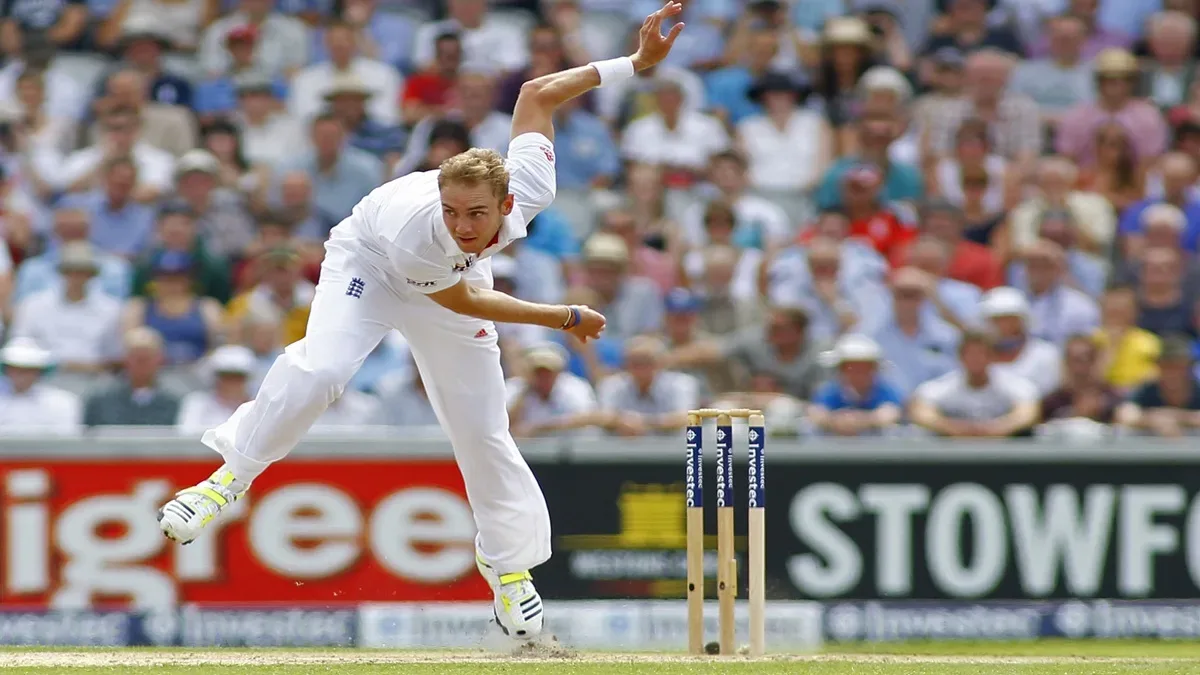
Jim Laker’s extraordinary 10-53 against Australia at Old Trafford in 1956 ranks as the greatest Ashes bowling spell of all time. His 19 wickets across the match established a Test cricket record that remains unbeaten.
Stuart Broad’s 8-15 at Trent Bridge in 2015 and Bob Willis’s 8-43 at Headingley in 1981 are among the strongest challengers. Both transformed crucial Ashes Tests through sustained fast bowling, although their achievements came under very different circumstances.
The rivalry has also produced remarkable performances in women’s Test cricket. Betty Wilson’s 7-7 in 1958 and Ashleigh Gardner’s 8-66 in 2023 deserve consideration alongside the finest spells in the men’s series.
This ranking examines 15 individual innings performances, from the nineteenth century to the 2025-26 Ashes, weighing their match-winning influence, technical quality and historical significance.
How we ranked the greatest Ashes bowling spells
Bowling figures provide a starting point, but wickets alone cannot settle the argument.
We considered five factors: bowling quality, opposition strength, match situation, result, and the performance’s wider historical significance.
Taking eight wickets in a comfortable victory differs from defending a modest target as the match slips away. Likewise, an exceptional bowling burst can outweigh a larger haul accumulated across several sessions.
The rankings include men’s and women’s Ashes Tests. White-ball performances are excluded to maintain a consistent format. Historical playing conditions, including uncovered pitches, different over lengths and the development of women’s Test cricket, also matter.
The emphasis is on individual bowling performances rather than entire careers. A cricketer’s standing in the wider game, as explored in World in Sport’s greatest cricketers ranking, does not automatically determine their position here.
Readers less familiar with the longer format can also explore our guide to Test cricket rules and match outcomes for an explanation of innings, declarations and how results are decided.
1. Jim Laker – 10-53, Old Trafford, 1956
Jim Laker’s extraordinary performance at Old Trafford in 1956 remains the benchmark against which every great Ashes bowling spell must be measured.
The England off-spinner began the fourth Test by taking nine wickets for 37 runs in Australia’s first innings.
Only a wicket taken by Tony Lock prevented Laker from claiming all ten.
Australia were dismissed for 84, leaving England in complete control.
When the visitors followed on, Laker produced an even more remarkable performance.
He took every wicket in Australia’s second innings, finishing with 10-53 from 51.2 overs.
England won by an innings and 170 runs, while Laker completed match figures of 19-90. ICC
No bowler has surpassed his 19 wickets in a Test match.
Laker became the first player to take all ten wickets in a Test innings. Anil Kumble and Ajaz Patel subsequently matched that innings feat, but neither equalled his match figures.
The ICC’s review of Laker’s ten-wicket achievement places the performance alongside the other two ten-wicket innings in Test history.
Conditions certainly contributed. The Old Trafford pitch offered considerable assistance to spin, and Laker exploited it through flight, control and repeated deliveries on a threatening length.
However, favourable conditions alone cannot explain such an exceptional record.
Other bowlers operated on helpful surfaces throughout cricket history without approaching his figures.
Laker also achieved something that separates his performance from every other entry on this list: he sustained extraordinary dominance across both opposition innings.
Broad’s 8-15 was more destructive in a shorter period. Willis produced his figures under greater immediate pressure, while Spofforth’s spell helped establish the rivalry itself.
Yet none combined Laker’s statistical dominance with such a comprehensive individual contribution across an entire Test.
His 10-53 remains the greatest Ashes bowling spell of all time.
2. Stuart Broad – 8-15, Trent Bridge, 2015
Embed from Getty ImagesStuart Broad’s 8-15 at Trent Bridge in 2015 is arguably the finest sustained spell of modern Ashes fast bowling.
England entered the fourth Test leading the series 2-1. Victory would secure the urn with one match remaining.
Broad immediately attacked Australia’s top order, dismissing Chris Rogers with the third delivery of the morning to claim his 300th Test wicket.
The wickets continued falling.
Australia were dismissed for just 60 in 18.3 overs, with Broad taking eight wickets from 9.3 overs at a cost of only 15 runs.
His five-wicket haul arrived in just 19 deliveries, equalling the fastest recorded in Test cricket at the time. BBC Sport
Broad repeatedly found the outside edge, using movement and an attacking length to force Australia’s batters into mistakes.
The performance was not simply the product of favourable conditions.
Broad identified the appropriate length almost immediately and maintained it while several experienced international batters struggled to adjust.
England eventually won by an innings and 78 runs, securing the 2015 Ashes.
Broad’s achievement ranks above Willis because it combined outstanding figures with the near-total destruction of Australia’s batting order in a single morning.
Its weakness in comparison with Willis is the absence of a desperate fourth-innings defence.
Nevertheless, for speed, accuracy and sustained control, Broad’s spell stands among the finest in Test cricket.
3. Bob Willis – 8-43, Headingley, 1981
Bob Willis’s bowling at Headingley in 1981 completed one of the most remarkable comebacks in Test cricket.
England had followed on after falling 227 runs behind Australia on first innings.
Ian Botham’s unbeaten 149 gave the hosts an unexpected opportunity, but Australia still needed only 130 to win.
Willis then produced an exceptional spell of hostile fast bowling, dismissing key Australian batters and maintaining relentless pressure.
He finished with 8-43 from 15.1 overs as Australia collapsed to 111.
England won by 18 runs.
Willis’s performance was particularly significant because the victory appeared unlikely even after Botham’s contribution with the bat.
England needed wickets quickly. Defensive containment would not have been enough.
Willis attacked, forcing batters to respond to deliveries directed aggressively around the stumps and off-stump channel.
His intensity contributed to Australia’s loss of momentum, turning a modest chase into an increasingly difficult task.
The result changed the direction of the series, which England eventually won 3-1.
Willis ranks above Massie because of the extraordinary match situation and the immediate pressure surrounding every wicket.
Only Broad’s overwhelming control and Laker’s unmatched records place them ahead.
4. Fred Spofforth – 7-44, The Oval, 1882
Fred Spofforth’s bowling at The Oval in August 1882 helped create the Ashes rivalry as it is recognised today.
Australia had set England a target of just 85 in the second innings.
The hosts appeared favourites when they reached 51-2, but Spofforth’s relentless attack transformed the contest.
Seven runs dismissed. He finished with 7-44 as England for 77, giving Australia victory.
Spofforth had also taken 7-46 in England’s first innings, completing match figures of 14-90. Australian Dictionary of Biography
The result prompted the famous mock obituary for English cricket that gave rise to the Ashes name.
Spofforth’s performance therefore carries historical importance beyond the immediate result.
His achievement came during a very different era of cricket. Playing surfaces, bowling techniques and the structure of international competition cannot be compared directly with modern Tests.
Yet the essential challenge remained familiar: a bowler had to dismiss established batters while defending an extremely small target.
Spofforth succeeded under extraordinary pressure.
Although Willis and Broad produced more dominant numerical performances, few bowling displays have influenced the identity of a sporting rivalry so profoundly.
5. Bob Massie – 8-53, Lord’s, 1972
Bob Massie’s Test debut at Lord’s in 1972 produced a performance that few established international bowlers have matched.
Australia selected the Western Australian seamer for the second Test after losing the series opener at Old Trafford.
Massie immediately justified his inclusion.
Bowling with exceptional control of conventional swing, he took 8-84 in England’s first innings.
He then repeated the achievement, claiming 8-53 in the second innings as England were dismissed for 116.
His match figures of 16-137 remain a record for a Test at Lord’s. Lord’s
Australia completed an eight-wicket victory, levelling the series.
Massie’s ability to move the ball in both directions left England’s batters uncertain whether to play or leave deliveries. He maintained his threat throughout long spells rather than relying on an isolated burst.
The second-innings haul receives the ranking here because it completed the work required to secure victory.
Massie played only five more Tests and never repeated his debut success.
That brief international career does little to diminish the quality of the performance itself. If anything, it demonstrates how an individual Test can produce an achievement far beyond a player’s wider record.
6. Betty Wilson – 7-7, Melbourne, 1958
Betty Wilson’s performance against England at St Kilda Cricket Ground in Melbourne remains one of the most extraordinary individual achievements in Ashes history.
During the second Women’s Test of the 1957-58 series.
Wilson responded by taking seven wickets for seven runs, including the first hat-trick recorded in women’s Test cricket.
England were bowled out for 35, giving Australia an unlikely first-innings lead.
Wilson subsequently scored 100 in Australia’s second innings and captured another four wickets, completing match figures of 11-16. Sport Australia Hall of Fame
She became the first cricketer, male or female, to score a century and take ten wickets in the same Test.
The match eventually ended in a draw, an important distinction when comparing Wilson with other ranked performers.
However, her bowling transformed Australia’s position after an exceptionally poor batting display.
The achievement also occurred during a period when women’s international cricket had far fewer opportunities and resources than the men’s game.
Wilson’s figures, hat-trick and all-round contribution justify her place among the leading Ashes performances.
7. Ashleigh Gardner – 8-66, Trent Bridge, 2023
Embed from Getty ImagesAshleigh Gardner delivered one of the finest bowling performances in women’s Test history during the 2023 Ashes encounter at Trent Bridge.
Australia had set England 268 to win, leaving the contest open entering the final stages.
Gardner’s off-spin steadily reduced England’s chances before she completed a decisive spell on the fifth morning.
She took all five England wickets to fall that day, finishing with 8-66 as the hosts were dismissed for 178.
Australia won by 89 runs, while Gardner’s match figures of 12-165 became the best recorded by an Australian woman in Test cricket at the time. cricket.com.au
The ICC’s account of Gardner’s performance also highlights its place among the finest recorded women’s Test bowling figures.
Gardner combined control with increasingly effective turn on a wearing pitch. She remained dangerous even when England attempted to counterattack.
The spell deserves its high position because Australia still needed to complete a difficult final-innings victory.
Gardner did not merely dominate favourable conditions. She finished the contest when England retained a realistic opportunity to resist.
8. Scott Boland – 6-7, Melbourne, 2021
Scott Boland’s Test debut at the Melbourne Cricket Ground produced one of the most economical six-wicket hauls in Ashes history.
Australia were leading the 2021-22 series 2-0 and needed another victory to retain the urn.
Boland’s opportunity came after Josh Hazlewood was unavailable through injury.
On the third morning, he dismantled England’s batting order with remarkable accuracy, finishing with 6-7 from four overs.
England were bowled out for 68, handing Australia victory by an innings and 14 runs. cricket.com.au
Boland dismissed established batters including Joe Root and Jonny Bairstow, repeatedly finding an awkward length that made scoring and defending difficult.
His method contrasted sharply with the intimidation associated with Johnson or Tyson. Boland relied on seam movement, consistency and subtle changes in trajectory.
The result secured the Ashes for Australia with two Tests remaining.
Boland ranks above several bowlers with larger innings hauls because of his remarkable economy, the brevity of his spell and its direct contribution to winning the series.
9. Ian Botham – 5-11, Edgbaston, 1981
Ian Botham’s bowling at Edgbaston in 1981 illustrates why match-winning influence matters more than wicket totals alone.
England were defending 151 in the fourth Test, having completed their remarkable comeback victory at Headingley in the previous match.
Australia appeared well placed to level the series when they reached 105-4.
Botham then produced a devastating passage of bowling, taking five wickets for one run in just 28 deliveries.
His final innings figures were 5-11 from 14 overs as Australia collapsed to 121 all out. England won by 29 runs. Wisden
The remarkable feature was how quickly the balance changed.
Australia needed relatively few runs, but Botham attacked the stumps and exploited the conditions to remove the lower order before the visitors could complete the chase.
Unlike several larger hauls in this ranking, the decisive contribution came from a concentrated burst rather than sustained pressure across an entire innings.
Botham’s display strengthened England’s control of the 1981 series and provided another example of his ability to change a Test almost single-handedly.
10. Mitchell Johnson – 7-40, Adelaide, 2013
Mitchell Johnson’s bowling during the 2013-14 Ashes represented an unusually demanding challenge for England’s batters.
His outstanding individual performance came in the second Test at Adelaide, where he took 7-40 in England’s first innings.
Australia had accumulated 570-9 declared, placing considerable pressure on the tourists.
Johnson initially struggled to make the breakthrough consistently, but his spell after lunch on the third day transformed the innings.
He captured five wickets for just 12 runs in four overs, combining steep bounce with pace and aggressive short-pitched bowling. England were eventually dismissed for 172. cricket.com.au
Australia went on to win by 218 runs and take a 2-0 series lead.
Johnson’s spell was notable for the speed with which it changed the match. Established batters were suddenly forced into survival, while incoming players faced almost immediate pressure.
Australia ultimately completed a 5-0 series victory, with Johnson’s bowling central to their dominance.
Although his figures were surpassed by several historic performances, few Ashes spells have produced such a rapid shift in batting confidence.
11. Glenn McGrath – 8-38, Lord’s, 1997
Glenn McGrath produced one of the finest demonstrations of seam-bowling accuracy at Lord’s during the second Test of the 1997 Ashes.
England had won the opening match of the series at Edgbaston, but McGrath ensured their momentum did not continue uninterrupted.
Operating with relentless discipline, he finished with 8-38 from 20.3 overs as England collapsed to 77 all out.
The figures remain the best by an Australian bowler in an Ashes innings at Lord’s. Lord’s
McGrath made effective use of the conditions without needing extreme pace. His consistency forced batters to play deliveries around off stump, creating catching opportunities behind the wicket.
Rain prevented Australia from converting their advantage into victory, and the match ended in a draw.
That result counts against the performance when compared with spells that directly secured Test victories. Nevertheless, its technical quality was exceptional.
McGrath’s wider career also explains his position among World in Sport’s greatest fast bowlers of all time, although his Lord’s display remains an individual achievement worthy of recognition.
12. Richie Benaud – 6-70, Old Trafford, 1961
Richie Benaud’s six wickets for 70 runs at Old Trafford rank among the most influential examples of tactical leg-spin bowling in Ashes history.
England needed 256 to win the fourth Test and were progressing comfortably at 150-1.
Australia appeared increasingly unlikely to defend their total until Benaud changed his approach, bowling around the wicket and exploiting rough outside the right-handers’ leg stump.
The adjustment transformed the contest.
England collapsed to 201 all out, giving Australia a 54-run victory and ensuring they retained the Ashes. cricket.com.au
Benaud’s spell stands apart from several other performances because it involved more than technical execution. His captaincy, field placements and recognition of changing pitch conditions all contributed.
England had experienced batters available and a realistic opportunity to win. Benaud forced them into mistakes when Australia urgently needed wickets.
The figures may appear modest beside the eight-wicket hauls elsewhere in this ranking, but their influence on the series was enormous.
13. Shane Warne – 8-71, Brisbane, 1994
Shane Warne’s reputation as an Ashes bowler extends far beyond his celebrated dismissal of Mike Gatting in 1993.
His finest Test innings figures came at Brisbane the following year, when he captured 8-71 against England in the opening match of the 1994-95 series.
Australia had set England a daunting target of 508. Warne then bowled more than 50 overs in the second innings, combining turn, accuracy and variations in flight to dismantle the visiting batting order.
England reached 323 before Australia completed a 184-run victory. Warne finished with 11 wickets in the match, having already taken three in the first innings. cricket.com.au
The performance demonstrated his ability to maintain pressure across long spells rather than rely exclusively on spectacular individual deliveries.
His presence also changed how England approached batting against Australia. Defensive intentions offered little security against a bowler capable of creating opportunities throughout an innings.
Warne’s extraordinary career features prominently in debates about the greatest spin bowlers in cricket history, but this particular performance stands on its own merits.
14. Frank Tyson – 7-27, Melbourne, 1954-55
Embed from Getty ImagesFew England fast bowlers have troubled Australia with the sustained pace that Frank Tyson produced during the 1954-55 Ashes.
His defining performance came in the third Test at Melbourne, where he took 7-27 in Australia’s second innings to secure a 128-run victory.
England had lost the opening Test heavily before fighting back in Sydney. Tyson’s Melbourne spell gave them a second successive victory and shifted the series in their favour.
Australia were dismissed for 111 while chasing 240. Tyson’s pace and attacking line repeatedly defeated the batters, with Brian Statham providing important support at the opposite end. England to Australia 1954-55
England eventually won the series 3-1.
Tyson’s figures remain particularly impressive because they came in Australian conditions against a side containing several established international batters.
He sits outside the top ten largely because the leading entries combined similar individual excellence with even more exceptional match circumstances or records.
15. Mitchell Starc – 7-58, Perth, 2025
Mitchell Starc opened the 2025-26 Ashes with the best Test bowling figures of his career, taking seven wickets for 58 runs as England were dismissed for 172 at Perth Stadium.
Australia were without Pat Cummins and Josh Hazlewood, increasing the responsibility on their experienced left-arm fast bowler.
Starc responded by removing Zak Crawley, Ben Duckett and Joe Root during the opening session. He subsequently dismissed captain Ben Stokes and returned to finish England’s innings. ABC News
His combination of early movement, pace and accurate fuller deliveries presented England with problems throughout the innings.
The performance helped establish Australia’s advantage in a Test they won by eight wickets inside two days. World in Sport’s report on the Perth Ashes opener examines how the hosts completed that victory.
Starc’s performance deserves inclusion because of its quality and immediate effect on the series, although other spells carried greater significance in deciding unusually close contests.
Honourable mentions
Several performances narrowly missed the top 15.
Arthur Mailey’s 9-121 against England at Melbourne in 1921 remains the best innings return by an Australian bowler in men’s Test cricket. His leg-spin helped Australia secure an eight-wicket victory during their 5-0 series triumph.
John Snow’s 7-40 at Sydney in 1970-71 was a major contribution to England’s successful Ashes campaign. His aggressive fast bowling helped dismiss Australia for 116 in the second innings.
Myrtle Maclagan’s 7-10 during the first women’s Test at Brisbane in 1934 deserves special recognition. Australia were dismissed for 47 before England completed a nine-wicket victory. Her performance helped establish women’s international Test cricket.
Each has a compelling claim to inclusion, particularly when historical importance and differences between playing eras are considered.
Which Ashes bowling spell was the greatest?
Jim Laker’s 10-53 remains the strongest choice because of the exceptional achievement itself and the wider match record it helped establish.
Stuart Broad’s 8-15 offers the most convincing modern alternative, while Bob Willis’s performance at Headingley provides perhaps the clearest example of bowling changing an apparently lost Test.
Fred Spofforth’s 1882 contribution and the achievements of Betty Wilson and Ashleigh Gardner demonstrate how the rivalry has produced defining performances across generations.
The exact order will always invite debate, but Laker’s combination of ten wickets in an innings and 19 across the match gives him a distinction no other Ashes bowler has matched.

World In Sport Forum
Continue the discussion
Join other fans in the World In Sport Forum and debate the biggest talking points from this article.