
For the first time since 2018, a Cubs player is in position to bring home the National League’s highest honor: the Most Valuable Player Award.
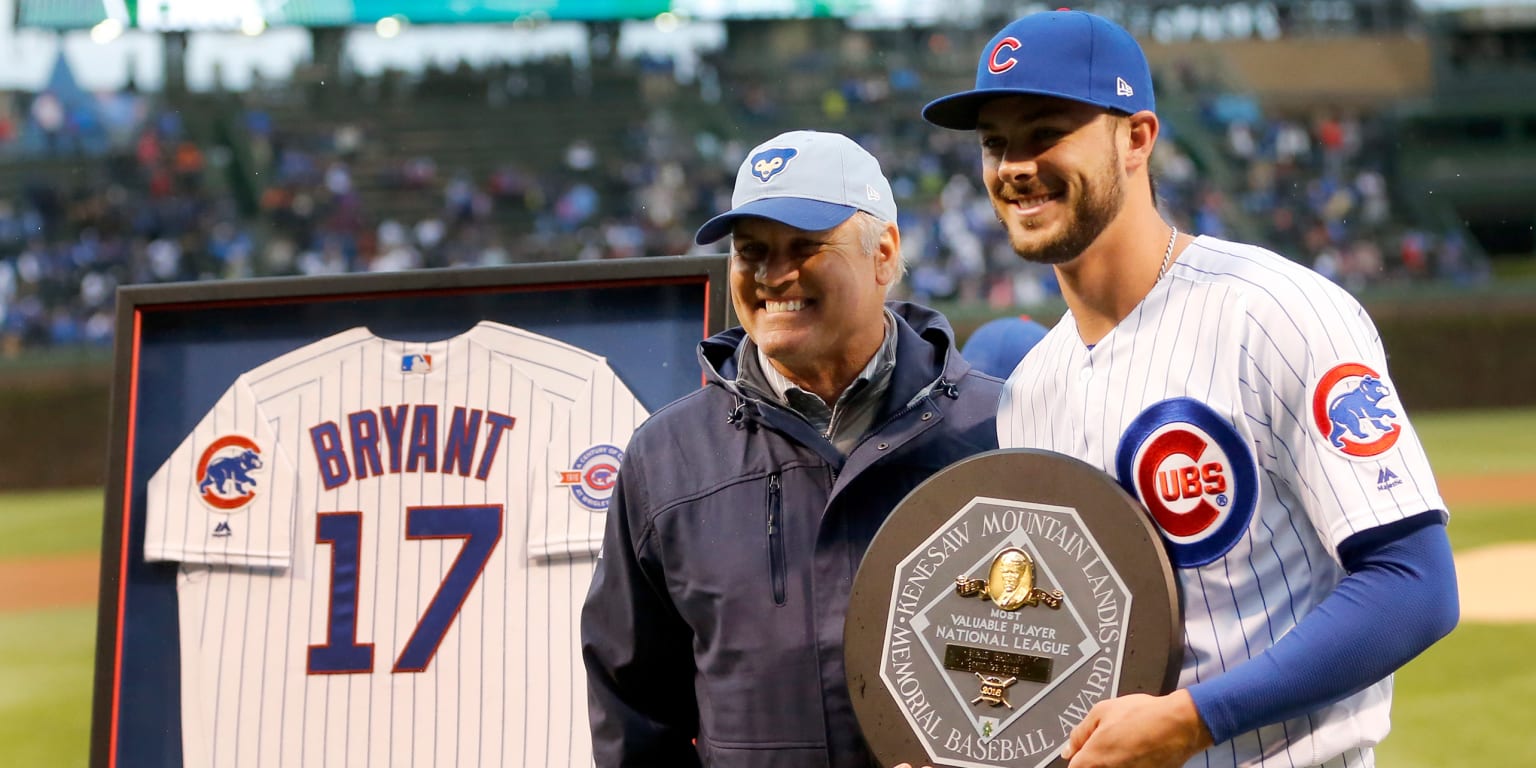
Back then, Javier Báez finished second behind Christian Yelich in the NL race, just two seasons after his teammate, Kris Bryant, became the most recent Cub to win NL MVP in 2016.
Now, Pete Crow-Armstrong -- Chicago’s defensive wunderkind fresh off the franchise’s first 40-40 season -- looks like the favorite to snap the Cubs’ decade-long MVP drought. Should he secure the award on Thursday, he’ll be joining some elite company.
Since the Baseball Writers' Association of America took over MVP voting in 1931, eight Cubs players have won the NL MVP Award, starting with one of the best catchers in franchise history:
1. Gabby Hartnett, 1935
By 1935, Harnett had already spent 13 seasons assembling a high-quality career as Chicago’s backstop, even finishing with down-ballot MVP votes in both 1933 and ‘34. Come the following season, at age 34, the future Hall of Famer proved he had plenty left in the tank.
Hartnett was one of the best hitters on the ‘35 club, batting a then-career-high .344 while leading the team with 91 RBIs. While he thrived at the plate, he was just as imposing behind it, finishing with a league-leading 77 assists while topping the Majors with a 60.3 percent caught-stealing rate. Toss in the fact that he helped guide a pitching staff that posted an MLB-best 3.26 ERA, and it was clear Hartnett’s impact was felt across the entire diamond.
Harnett helped guide the Cubs to the 1935 World Series, where they fell in six games to Detroit. Though the year ended in defeat, Hartnett found a nice consolation when the votes were tallied and he had edged out fellow future Hall of Famer Dizzy Dean by nine points to secure the only MVP Award of his Cooperstown-caliber career.
2. Phil Cavarretta, 1945
Ironically, the best season of Cavarretta’s 22-year career was partly a result of an ailment that kept him away from World War II battlefields. The Chicago native was exempt from military service due to a perforated eardrum, so he stayed on the diamond and put up numbers that made him a near-unanimous MVP.
Cavarretta led the league in both batting average (.355) and OBP (.449). Both numbers represented career highs, as did his 97 RBIs. He posted a .955 OPS over the final two months of the season, and he eventually hit .423 over a seven-game World Series loss to the Tigers.
Cavarretta played 10 more seasons in the bigs, but he never again saw the same level of success he did in 1945.
“It was the kind of a year you dream of,” Cavarretta said of his campaign. “Everything has to go your way; your line drives have to drop, your broken-bat hits have to drop.”
3. Hank Sauer, 1952
By the start of the 1952 season, the slugging Cubs outfielder had already established himself as “The Mayor of Wrigley Field.” But once that campaign wrapped, Sauer -- at age 35 -- had earned himself league-wide recognition.
Sauer finished the ‘52 season with 37 homers, tied with Ralph Kiner for tops in the Majors. His 121 RBIs were a career high and the most in MLB; nobody else on the Cubs tallied more than 67 that season. Even more impressive is the fact Sauer could’ve produced more had it not been for a neck injury suffered trying to break up a double play in mid-August.
Sauer slumped over the final month, though he still notched his 37th homer on Sept. 11 while suffering spasms and vision impairment. By then, though, he had done enough to eventually edge out future Hall of Famer Robin Roberts in MVP voting, despite the fact Chicago finished in fifth place that season.
4. Ernie Banks, 1958-59
The man endearingly remembered as “Mr. Cub” is still the only player in franchise history to win MVP honors more than once. He just so happened to accomplish that feat while becoming the first player in National League history to win it in back-to-back seasons.
Banks had already earned two Top 6 finishes in MVP voting by the 1958 season. Turns out all it took to put him over the top was setting a Major League record. His 47 homers in ‘58 were the most ever hit by a shortstop, a record that stood for 43 years. Banks slugged an NL-best .614 that season, while also tallying an MLB-leading 129 RBIs.
One year later, Banks plated a career-high 143 runs despite playing in just one more game than the previous season. He was worth 10.2 wins above replacement in 1959 (per Baseball Reference), a single-season number topped by only five other shortstops in MLB history.
Not that it needed to be said, but Banks didn’t need to sweat out a close MVP vote in either of those campaigns.
5. Ryne Sandberg, 1984
Sandberg had already established himself as a defensive standout for Chicago by 1984, having secured the first of his nine career Gold Glove Awards the previous season. But this particular campaign marked the moment he began making a name for himself with his bat, too.
Sandberg, who slugged .361 over his first two seasons in Chicago, finished 1984 with 74 extra-base hits and tied for first in MLB with 19 triples. He slashed .314/.367/.520, with each metric representing a career high by a wide margin, all while maintaining his trademark defense with an NL-leading 550 assists and committing just six errors.
His trademark moment of the ‘84 campaign occurred on June 23, in a contest simply known as “The Sandberg Game.” That day, Sandberg tallied five hits -- including homers in the ninth and 10th inning, both off Hall of Famer Bruce Sutter -- and seven RBIs to power a 12-11 Cubs win.
“It was the turning point of my career,” Sandberg recalled in “The Baseball Game I'll Never Forget: Fifty Major Leaguers Recall Their Finest Moments.” “It completely changed my life.”
It also helped make that year’s MVP vote a no-brainer.
6. Andre Dawson, 1987
Dawson’s 1987 began with him heading to Cubs Spring Training and giving then-GM Dallas Green a blank contract to sign. He’d spent 11 seasons playing on artificial turf in Montreal, and he felt the natural grass of Wrigley Field would be better for his surgically repaired knees.
“Feel free to fill in your own numbers,” his agent Dick Moss told Green at the time. Dawson signed for $500,000, but he could receive $250,000 in incentives. All he had to do was make the All-Star Game (and start in it) while earning NL MVP honors.
Just a few months later, he checked off all three boxes.
Dawson tied for the MLB lead with 49 homers, 17 more than his previous career high. He also led the Majors with 137 RBIs. Prior to 1987, he’d only topped 100 RBIs in a season one time.
Dawson indeed earned a start in the outfield for the 1987 All-Star Game and, despite the Cubs finishing the season in last, he edged out Cardinals shortstop Ozzie Smith by two first-place votes to secure the lone MVP Award of his career.
Not bad for a last-minute signing.
7. Sammy Sosa, 1998
Sosa was already an established power hitter for the Cubs by the late 90s. In the ‘98 season, he became a nationwide phenomenon.
The then-29-year-old spent that entire summer going toe-to-toe with Cardinals slugger Mark McGwire in the chase to break Roger Maris’ record of 61 homers in a single season. Well, maybe not the whole summer. After all, he didn’t even enter the discussion until he slugged a record-breaking 20 blasts in the month of June.
Though he came up just shy of McGwire, who finished the year with 70 homers to Sosa’s 66, the Cubs outfielder still led the Majors in both runs (134) and RBIs (158) while helping guide Chicago to its first playoff appearance since 1989. He took home 30 first-place votes to easily win NL MVP, quite a turnaround for a player already on his third team after opening his career with years of struggles at the plate.
8. Kris Bryant, 2016
Bryant famously struck out three times during his MLB debut on April 17, 2015, and then almost immediately erased any concerns that the Cubs’ then-top prospect might not be ready for the bigs. He finished the season as the unanimous NL Rookie of the Year, then proceeded to put forth an even better campaign in 2016.
Bryant, the second overall pick of the 2013 Draft, helped issue a new era of success on the North Side by leading the eventual 2016 World Series winners in homers (39) and hits (176) while finishing the year with an NL-best 121 runs. The season featured both his first career five-hit game and his first three-homer game, which happened to take place on the same day in a June 27 win over the Reds when he became first player in modern MLB history (since 1913) to hit three home runs and two doubles in the same game.
That November, just a few days after fielding the final out of the 2016 World Series, Bryant secured NL MVP honors with 29 first-place votes. In doing so, became just the fourth player to win the MVP Award one season after earning Rookie of the Year honors, joining Dustin Pedroia (2007-08), Ryan Howard (2005-06) and Cal Ripken Jr. (1982-83).