
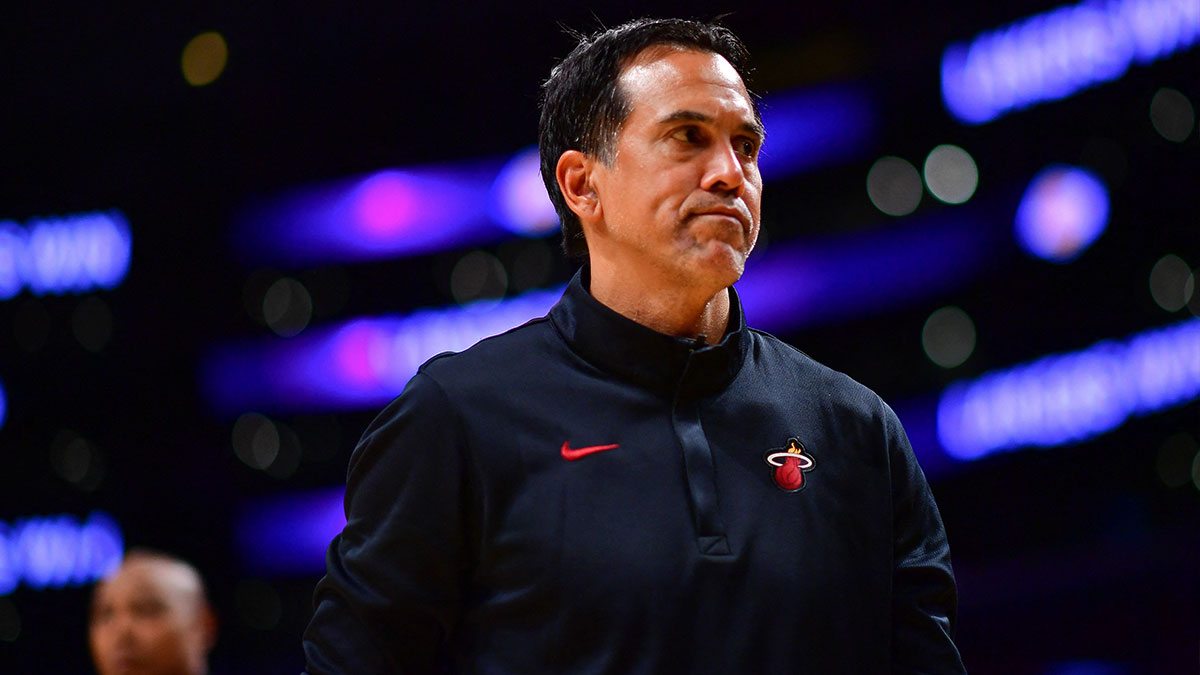
With the Miami Heat taking on the Cleveland Cavaliers in NBA Cup group play action on Friday night, the team is looking to continue to improve after their second-straight win on Tuesday against the Utah Jazz, 115-109. As the Heat come back home after the five-game West Coast road trip, head coach Erik Spoelstra gave insight into the evolving rotation that he's still looking to lock down.
Spoelstra has been working diligently to see what rotations work best with the team that started off 0-4, and while Miami has won five of their last seven games, a consistent rotation has been hard to find. With moves such as benching Andrew Wiggins to start Pelle Larsson the last two games or Tim Hardaway Jr.'s minutes dwindling, leading to a did-not-play (DNP) on Tuesday, Spoelstra has gone to other options.
Even looking at the aforementioned win over Utah, Spoelstra deployed Myron Gardner and Simone Fontecchio in meaningful minutes after they each played two and five minutes, respectively. It was also another game in which Nikola Jovic didn't log any minutes, with Bobby Portis Jr. and Ryan Conwell being the mainstays at the moment in the second unit.
Heat's Erik Spoelstra on the “tough decisions” he has to make
Speaking after Thursday's practice, Spoelstra admitted how “some of these decisions are tough for me,” and also acknowledged how it could be hard for players to “find their rhythm,” according to The Miami Herald.
Article Continues Below“It’s tough for some of the guys to find their rhythm. Right now, we have to overcome all of that and put things aside and just figure out a way to make that second unit a positive,” Spoelstra said. “Right now, it’s clear minds. Be a positive on the scoreboard, change the energy of the game, and then we’ll sort through rhythm, touches, getting guys playing comfortably the way that they are. But that second unit can be a game-changing energy unit.”
In that win over the Jazz, the Heat's bench outscored Utah by 5.9 points per 100 possessions, as it remains to be seen how Spoelstra continues to evolve the second unit.