
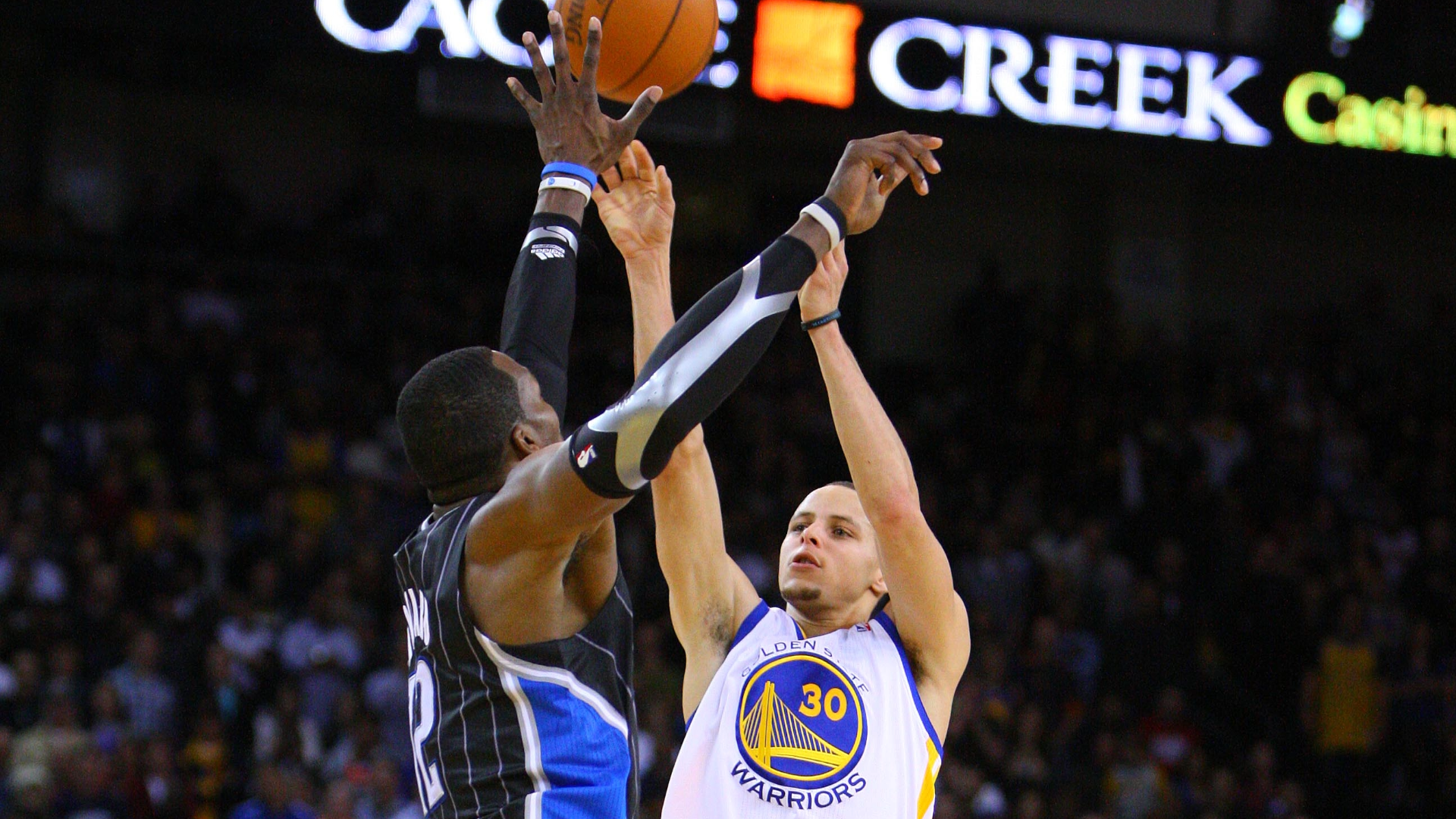
It is exceedingly rare for teams to have a chance to trade for one of the greatest players in NBA history. There were never serious rumors, for instance, about LeBron James or Michael Jordan getting traded. Magic Johnson and Kobe Bryant both issued public trade demands, but pulled back before a deal was consummated. Players like this, for the most part, don't make it to the rumor mill because nobody ever thinks they're seriously available.
The exception to this, bizarrely, has been Stephen Curry. Though the rumors all died once he hit his prime, there is a rich history of teams that nearly traded for the greatest shooter of all time before he became, well, the greatest shooter of all time. At least three notable deals were reportedly scuttled at the finish line:
- On the night of the 2009 NBA Draft, Curry was almost traded for Phoenix Suns star Amar'e Stoudemire. The Suns at the time were run by current Golden State Warriors head coach Steve Kerr. Curry's father, current Hornets broadcaster and former NBA player Dell Curry, later revealed that Kerr called him asking not to take Curry to his press conference after getting drafted. "We have a trade that they reneged on," Curry says Kerr said at the time. He did go through with that press conference, and Kerr would eventually get to work with Curry in Golden State instead of Phoenix.
- Curry and Klay Thompson were almost traded to the New Orleans Hornets for Chris Paul in 2011, Ethan Sherwood Strauss reported in his book "The Victory Machine." Paul, in an interview with UNINTERRUPTED, explained that he told the Warriors that he would not sign an extension with the Warriors.
- One of the foundational moves of Golden State's ascent was its decision to trade its other explosive scoring guard, Monta Ellis, for Andrew Bogut in part to seemingly hand the reins of the offense to Curry in 2012. The only problem? Several stakeholders have attested that Curry, not Ellis, was originally meant to be in that trade. "That was the deal," former Bucks owner Marc Lasry told The Athletic in 2019. "But the Bucks' medical staff didn't think Steph's ankle would hold up. That killed the deal." Bogut himself backed up this assertion in an interview on the House of Strauss podcast, saying Milwaukee's medical team told him as much. "I had a good relationship with them, so they just blatantly told me: 'The other option was Steph and his bad ankle. We decided to go with Monta.' So I was like, 'Alright.'"
There have been various levels of denial involved in all of these rumors, and we'll never really know all the details, but again, it's not as though we hear about this many botched deals for most of Curry's contemporaries. Of course, Curry differs from those contemporaries in one key way: he was not a sure thing. James came into the NBA as a preordained star. Anyone claiming they knew what Curry was going to become is almost certainly lying. There was quite a bit of doubt about him early in his career, and that doubt informs our latest entry into the Curry trade chronicles.
Dwight Howard appeared on the AM Hoops Show on Saturday and shared something few would be eager to admit: he told his former team, the Orlando Magic, not to trade for Stephen Curry. "I wanted to play with Monta Ellis and the Magic wanted to get Steph. The Magic wanted to get Steph and I said no. I said no because I didn't know. I didn't know Steph Curry was going to be one of the greatest," Howard said, regretfully. Asked specifically if the Magic came to him with this, he confirmed. "At the time, Monta was the one who was playing all the minutes," he added.
Howard did not offer a specific trade proposal or window of time when this could have happened, but two options come to mind. The first would be during the 2010-11 season, when Orlando revamped its team in mid-December by making two blockbuster deals that sent Vince Carter, Rashard Lewis, Marcin Gortat and Mickael Pietrus out while bringing back Gilbert Arenas, Hedo Turkoglu, Jason Richardson and Earl Clark. This would make sense as a period of roster transition, and Ellis was the league leader in minutes that season, averaging more than 40 per game across 80 appearances.
But Curry was no slouch that season when it came to availability either. He appeared in 74 games and averaged nearly 34 minutes. His availability didn't become a major concern until a year later, when ankle injuries limited him to just 26 games. At that point, his trade value would have been at its lowest, and Howard's leverage with the team would have been at its height. Howard had a player option for the 2012-13 season that he surprisingly exercised... even though the Magic didn't acquire Ellis. Orlando still wound up trading Howard to the Los Angeles Lakers in the summer of 2012.
On paper, Curry was perhaps the perfect guard to pair with Howard at his peak. Of course, Curry was and remains the perfect player to pair with just about anyone, but Howard, specifically, tried and failed to mesh with two high-usage star guards in Kobe Bryant and James Harden. Curry's eagerness to play off of the ball would have allowed Howard more post-up possessions, a priority of his at the time even if such plays didn't represent great offense. The team could have run through Howard, but still benefitted enormously from the young Curry's presence before eventually shifting in Curry's direction as Howard aged out of his physical prime.
Stan Van Gundy was a pioneer in the 3-point revolution, building a four-out lineup around Howard with players like Lewis and Turkoglu. It's tempting to think about what he could have done with a young Curry, especially since Van Gundy would miss another chance to coach him down the line, when he elected to take the Detroit Pistons job in 2014 rather than continuing to pursue Golden State's vacant position.
But if there ever really was a window for someone to swoop in and steal Curry, it closed after that third, injury-plagued season. Curry broke out in the 2012-13 season by leading the Warriors back to the playoffs, made his first All-Star team a year later, and then a year after that, he won the first of his two MVP awards and four championships. From that point forward, Golden State had no reason to ever entertain the notion of trading Curry, and Howard, like the Suns, Hornets and Bucks, was left to wonder about what might have been.
Ironically enough, Howard would get another chance to pair up with Curry in 2013, after Curry had proven himself as Golden State's lead guard. He was a free agent that offseason and met with the Warriors, but seemingly preferred Harden as his running mate, as he signed with the Houston Rockets. The Warriors turned around and used their cap flexibility to add dynasty mainstay Andre Iguodala, an essential part of a team that largely won without high-profile centers like Howard. With the benefit of hindsight, Howard might be one of the most important hidden figures in Golden State's rise to prominence. If he had any inkling of the sort of legend Curry was destined to become, the Warriors dynasty may never have happened.