
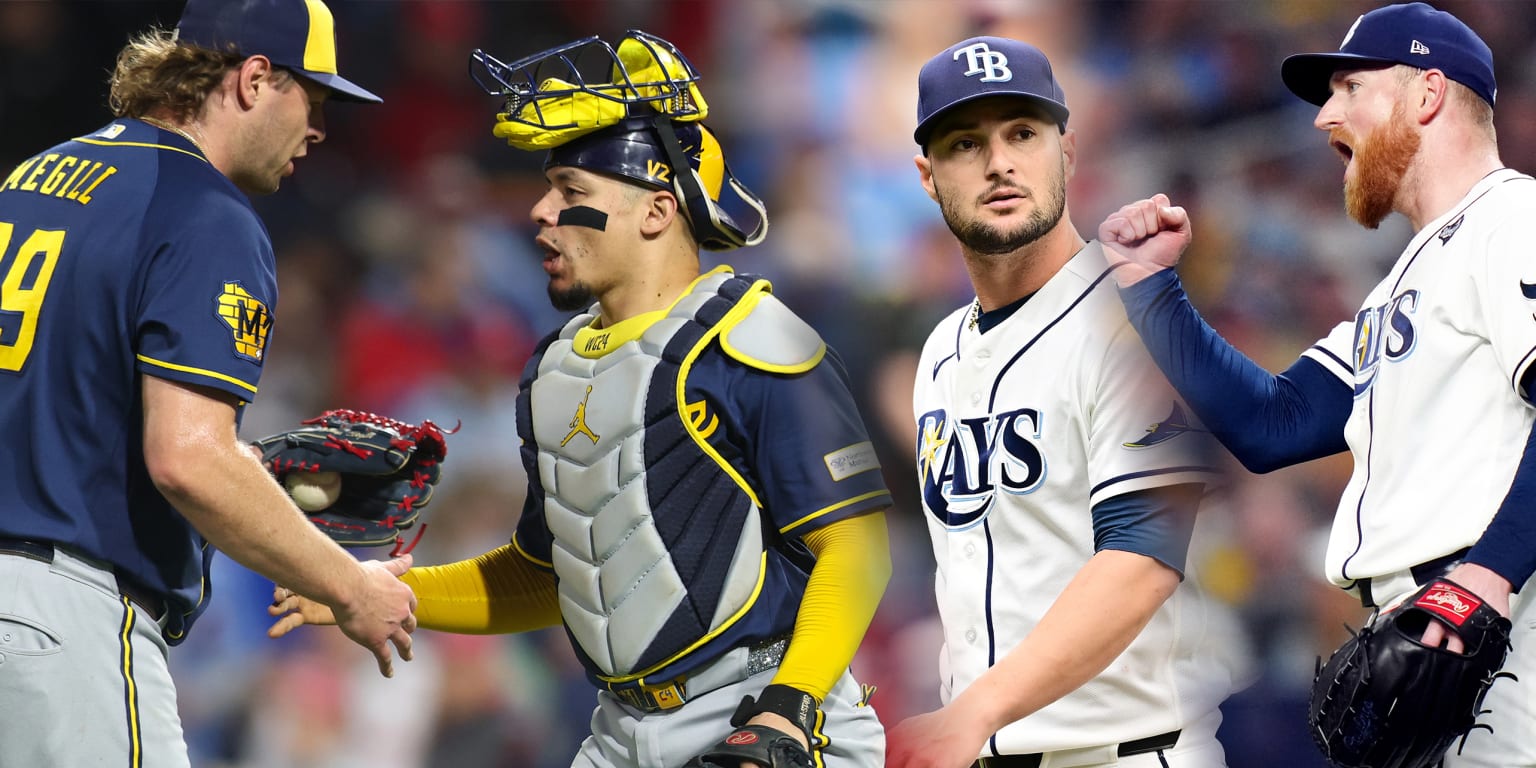
Four members of the Brewers formally became free agents before the 2026 champs even had their World Series parade.
That’s how fast the necessary business of the offseason comes at you.
Let’s explore the three key areas (free agents, trade candidates and extension candidates) that will impact the reigning pennant-winners in what figures to be an interesting winter.
BREWERS
Free agents
According to Cot’s Contracts data, the Brewers finished this season ranked 19th in MLB with a 40-man payroll at $154 million. That is the lowest rank by a World Series champion since the 2003 Marlins (24th), but it was also the second-highest payroll in franchise history (they ended 2024 at $162.8 million). Despite ranking last in market size among MLB’s 30 teams, the Brewers have been consistently punching above their market rank in recent years.
Cot’s estimates that, between guaranteed salaries, arbitration estimates and buyouts, the Brewers would be looking at a projected 40-man payroll of $115 million for 2027, inclusive of catcher and World Series MVP William Contreras’ no-brainer of a $15.5 million club option.
With that said, the Brewers will have to figure out how to maintain or replace the production of a few free agents. The most notable is NLCS MVP Jake Bauers, who will command a substantial rise from the $2.7 million he made during a breakthrough age-30 season in which he finished fourth on the team in bWAR (3.3). Other free agents include longtime starter Brandon Woodruff (who returned from shoulder surgery to pitch in the World Series) and two midseason acquisitions -- reliever JoJo Romero (120 ERA+ in 55 appearances in 2026) and starter Dustin May (85 ERA+ in 31 starts). The Brewers and backup catcher Gary Sánchez have a $1.75 mutual option or $250,000 buyout.
Trade candidates
The Brewers have made some very difficult decisions in recent years to trade away highly accomplished arms of Josh Hader, Devin Williams, Corbin Burnes and Freddy Peralta when they were within 16 months of free agency.
While the World Series championship perhaps presents a different dynamic this time around, the club’s past operations at least point to the possibility that Contreras would be in the same position. The aforementioned $15.5 million club option is the final year of contractual control before Contreras reaches free agency ahead of his age-30 season.
The Brewers are in the same position with closer Trevor Megill and first baseman Andrew Vaughn, both of whom are entering their final year of arbitration-eligibility.
While it would be unusual and, in all likelihood, unpopular for a reigning World Series winner to trade away either of those pieces, it would be in line with the methods the Brewers’ excellent front office have used in the past to consistently churn out competitive rosters on a budget. Note, though, that there have been exceptions, most notably the club’s decision to keep star shortstop Willy Adames for his final year of control in 2024.
With no proven catching solution on the roster beyond Contreras, the Brewers could opt to give Contreras the Adames treatment. They would seemingly be in a better position to replace Megill and/or Vaughn in-house should they opt to move one or both.
Extension candidates
The Brewers have done an excellent job locking up core pieces. Captain Christian Yelich doesn’t provide the on-field impact he once did, but the hometown discount he took back in 2020 has benefited the organization’s overall stability. Outfielder Jackson Chourio ($8.25 million salary for 2027), left-hander Aaron Ashby ($5.7 million) and shortstop Cooper Pratt ($3.9 million) are all locked in under reasonable terms.
Looking ahead, the Brewers will have to factor in the arbitration timetables and expected salary bumps for second baseman Brice Turang (a “Super Two” entering his second of four possible arbitration rounds) and outfielder Garrett Mitchell (entering his second of three arbitration rounds).
Turang is pretty easy to identify as a potential extension priority, given the likely trajectory of his arbitration price tags. The same might even be said of likely NL Cy Young Award winner Jacob Misiorowski, who is still two full seasons away from arbitration eligibility but looks to have the talent to break arbitration records on his current trajectory.
Of course, extending Contreras instead of trading him or merely keeping him for his final year of control is also an option. The Brewers could follow organizational precedent in locking up a prospect like Jesús Made or Andrew Fischer prior to either reaching the big leagues.
Obviously, any of the above would cut into whatever budget capabilities the Brewers have. But extensions are far more common with this front office than free-agent splashes.
RAYS
Free agents
The Rays haven’t ranked higher than 24th at the end of the year in 40-man payroll since 2011, according to Cot’s. They have a new ownership group and a new ballpark opening in 2029, which could eventually alter the equation significantly. We just don’t know for sure how much that will move the needle in the immediate future.
What we do know is that the Rays finished 2026 with an estimated payroll of $112 million when calculated for luxury tax purposes, according to Cot’s. That same site estimates their projected 40-man payroll for 2027 to be $103 million, when Yandy Díaz’s vested $13 million option, Drew Rasmussen’s escalator-driven $20 million club option and estimated arbitration raises for the likes of Shane McClanahan, Jonathan Aranda, Griffin Jax and Bryan Baker are all taken into account.
So you can see that the Rays don’t have a lot of wiggle room between where they were and where one might project them to be.
With all that said, the Rays’ free agents include ALCS MVP Freddy Peralta, starter Nick Martinez, infielder Jorge Mateo and outfielder Cedric Mullins.
Peralta and Martinez (who will receive a $4 million buyout after opting out of his 2027 contract) joined Rasmussen and McClanahan in accounting for 42 of the club’s 54 quality starts this season. Keeping that group together would require a substantial raise of the Rays’ spending floor, otherwise the club’s elite rotation will look quite a bit different next year.
Trade candidates
The Rays are highly transactional, and their postseason roster included 16 players and 31.2 bWAR acquired in trades.
So… expect trades.
Rasmussen’s excellent 2026 ensured him a $20 million salary for 2027, which is below the market rate for a pitcher coming off a borderline Cy Young season but above the Rays’ typical spending behavior. When Tyler Glasnow was projected to make more than that going into 2024, the Rays traded him to the Dodgers (yet Glasnow enjoyed his time with the Rays so much that he was among the former members of the club in the stands at Tropicana Field rooting them on in the World Series).
Rasmussen’s big bump, Díaz’s $13 million salary and a massive arbitration class all combine for nearly $80 million in projected commitments to only 13 players. While not all of those arbitration-eligible players will be tendered contracts, this at least opens the door to the possibility of a trade involving Rasmussen, Díaz, McClanahan or others, given the Rays’ established history.
Rasmussen is the big one. He became a Ray in the first place when the club traded star shortstop Adames to the Brewers.
Extension candidates
While the Rays are exceptionally adept at cycling through impact players and restocking their system with cold, calculated transactions, it seems fair to suggest Caminero comes with a different equation. He has the combination of age (23) and output (consecutive 40-homer seasons and 10 bWAR across 2025-26) to become a genuine, perennial MVP candidate.
He’s also now just one season away from what figures to be a sizable bump in arbitration.
Caminero is exactly the type of player teams target as a cornerstone. But given his output to date and the aforementioned cost constraints we’ve typically seen from this franchise, an extension is highly complicated under the sport’s current financial format.
Pivoting away from trade possibilities referenced above, the Rays could potentially try to lock in someone like McClanahan or Jax as they enter their final year of team control. Again, though, existing contract commitments will impact how the Rays go about the business of their offseason, which could require trade creativity first and foremost.