
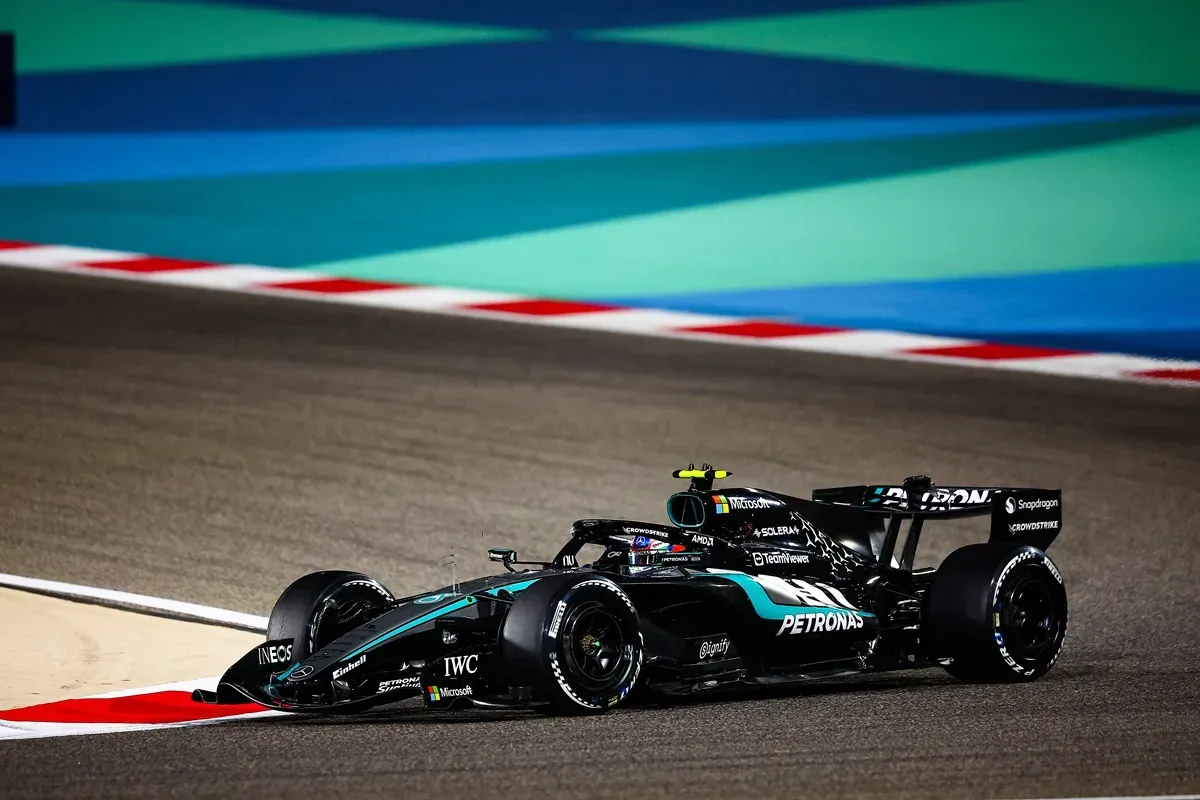
Formula 1 returns to Sepang this weekend for the first time since 2017, but the event is not officially the revived Malaysian Grand Prix.
Instead, Sepang International Circuit will stage the Formula 1 Gulf Air Bahrain Grand Prix in Malaysia from 2–4 October. The unusual arrangement restores the Bahrain round that could not take place at Sakhir earlier this season.
The Bahrain and Saudi Arabian Grands Prix were removed from their scheduled April dates because of the situation in the Middle East. Formula 1 and the FIA later reached an agreement with the governments of Bahrain and Malaysia for Sepang to host the Bahrain Grand Prix in October.
That decision brings Formula 1 back to one of its most recognisable Asian circuits nine years after Max Verstappen won the final Malaysian Grand Prix of the original run.
More importantly for the 2026 championship, Sepang arrives immediately after George Russell’s victory in Azerbaijan and begins another demanding stretch of races in hot and humid conditions.
Readers can follow the wider season through World in Sport’s Formula 1 coverage.
Embed from Getty ImagesWhy is the Bahrain Grand Prix taking place in Malaysia?
The explanation starts with the original 2026 calendar.
Bahrain had been scheduled to host Formula 1 at the Bahrain International Circuit from 10–12 April, followed by Saudi Arabia one week later. Both events were subsequently taken off those dates following an FIA review of the regional situation.
The FIA confirmed on 14 March that neither event would take place in April and that there would be no immediate replacement.
Formula 1 and the FIA then announced a different solution for Bahrain in July.
Malaysia agreed to provide Sepang as the venue while Bahrain retained the Grand Prix identity. The official event name therefore became the Formula 1 Gulf Air Bahrain Grand Prix in Malaysia.
That distinction matters. Formula 1 is returning to Malaysia, but this is not officially the Malaysian Grand Prix that ran at Sepang between 1999 and 2017.
The Formula 1 announcement described the agreement as a way of preserving a Bahrain Grand Prix that otherwise would not have taken place in 2026.
Formula 1’s current race calendar now lists Sepang as Round 16 of the championship, between Azerbaijan and Singapore. The season therefore contains 23 Grands Prix after Saudi Arabia’s cancelled round was not restored.
When is the 2026 Bahrain Grand Prix in Malaysia?
The race weekend runs from Friday, 2 October to Sunday, 4 October.
Sepang will use the conventional Grand Prix format rather than a Sprint weekend. Teams therefore have three practice sessions before qualifying on Saturday.
The Grand Prix starts at 15:00 local time on Sunday, which is 08:00 BST in the UK. Formula 1 has scheduled 56 laps of the 5.543-kilometre circuit.
| Session | Malaysia time | UK time |
|---|---|---|
| Practice 1 – Friday | 12:30 | 05:30 BST |
| Practice 2 – Friday | 16:00 | 09:00 BST |
| Practice 3 – Saturday | 12:30 | 05:30 BST |
| Qualifying – Saturday | 16:00 | 09:00 BST |
| Grand Prix – Sunday | 15:00 | 08:00 BST |
Times remain subject to change.
What makes Sepang different?
Sepang was one of the circuits that helped define Formula 1’s expansion into Asia.
The 5.543km layout opened in 1999 and combines long straights with medium and high-speed corners. There are 15 turns, while the wide track gives drivers several possible lines through parts of the lap.
Formula 1 will race over 56 laps for a scheduled distance of 310.398km.
The circuit also places considerable demands on tyres and drivers.
Malaysia’s heat and humidity can make cockpit conditions difficult, while tropical rainfall has repeatedly affected races at Sepang. A dry session can change quickly if rain develops around the circuit.
Those conditions could add another layer of uncertainty for teams still learning the characteristics of Formula 1’s new-generation cars.
The 2026 regulations introduced major changes to the chassis, aerodynamics and power units. The cars are smaller than their predecessors and use active aerodynamics alongside a substantially increased electrical contribution from the hybrid system.
World in Sport’s guide to the 2026 F1 regulations explains those changes in detail.
Sepang therefore presents something unusual. Formula 1 knows the circuit well historically, but no team has raced the current generation of machinery there.
Previous data remains useful for understanding the layout, yet teams cannot simply copy their 2017 set-ups.
Embed from Getty ImagesFormula 1’s history at Sepang
Malaysia first joined the Formula 1 World Championship in 1999.
Eddie Irvine won the inaugural race for Ferrari, although much of that weekend centred on Michael Schumacher’s return from the broken leg that had kept him out for several months.
Sepang then became a permanent fixture on the calendar.
Its combination of long straights, high-speed direction changes and unpredictable weather produced several memorable races. The circuit also became an important part of Formula 1’s growth in South-East Asia before the event left the championship after 2017.
Formula 1 and Sepang International Circuit jointly announced that departure during the 2017 season. The final Malaysian Grand Prix took place on 1 October that year.
Verstappen won for Red Bull after passing Lewis Hamilton in the early stages. Hamilton finished second for Mercedes, with Daniel Ricciardo completing the podium in the other Red Bull.
Sebastian Vettel recovered from the back of the grid to finish fourth for Ferrari.
Verstappen is therefore the most recent Formula 1 winner at Sepang entering the 2026 weekend.
However, nine years and an extensive series of regulatory changes separate the two events.
Championship battle arrives at Sepang after Baku
The timing of Sepang’s return also gives the weekend greater championship significance.
George Russell won the Azerbaijan Grand Prix on 26 September after starting from pole. He held off Verstappen by just 0.196 seconds, while Isack Hadjar completed the podium for Red Bull. Championship leader Kimi Antonelli recovered to fifth.
World in Sport’s Azerbaijan Grand Prix review covers the events in Baku in more detail.
Antonelli travels to Sepang with 302 points, while Russell has 236. That leaves the Mercedes drivers separated by 66 points. Lewis Hamilton sits third on 199 for Ferrari, ahead of Lando Norris on 186 and Charles Leclerc on 179.
Russell’s Baku result was his third Grand Prix victory of the season and reduced Antonelli’s advantage.
The championship leader still holds a substantial margin, but Sepang offers a very different challenge from Baku.
Mercedes have set the pace across much of 2026, with Antonelli and Russell occupying the top two positions in the Drivers’ Championship. Ferrari, McLaren and Red Bull have also shown competitive pace at different circuits.
Verstappen’s second place in Azerbaijan was another sign of improved Red Bull form. He now returns to a circuit where he won the previous Formula 1 race.
The Dutch driver will not be fighting from the championship position he occupied during some of his dominant seasons, but Sepang’s mix of fast corners, braking zones and long straights could give teams a clearer indication of their all-round performance.
Embed from Getty ImagesStrategy could become difficult to predict
Sepang has traditionally asked teams to balance straight-line speed against stability through its faster corners.
Tyre management will also matter.
High track temperatures can increase degradation, while rain can overturn a strategy within minutes. Teams must therefore prepare for several different scenarios rather than relying on one expected race pattern.
The long run from the final corner through the main straight also creates an opportunity for cars to attack under braking into Turn 1.
The second long straight later in the lap adds another possible overtaking area.
Track position will still matter, particularly if the field remains closely matched under the 2026 regulations. However, Sepang has more natural overtaking opportunities than many modern street circuits.
For newer Formula 1 fans, World in Sport’s F1 rules guide covers qualifying, tyres, pit stops and the championship system.
Sepang’s return is unusual rather than permanent
The 2026 race should not automatically be treated as the start of a full Malaysian Grand Prix comeback.
The confirmed arrangement concerns this year’s Bahrain Grand Prix and emerged from the exceptional circumstances surrounding the original race.
Formula 1 has named the event after Bahrain, Bahrain remains part of its official identity and Sepang is serving as the host venue in Malaysia.
There is therefore a difference between Formula 1 returning to Sepang and Malaysia regaining its old permanent place on the championship calendar.
For now, the immediate focus is the race itself.
Nine years after Verstappen took the chequered flag at the final Malaysian Grand Prix, Formula 1 will again tackle Sepang’s long straights, fast corners, tropical heat and uncertain weather.
This time, however, the Bahrain Grand Prix name will sit above the circuit.

World In Sport Forum
Continue the discussion
Join other fans in the World In Sport Forum and debate the biggest talking points from this article.