
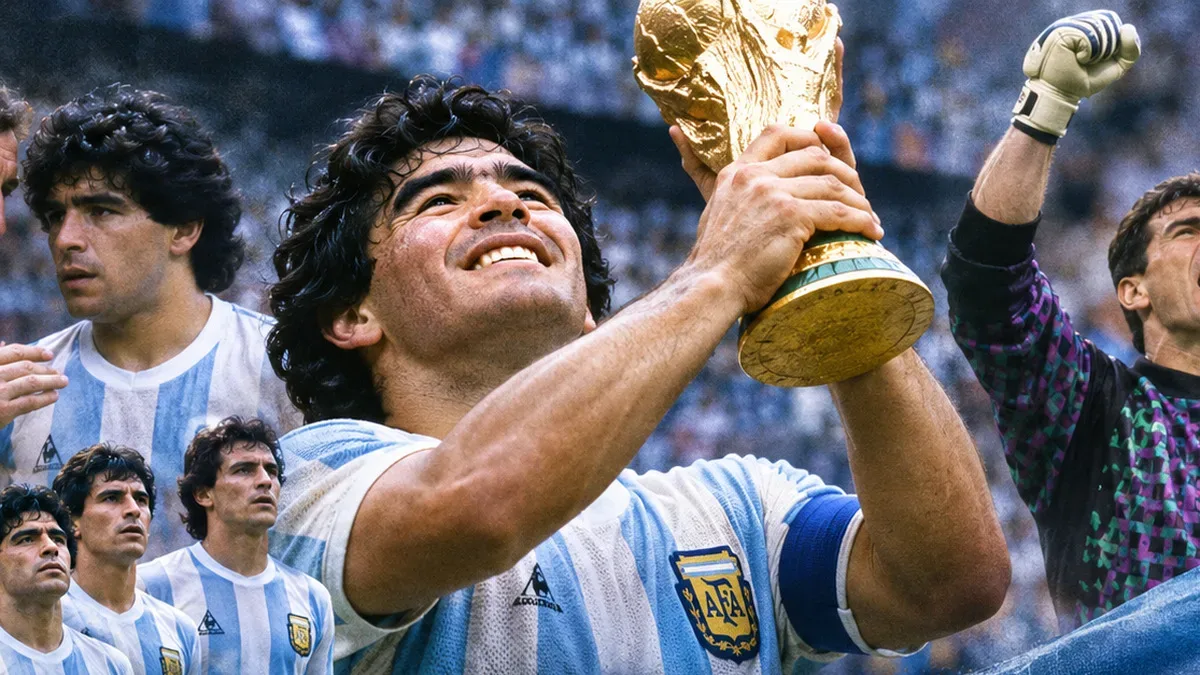
Argentina won the 1986 World Cup and reached the 1990 final under Carlos Bilardo, with Diego Maradona captaining both teams. The 1986 side combined tactical organisation, attacking partnerships and Maradona’s creativity to defeat West Germany 3–2 in the final.
The 1990 team was less consistent and more reliant on defensive resilience, penalty-shootout victories, Sergio Goycochea’s goalkeeping and individual moments from Maradona and Claudio Caniggia. Argentina lost 1–0 to West Germany in the final, concluding a significant period of international competitiveness.
Argentina’s national football team between 1986 and 1990 produced one of the most remarkable four-year periods in World Cup history. Under Carlos Bilardo, they won the 1986 tournament in Mexico and returned to the final four years later in Italy. Diego Maradona captained both sides, providing the creative brilliance around which Argentina built their identity.
Yet these were two very different campaigns.
In 1986, Argentina combined tactical discipline with Maradona’s extraordinary attacking influence. They went unbeaten through seven matches, defeating West Germany 3-2 in the final to secure their second World Cup.
By 1990, injuries, changes in personnel and inconsistent performances had weakened the defending champions. Argentina nevertheless reached another final, relying increasingly on defensive organisation, individual inspiration and exceptional goalkeeping.
Their achievements demonstrated two sides of international tournament football: the ability to dominate through a coherent playing system. The determination to survive when that system no longer functioned at its best.
To understand why this period remains significant. It is necessary to look beyond Maradona’s individual performances. Bilardo’s coaching, the contributions of his supporting players and Argentina’s ability to adapt were equally important to the team’s story.
How Carlos Bilardo rebuilt Argentina
Embed from Getty ImagesArgentina entered the mid-1980s seeking a new direction.
César Luis Menotti had guided the country to their first World Cup triumph in 1978, but Argentina failed to defend their title at Spain 1982. Maradona’s first World Cup ended with elimination in the second group stage and a red card against Brazil.
Bilardo replaced Menotti in 1983 and introduced a different tactical approach.
Where Menotti had become associated with expressive attacking football, Bilardo placed greater emphasis on organisation, positioning and adapting to opponents. His philosophy prioritised results without eliminating individual creativity.
The transition was difficult.
Argentina struggled to convince supporters during qualification for Mexico 1986. Their decisive home match against Peru ended 2-2, with Ricardo Gareca scoring the late equaliser that secured qualification.
Criticism surrounded Bilardo’s selections and tactical methods. His decision to make Maradona captain also represented a significant change in leadership.
Daniel Passarella, captain of the 1978 champions, remained in the 1986 squad but did not feature during the tournament.
Bilardo instead developed a team around Maradona, Jorge Valdano, Jorge Burruchaga and a group of disciplined defensive and midfield players.
The side did not possess an unlimited collection of attacking stars. Its strength came from clearly defined responsibilities and the ability to maximise the qualities of its leading footballer.
For readers examining the original tournament squad, World in Sport’s Argentina 1986 World Cup squad profile provides additional background on the championship-winning players.
The tactical system that gave Maradona freedom
Bilardo’s most important contribution was creating a tactical structure that allowed Maradona to influence matches without leaving Argentina exposed defensively.
His preferred system was commonly described as 3-5-2, although the exact attacking arrangement varied according to personnel and opposition.
Three central defenders provided cover, while wider players contributed to both defending and attacking.
José Luis Brown, Oscar Ruggeri and José Luis Cuciuffo formed an important defensive combination. Their positioning helped Argentina defend central areas while allowing players further forward to operate more aggressively.
Sergio Batista offered stability in midfield. Ricardo Giusti contributed energy, defensive work and tactical discipline, while Héctor Enrique supplied additional movement and passing.
Julio Olarticoechea provided width from deeper positions.
Burruchaga operated between midfield and attack, supporting Maradona while making forward runs when opportunities appeared.
Valdano supplied the main attacking reference point. His movement stretched opposing defences and created opportunities for Argentina’s captain to receive possession in dangerous positions.
Maradona enjoyed considerable attacking freedom.
Rather than remaining in one fixed position, he could move across the pitch, collect possession between the lines and accelerate towards goal.
The supporting structure was essential.
When Maradona advanced, other players maintained defensive balance. When opponents attempted to surround him, teammates offered passing options or attacked the spaces left behind.
Argentina could defend with numbers before releasing the ball towards their captain during transitions.
This made them particularly difficult to contain.
Bilardo did not invent the three-defender system. Earlier coaches had used comparable formations. However, his application of its principles was an important feature of Argentina’s 1986 success.
The system also had limitations.
Its attacking effectiveness depended heavily on Maradona’s availability and ability to create opportunities. When opponents restricted his involvement, Argentina could struggle to generate chances through alternative routes.
That dependence became increasingly apparent in 1990.
The players behind the 1986 triumph
Embed from Getty ImagesMaradona was the centre of Argentina’s attacking identity, but several teammates played indispensable roles.
Diego Maradona: The creative leader
Maradona was 25 when Argentina won the 1986 World Cup.
He scored five goals across seven appearances and received the Golden Ball as the tournament’s outstanding player.
His contribution extended beyond goalscoring.
He controlled attacking movements, drew opponents towards him and created openings through passing, acceleration and close control.
Opposing defenders frequently attempted to stop him through physical challenges. FIFA records that Maradona suffered 53 fouls during the 1986 tournament.
His influence was so significant that Argentina’s attacking strategy often began with finding him in space.
However, his best performances also highlighted the effectiveness of Bilardo’s supporting structure. Maradona had teammates prepared to defend, regain possession and make movements that complemented his creativity.
His wider career, including the importance of Mexico 1986, is explored in World in Sport’s Diego Maradona career profile.
Jorge Valdano: Movement and finishing
Valdano was Argentina’s principal centre-forward in Mexico.
The Real Madrid striker scored four goals, including two against South Korea and another in the final against West Germany.
His greatest contribution was not simply his finishing.
Valdano stretched defensive lines through intelligent movement, allowing Maradona to operate between midfield and attack.
He also provided a reliable outlet when Argentina moved possession forward quickly.
Without that movement, opposing defenders could have concentrated more heavily on Maradona.
Jorge Burruchaga: The decisive supporting attacker
Burruchaga gave Argentina another creative option and frequently connected their midfield with the attack.
His positional awareness allowed him to exploit space when defenders focused on Maradona or Valdano.
He scored twice during the tournament, including the winning goal in the final.
That contribution demonstrated why Argentina’s attacking threat could not be reduced entirely to their captain.
The defensive foundation
Ruggeri supplied experience and physical strength in central defence.
Brown contributed defensive leadership and scored the opening goal against West Germany in the final.
Batista helped protect the back line, while Giusti and Olarticoechea performed essential supporting roles. Goalkeeper Nery Pumpido completed the defensive structure.
These players rarely attracted the same attention as Maradona, but their collective organisation made his attacking freedom possible.
Mexico 1986: A World Cup campaign built on balance
Argentina began the 1986 tournament with a 3-1 victory over South Korea on 2 June.
Their opening performance demonstrated the value of Maradona’s creativity and Valdano’s movement.
Valdano scored twice, while Ruggeri also found the net.
A 1-1 draw against defending champions Italy followed, with Maradona equalising after Alessandro Altobelli had converted a penalty.
Argentina then defeated Bulgaria 2-0 to finish top of Group A.
Their knockout campaign began with a narrow 1-0 victory over Uruguay, decided by Pedro Pasculli.
The performance showed that Argentina could progress without depending on a spectacular individual goal from Maradona.
However, their next two matches transformed the tournament into a defining chapter of his career.
The England quarter-final
On 22 June 1986, Argentina faced England at the Estadio Azteca in Mexico City.
The match carried additional significance because of the political tensions surrounding the 1982 Falklands War.
Maradona scored twice in Argentina’s 2-1 victory, producing two moments that remain central to World Cup history.
His first goal came when he illegally used his hand to beat England goalkeeper Peter Shilton to the ball. The officials failed to identify the infringement, and the goal stood.
Four minutes later, Maradona collected possession inside his own half and dribbled through England’s defence before rounding Shilton and scoring.
FIFA subsequently recognised the second strike as the Goal of the Century.
Gary Lineker reduced England’s deficit late in the match, but Argentina held on.
The contrast between Maradona’s two goals remains inseparable from the occasion. One involved an undetected infringement; the other demonstrated extraordinary individual skill.
The fixture also features in World in Sport’s ranking of the greatest World Cup matches of all time.
Belgium and the road to the final
Argentina faced Belgium in the semi-final on 25 June.
Maradona again proved decisive, scoring both goals in a 2-0 victory.
His first came through intelligent movement and a delicate finish. His second followed another outstanding dribble through the Belgian defence.
Argentina’s collective organisation helped create the conditions for these moments.
Belgium could not concentrate exclusively on defensive containment without conceding opportunities elsewhere.
The victory secured Argentina’s place in their third World Cup final.
Across the tournament, Bilardo’s side had demonstrated defensive resilience, tactical adaptability and the ability to win close matches.
FIFA’s review of Maradona’s 1986 World Cup performances documents the progression of Argentina’s championship campaign.
The 1986 final against West Germany
Argentina faced West Germany at the Estadio Azteca on 29 June 1986.
The match became a defining examination of their ability to respond under pressure.
Brown opened the scoring in the 23rd minute with a header, giving Argentina an early advantage.
Valdano doubled the lead in the second half, finishing a move that reflected his importance to the attacking system.
At 2-0, Argentina appeared well placed to claim the trophy.
However, West Germany recovered through goals from Karl-Heinz Rummenigge and Rudi Völler.
Both goals came from corner situations, exposing weaknesses in Argentina’s set-piece defending.
With the score level at 2-2, momentum appeared to favour the Germans.
Argentina nevertheless retained the attacking quality needed to produce another decisive moment.
In the 84th minute, Maradona received possession and played a perfectly weighted forward pass into Burruchaga’s path.
The midfielder accelerated beyond the German defence and finished past Harald Schumacher.
Argentina won 3-2.
The goal illustrated the partnership between Maradona and his supporting players. Maradona recognised the opening, but Burruchaga’s timing, movement and composure completed the move.
Argentina finished the tournament unbeaten, with six victories and one draw.
They scored 14 goals and conceded five.
It was a convincing championship campaign, achieved against substantial opposition and completed with victory over one of Europe’s strongest international sides.
From world champions to an uncertain title defence
Argentina’s success in Mexico did not establish an uninterrupted period of dominance.
Over the following four years, Bilardo faced the challenge of maintaining the team’s competitiveness as players aged, changed clubs or became unavailable.
Several important members of the championship side remained involved, but the 1990 squad differed considerably from its predecessor.
Valdano was a particularly significant absence.
After leaving professional football in 1987 because of health problems, he attempted a comeback before the 1990 tournament. Bilardo ultimately omitted him from the final squad, citing concerns about his physical condition.
His absence removed an important attacking partner for Maradona.
Claudio Caniggia offered a different option.
The forward possessed exceptional acceleration and could threaten opponents through direct running into space.
However, his playing style did not replicate Valdano’s combination of movement, experience and attacking presence.
Argentina also struggled to maintain the consistency they had demonstrated in Mexico.
Their preparations for Italy 1990 generated considerable uncertainty, and the defending champions entered the tournament without the same convincing collective identity.
Italy 1990: Resilience replaces attacking authority
Embed from Getty ImagesArgentina’s title defence began disastrously.
On 8 June 1990, Cameroon defeated the defending champions 1-0 in Milan.
François Omam-Biyik scored the winning goal, delivering one of the tournament’s major surprises.
The defeat exposed Argentina’s attacking limitations and inability to control the match consistently.
Bilardo’s side recovered with a 2-0 victory over the Soviet Union, although the match also brought another setback.
Pumpido suffered a serious leg injury, forcing Sergio Goycochea into the team.
The replacement goalkeeper would become central to Argentina’s progress.
A 1-1 draw with Romania left Argentina third in their group. They advanced as one of the best third-placed teams under the tournament’s qualification system.
Their performances were considerably less convincing than those of 1986.
Yet knockout football offered another opportunity.
Maradona and Caniggia eliminate Brazil
Argentina faced Brazil in Turin on 24 June.
Brazil controlled substantial periods of the match and created several dangerous opportunities.
Argentina defended under pressure and struggled to establish sustained possession.
However, Maradona remained capable of changing a match through one attacking movement.
Late in the second half, he collected possession and advanced through Brazil’s midfield.
Drawing defenders towards him, Maradona released a pass to Caniggia.
The forward rounded goalkeeper Cláudio Taffarel and scored.
Argentina won 1-0.
The goal reflected a different version of the partnership that had proved successful in Mexico.
Rather than constructing regular attacking opportunities, Argentina relied on a moment of individual invention and Caniggia’s pace to exploit a defensive opening.
It was effective, but also demonstrated their reduced attacking consistency.
Goycochea transforms Argentina’s campaign
Argentina subsequently faced Yugoslavia in the quarter-finals.
The match finished 0-0 after extra time, forcing a penalty shoot-out.
Maradona missed his penalty, but Goycochea rescued Argentina with two decisive saves.
Argentina won the shootout 3-2.
The goalkeeper again proved decisive against hosts Italy in the semi-final.
Salvatore Schillaci opened the scoring for Italy before Caniggia equalised in the second half.
Neither side could find a winner during extra time.
Goycochea saved penalties from Roberto Donadoni and Aldo Serena, helping Argentina win the shoot-out 4-3.
The victory sent Bilardo’s team into another World Cup final.
The tournament’s official account of Argentina’s 1990 title defence highlights how the team’s fortunes increasingly depended on individual interventions.
The 1990 final and the end of Bilardo’s era
Argentina met West Germany again in the final on 8 July 1990.
The occasion offered an opportunity to retain the World Cup, but the defending champions entered the match severely weakened.
Caniggia, Giusti, Olarticoechea and Batista were unavailable through suspension.
Their absences disrupted Argentina’s attacking options and tactical organisation.
West Germany, managed by Franz Beckenbauer, approached the final with a more balanced and effective side. Lothar Matthäus supplied midfield leadership, while Andreas Brehme and other experienced internationals contributed to their attacking and defensive structure.
Argentina struggled to create clear chances.
Pedro Monzón was sent off during the second half, leaving Bilardo’s team with ten players.
West Germany eventually took the lead through Brehme’s 85th-minute penalty, awarded following a challenge by Roberto Sensini on Rudi Völler.
Gustavo Dezotti also received a red card before the final whistle.
Argentina lost 1-0, finishing with nine players.
The defeat ended their attempt to become consecutive World Cup champions.
Bilardo subsequently left the national team, bringing the period examined here to a close.
What separated the 1986 and 1990 teams?
The contrast between Argentina’s two World Cup campaigns provides the clearest assessment of this era.
In Mexico, Argentina had a coherent tactical structure, an effective attacking partnership, and Maradona operating near the peak of his powers.
They won six matches and scored 14 goals.
In Italy, they won only two matches outright, scoring five goals in seven appearances. Their other two knockout victories came through penalty shoot-outs.
The 1990 side were more dependent on defensive resistance, Goycochea’s goalkeeping and occasional moments of creativity.
Maradona also faced greater physical difficulties.
An ankle injury affected his performances, although he still produced the decisive pass against Brazil.
The 1986 team could create opportunities through several established attacking combinations.
By 1990, Argentina found those opportunities harder to manufacture.
Their progress remained impressive, particularly given the quality of Brazil and Italy, but reaching the final did not mean they had reproduced the standard of their championship-winning predecessors.
The distinction matters when assessing the team’s historical achievements.
How Argentina compare with other great World Cup teams
Argentina’s 1986 side deserves recognition among the most accomplished international teams because of their results, tactical organisation and exceptional individual performances.
However, comparisons with other eras require context.
Brazil’s 1970 champions offered a different example of attacking excellence, with Pelé, Jairzinho, Tostão and Rivellino contributing to a celebrated collective system.
West Germany’s great teams of the 1970s demonstrated sustained tournament competitiveness, while Italy’s 1982 champions showed how defensive discipline and individual attacking quality could produce success.
Argentina’s distinction in 1986 was the relationship between Maradona’s creative dominance and Bilardo’s carefully organised supporting structure.
Few World Cup-winning teams have depended so visibly on one player’s attacking influence while maintaining such clear collective responsibilities.
The achievement strengthens Maradona’s case in debates surrounding the greatest footballers of all time, although individual and team greatness should not be treated as identical measures.
Argentina’s achievement between 1986 and 1990 also demonstrated sustained competitiveness without continuous superiority.
They reached consecutive World Cup finals, but only their first campaign represented a consistently convincing run through the tournament.
This makes the era historically significant without requiring claims that Argentina were unquestionably superior to every other international side.
The lasting influence of Maradona’s Argentina
The most enduring feature of Argentina’s 1986–1990 period was its demonstration that exceptional individual talent could thrive within a demanding collective structure.
Bilardo’s methods emphasised positional discipline, tactical preparation and clearly defined responsibilities.
Maradona supplied the invention that transformed those principles into attacking opportunities.
Their partnership showed that creativity and organisation were not necessarily opposing football philosophies.
The championship-winning side also helped establish the three-defender formation as a credible option at the highest international level.
However, it would be inaccurate to attribute every subsequent use of that system directly to Bilardo. Comparable tactical ideas existed before 1986 and continued to develop independently.
Argentina’s influence also extended into the national team’s identity.
Their ability to compete under difficult circumstances became an important part of the country’s World Cup history.
Yet the two tournaments should be remembered differently.
Mexico 1986 represented tactical cohesion and exceptional individual performance working together. Italy 1990 demonstrated resilience, adaptability and the limitations of a team whose attacking strength had declined.
Maradona remained the central figure throughout, but the contributions of Bilardo, Valdano, Burruchaga, Ruggeri, Batista, Caniggia and Goycochea explain why Argentina achieved so much across both competitions.
The team’s greatest accomplishment was not simply reaching consecutive finals.
It was showing how an international side could build a championship-winning identity around a remarkable player, then remain competitive even as the circumstances that created that success changed.
Argentina’s 1986 triumph remains the defining achievement of Bilardo’s tenure. Their return to the final in 1990 gives the era a broader significance, illustrating both the possibilities and the limitations of building a team around one outstanding footballer.

World In Sport Forum
Continue the discussion
Join other fans in the World In Sport Forum and debate the biggest talking points from this article.