
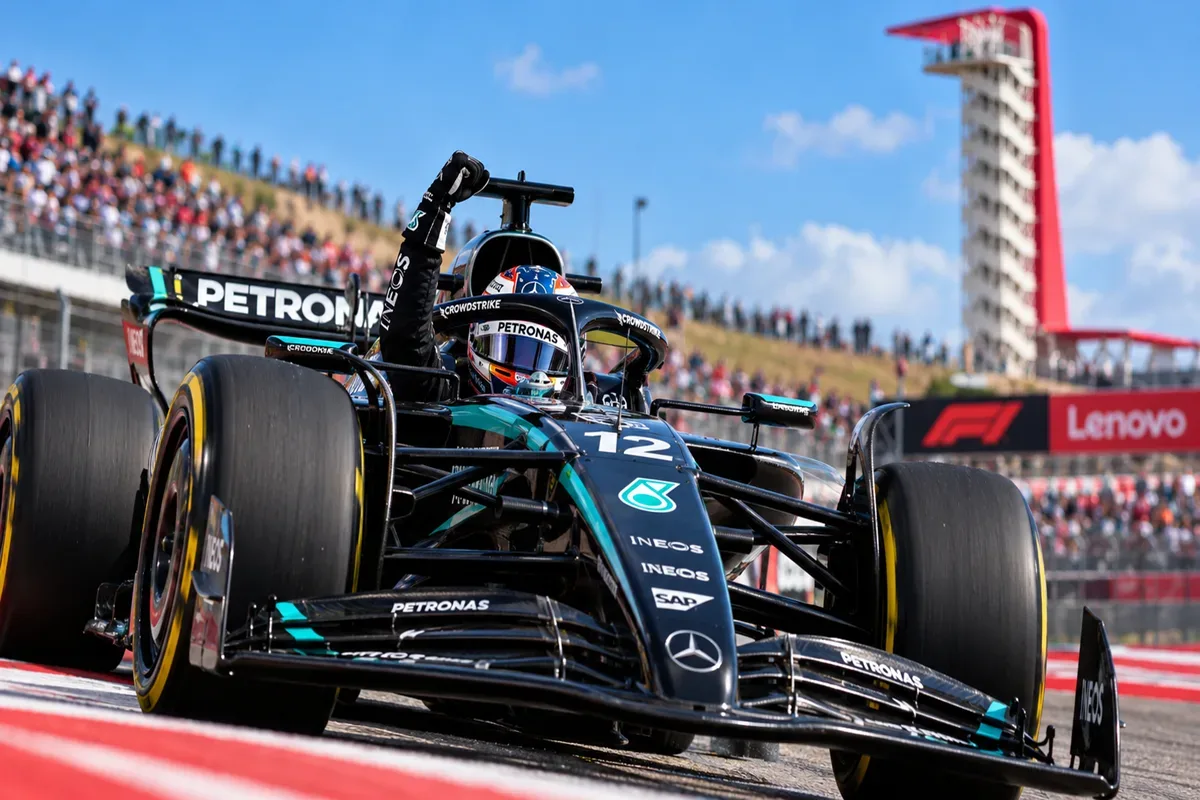
Kimi Antonelli claimed pole position for the 2026 United States Grand Prix on Saturday, 24 October, beating Max Verstappen in qualifying at the Circuit of the Americas as the Mercedes driver moved a step closer to securing his first Formula 1 World Championship.
Verstappen secured second for Red Bull, while team-mate Isack Hadjar completed the top three. Ferrari, who had dominated all three practice sessions, could not maintain that advantage when qualifying reached its decisive stage.
Charles Leclerc finished fourth, ahead of Lewis Hamilton in fifth, leaving Ferrari with work to do when Sunday’s 56-lap race begins.
The result gives Antonelli the strongest possible starting position for a weekend in which he could become Formula 1’s youngest world champion.
However, the championship remains dependent on more than his own performance. Antonelli must win Sunday’s Grand Prix and hope that his nearest challengers finish sufficiently far behind.
World in Sport’s United States Grand Prix 2026 preview examined the championship situation before the weekend. Qualifying has now strengthened Antonelli’s position, although Verstappen remains a substantial threat to his hopes of victory.
Antonelli delivers when Mercedes need him most
Ferrari entered qualifying as the team to beat after topping every practice session in Austin.
However, Antonelli gradually established himself as a leading contender through the three qualifying stages.
The Italian finished behind Leclerc in Q2 before producing the decisive performance in Q3.
The final qualifying order, reported by RacingNews365, placed Antonelli ahead of Verstappen and Hadjar, with both Ferraris occupying the next two positions.
It was an important response from Mercedes after Friday’s running suggested Ferrari and Red Bull might hold the advantage over a single lap.
Antonelli had already demonstrated his competitiveness during second practice, finishing just 0.042 seconds behind Leclerc.
Yet the transition from practice to qualifying is rarely straightforward at Austin.
The circuit’s uneven surface, changing grip and demanding first sector can make finding a consistent car balance particularly difficult.
Antonelli managed those challenges effectively enough to secure pole position, giving Mercedes an opportunity to end Verstappen’s recent run of victories.
Embed from Getty ImagesVerstappen and Hadjar give Red Bull a strong qualifying result
Although Antonelli secured pole, Red Bull also emerged from qualifying with reasons for confidence.
Verstappen will line up alongside the Mercedes driver on the front row after continuing the competitive form that brought him victories in Malaysia and Singapore.
The four-time world champion has been one of Formula 1’s strongest performers during the closing stages of the season.
His victory in Singapore followed another win at Sepang, demonstrating that Red Bull have become increasingly competitive after a difficult opening period.
World in Sport recently examined that improvement in its analysis of Verstappen’s Singapore Grand Prix victory.
Austin provides another opportunity to establish whether that progress can produce sustained success.
Verstappen also knows the circuit exceptionally well.
He won the 2025 United States Grand Prix from pole position, controlling the race ahead of Lando Norris and Leclerc.
Starting second this year gives him an immediate opportunity to challenge Antonelli.
The approach to Turn 1 is particularly important. Drivers climb a steep hill before reaching a wide left-hand corner, creating several possible braking lines.
A strong launch could bring Verstappen alongside the Mercedes before the first corner.
However, he will also need to consider the presence of Hadjar immediately behind.
The Frenchman secured third place in qualifying, giving Red Bull two cars inside the top three.
That result improves the team’s prospects in the Constructors’ Championship, where Red Bull entered Austin seven points behind McLaren.
Hadjar’s position could also influence the early stages of Sunday’s race.
If both Red Bull drivers maintain their places near the front, Mercedes may have to consider a wider range of strategic possibilities.
Nevertheless, qualifying pace does not automatically translate into race performance, particularly over a demanding 56-lap distance.
Ferrari’s practice advantage disappears in qualifying
Ferrari arrived in Austin with an updated aerodynamic package and immediately demonstrated encouraging pace.
Leclerc topped both Friday practice sessions, while Hamilton led Saturday’s final hour.
Hamilton recorded a 1:34.893 in FP3, finishing 0.168 seconds ahead of Verstappen and 0.234 seconds clear of Leclerc.
The result completed a clean sweep of practice sessions for Ferrari.
However, the competitive order changed during qualifying.
Leclerc remained in contention throughout the session and topped Q2, but neither Ferrari driver could match Antonelli when it mattered most.
Fourth and fifth represented a disappointing outcome after the team’s earlier performances.
Before qualifying, Leclerc had already warned against drawing excessive conclusions from Friday’s results.
He believed Mercedes and Red Bull still had performance to unlock, despite Ferrari’s encouraging start.
Those concerns proved justified.
The immediate question for Ferrari are whether their long-run performance will be stronger than their final qualifying positions suggest.
Practice results demonstrated that the upgraded car could perform competitively around Austin’s varied corners.
However, race conditions will introduce different demands.
Fuel loads, tyre wear and traffic could alter the balance between Ferrari, Mercedes and Red Bull.
Hamilton and Leclerc must also consider their opening-lap approach.
Both start close enough to the leading group to challenge for podium positions, but an aggressive move carries additional risk if several drivers converge at Turn 1.
Embed from Getty ImagesWhat does Antonelli need to win the F1 championship?
Antonelli arrived at the United States Grand Prix with 340 points, holding a 102-point advantage over Mercedes team-mate George Russell.
Hamilton occupied third place with 229 points, while Verstappen followed on 221.
With six Grands Prix remaining before Austin, a maximum of 150 points remained available.
That total will fall to 125 after Sunday’s race.
Consequently, Antonelli can secure the championship in Texas only if he wins and his nearest rivals fail to score enough points.
The required results are straightforward:
- Antonelli must win the United States Grand Prix.
- Russell must finish ninth or lower.
- Hamilton must finish fifth or lower.
Victory would give Antonelli 25 points, extending his advantage over Russell and Hamilton if those conditions are met.
World in Sport’s guide to the Formula 1 points system explains how championship points and countback rules determine the final standings.
Pole position itself carries no championship points.
It does, however, allow Antonelli to control the race from the front rather than recover positions through strategy or overtaking.
Russell’s qualifying performance leaves him with a more difficult task than his team-mate, while Hamilton will begin from fifth.
Even if Antonelli wins, the championship may remain undecided if Russell collects enough points.
That distinction matters because Mercedes must balance the immediate opportunity to secure the Drivers’ Championship against the team’s wider race objectives.
Antonelli does not need to win the title this weekend to remain firmly in control of the standings.
A strong points finish would preserve much of his advantage heading into Mexico City.
Why the Circuit of The Americas makes strategy important
The Circuit of The Americas presents a demanding combination of fast corners, heavy braking zones and long straights.
Its 5.513km layout features 20 corners and several distinct sections that test different aspects of car performance.
The opening sector contains rapid direction changes that require stability and precise steering inputs.
Drivers then approach the long back straight, where straight-line speed and efficient energy deployment become important.
The final sector features slower corners that place greater emphasis on traction and tyre management.
Finding a set-up that works across all three sectors can be difficult.
The circuit’s bumps add another complication.
Several drivers complained about the uneven asphalt during the weekend, while track-limits infringements affected practice and qualifying.
For Sunday’s Grand Prix, tyre behaviour could become especially important.
Drivers who push aggressively during the opening laps may gain track position but increase tyre temperatures and wear.
Conversely, managing the tyres too conservatively could leave a driver vulnerable to rivals with greater pace.
Ferrari, Mercedes and Red Bull must therefore decide how much early speed they can use without compromising the later stages of their stints.
Pit-stop timing will also influence the outcome.
An early stop could allow a driver to gain time on fresh tyres, but it may leave them exposed to traffic.
Staying out longer could preserve flexibility, although worn tyres may eventually cost more time than the strategy saves.
Safety Car periods, changing weather and unexpected incidents could further alter those calculations.
Qualifying has established the starting order, but it has not settled the question of which team possesses the strongest race package.
McLaren face an important fight for constructors’ points
While Mercedes, Red Bull and Ferrari attracted much of the attention, McLaren also have a significant incentive to recover ground on Sunday.
Lando Norris topped Q1 with a 1:35.029 and reached the final qualifying segment.
Oscar Piastri also progressed into Q3.
McLaren entered the weekend third in the Constructors’ Championship with 339 points, just seven ahead of Red Bull.
That relatively small margin makes the contrasting qualifying performances important.
Red Bull secured second and third with Verstappen and Hadjar, creating the possibility of a substantial points haul.
McLaren will need both Norris and Piastri to convert their starting positions into competitive results if they are to protect their advantage.
The team’s long-run potential also deserves attention.
Friday’s practice sessions suggested McLaren might be closer to the front than its single-lap results indicated.
However, tyre compounds, fuel loads and individual run programmes make direct practice comparisons uncertain.
McLaren must demonstrate that potential over a complete Grand Prix distance.
At a circuit with genuine overtaking opportunities, qualifying outside the front two rows does not rule out a strong result.
Nevertheless, the drivers must avoid losing further positions during the opening laps.
Grid penalties add another complication
Several drivers face additional challenges after taking power-unit components beyond their permitted allocations.
Gabriel Bortoleto, Franco Colapinto and Arvid Lindblad received grid penalties ahead of qualifying.
Bortoleto faces a 20-place penalty, while Colapinto has a 10-place drop and Lindblad a five-place sanction.
Those penalties mean the final starting grid may differ from the qualifying classification.
Bortoleto progressed into Q2 but will face a difficult recovery from the rear of the field.
Colapinto also reached Q2 before being eliminated.
Lindblad progressed further, reaching Q3, but his penalty will affect his starting position.
Their situations underline the importance of separating qualifying results from confirmed starting-grid positions.
The FIA’s final grid classification will determine the precise order after all applicable penalties.
For drivers starting towards the back, Austin’s overtaking opportunities provide some encouragement.
However, recovering places will still depend on tyre performance, race strategy and avoiding incidents in traffic.
Embed from Getty ImagesWhat time does the United States Grand Prix start?
The 2026 United States Grand Prix takes place on Sunday, 25 October, at the Circuit of The Americas in Austin, Texas.
According to the official Formula 1 event timetable, the race begins at 15:00 local time, equivalent to 20:00 GMT in the United Kingdom.
British Summer Time ends during the early hours of Sunday morning, so UK viewers should account for the change from BST to GMT.
Sky Sports F1 will broadcast the race live in the United Kingdom.
The Grand Prix covers 56 laps and approximately 308.4km.
Verstappen arrives as the defending Austin winner, while Hamilton remains the most successful driver in United States Grand Prix history with six victories across different venues.
For Antonelli, the immediate target is a first victory at the Circuit of the Americas.
He has secured the best possible starting position, but Verstappen’s presence alongside him ensures the opening lap will carry considerable importance.
Hadjar, Leclerc and Hamilton are also positioned to influence the battle near the front.
If Antonelli converts pole into victory, attention will turn to Russell’s and Hamilton’s finishing positions to determine whether the championship can be settled in Texas.
If not, the title contest will continue at the Mexico City Grand Prix on 1 November.
For Sunday, the first challenge is clear: Antonelli must protect his advantage into Turn 1 against a Verstappen who has won the previous two Grands Prix.

World In Sport Forum
Continue the discussion
Join other fans in the World In Sport Forum and debate the biggest talking points from this article.