
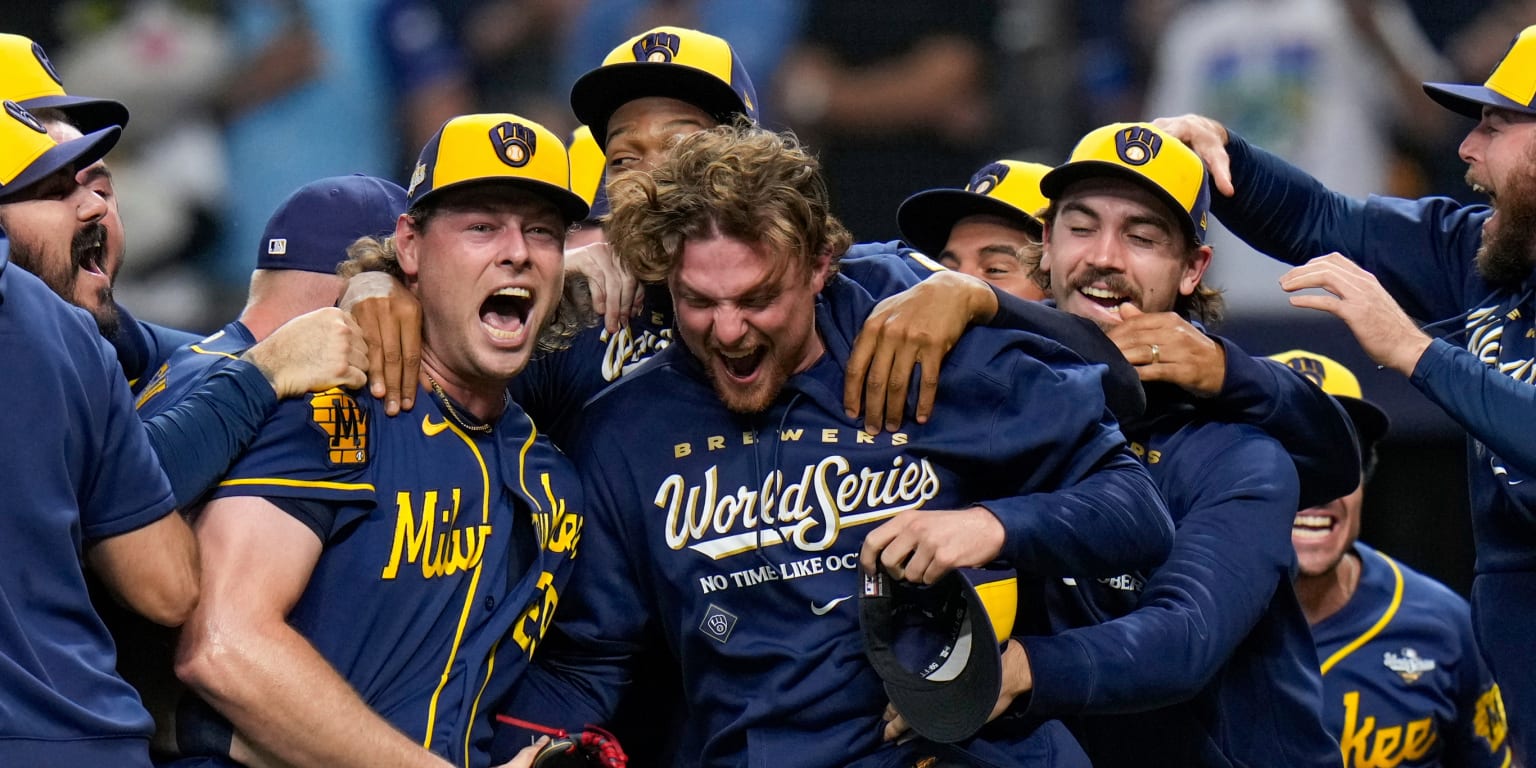
ST. PETERSBURG -- What a team. What a season. What a championship run.
The Brewers finished off one of the most dominant postseasons we’ve seen in recent memory with a 4-1 victory in front of a boisterous contingent of Milwaukee fans amid the masses at Tropicana Field on Wednesday night.
Here’s a look at 13 impressive stats and facts from the first-time champions.
- They finally did it. After beginning in 1969 as the Seattle Pilots, the Brewers franchise played 57 seasons before their first title-winning campaign. That’s the fourth-longest drought before winning a franchise’s first World Series. The Phillies played 77 seasons between the first Fall Classic in 1903 and their first title-winning season in 1980, 63 for the Orioles/Browns and 62 for the Rangers/Senators.
- The Brewers went 11-2 this postseason. They’re the fifth team to win at least 11 games and lose two or fewer in a postseason, joining the 2022 Astros (11-2), 2005 White Sox (11-1), 1999 Yankees (11-1) and 1998 Yankees (11-2).
- The pitching was a key component of that dominance. The Brewers did not allow more than four runs in any of their 13 postseason games. They joined the 1990 Reds and 1983 Orioles as the only teams to allow no more than four runs in a game throughout the entirety of a postseason that culminated with a World Series championship since playoffs expanded in 1969.
- Plenty of that credit goes to the bullpen. The Brewers threw 118 innings this postseason, and relievers handled 65 of them. That 55.1% of innings from relievers is the fourth-highest percentage among the 102 teams to throw at least 100 innings in a postseason. Only the 2021 Astros (58.6%), 2024 Dodgers (57.7%) and 2021 Dodgers (55.6%) had higher rates.
- This wasn’t just quantity, though – it was quality, too. The Brewers’ bullpen posted a 1.38 ERA and a .173 opponent average. Those marks are each the second-lowest allowed by any bullpen in a single postseason behind the 2022 Astros (0.83, .126), with a minimum of 50 innings.
- Chief among those bullpen arms was Aaron Ashby. He threw 18 innings, all scoreless. That tied 1960 Whitey Ford for the third-most innings pitched in a postseason, all scoreless, behind only 1905 Christy Mathewson (27) and 2006 Kenny Rogers (23).
- We also need to talk about the youngsters. Jackson Chourio and Cooper Pratt became the first teammates to each get at least eight hits in the same postseason series at age 22 or younger. Chourio’s 11 hits tied for the second-most in the first five games of a World Series, behind only 1931 Pepper Martin’s 12. Chourio tied 2013 David Ortiz, 1982 Robin Yount, 1980 Amos Otis, 1968 Lou Brock and 1951 Monte Irvin.
- Pratt’s seven RBIs tied 1951 Gil McDougald for the most by a rookie in a World Series (RBIs official since 1920). Pratt had an RBI in four straight games, tying Juan Soto in 2019 for the longest streak in the World Series before turning 23.
- At one point, Pratt recorded a hit in six consecutive at-bats. That’s the longest streak by a rookie in a World Series and tied for the second-longest streak within a World Series, per Elias. Pratt trailed only 1990 Billy Hatcher’s seven, and tied 2013 Ortiz, 1976 Thurman Munson, 1968 Norm Cash and 1924 Goose Goslin.
- Presumptive Cy Young winner Jacob Misiorowski delivered a scoreless start in Game 5. When awards are announced, he will presumably become the first starter to win a World Series clincher in the year he won the Cy Young Award since Orel Hershiser in 1988.
- Misiorowski threw 51 pitches at 100-plus mph. It was the 11th time a pitcher threw at least 50 pitches at 100-plus mph in an outing under tracking (since 2008, including postseason). All of those games were by Misiorowski this year.
- A moment for the MVP. William Contreras became the first catcher to win World Series MVP since Salvador Perez in 2015. He, Chourio and Antonio Senzatela became the second set of teammates to win the World Series and World Baseball Classic in the same year, joining 2017 Alex Bregman and Luke Gregerson.
- Contreras and his brother Willson, who won with the Cubs in 2016, became the 10th set of brothers to win the World Series (min. one World Series game appearance). They joined J.D. and Stephen Drew; Bengie, José and Yadier Molina; Livan and Orlando Hernandez; Jesus and Matty Alou; Clete and Ken Boyer; Hub and Gee Walker; Mort and Walker Cooper; Dizzy and Paul Dean; and Bob and Irish Meusel.