
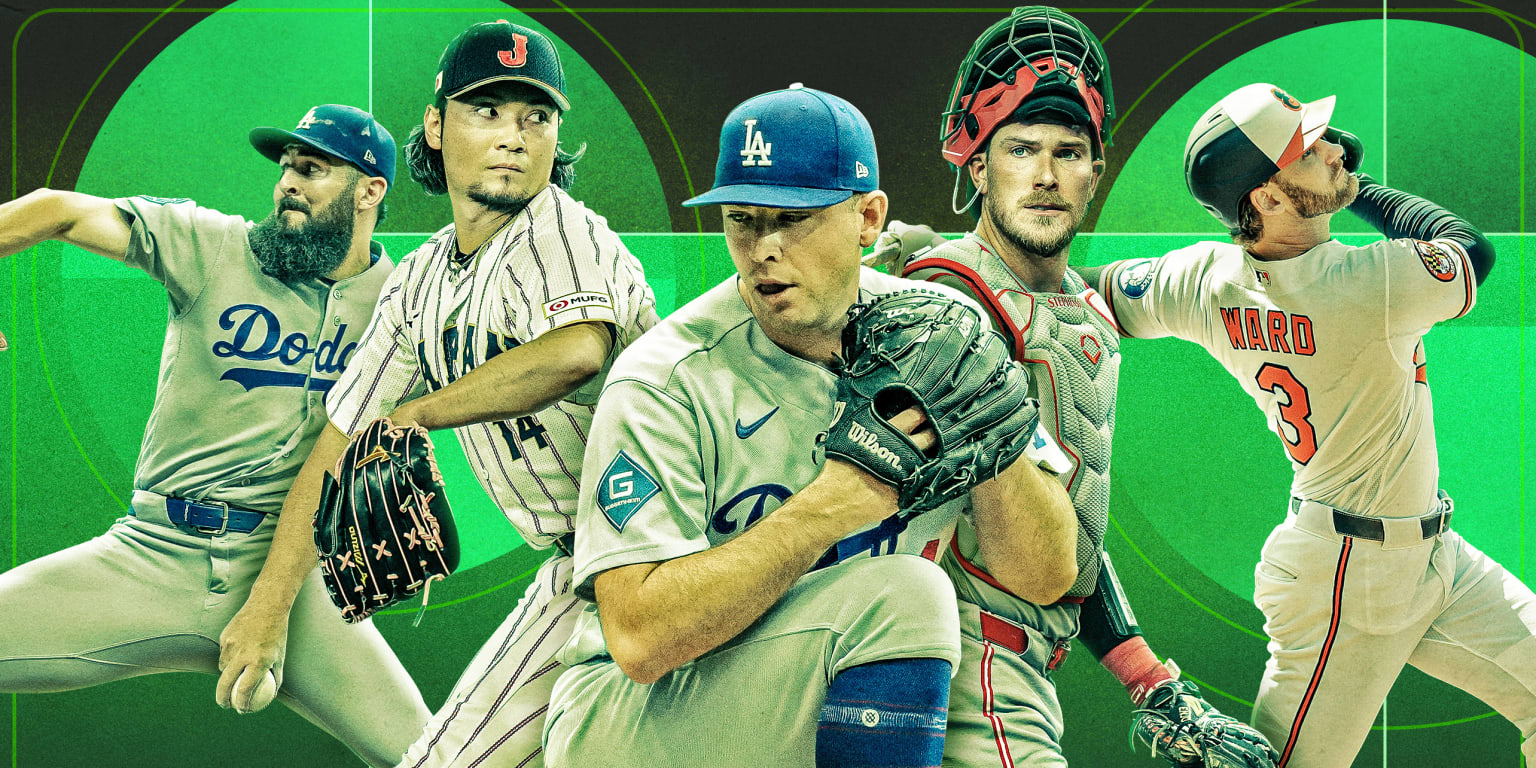
For all the resources and brain power teams apply to acquiring players, it’s a tricky task. Projecting how any one player will fare from season to season remains thorny.
One year ago, the clear No. 1 free agent on the market was Kyle Tucker, who signed a massive deal with the Dodgers. Ty France, on the other hand, was an afterthought and signed with the Padres on a Minor League deal. In the end, though, France produced 3.6 WAR, per FanGraphs, putting him among the top 70 players across the Majors. Tucker produced just 0.9.
The point is, the free-agent market contains surprises every year. With that in mind, we asked five MLB.com writers and researchers to each pick one unsigned free agent from outside Mark Feinsand’s top 30 list and explain why that player could outperform expectations.
Here are five intriguing free agents to watch this offseason. (France isn’t included; this time around, he’s ranked.)
Kris Bubic, SP
Why he’s unranked: There’s certainly going to be some concern about Bubic’s health, given that the left-hander has struggled to stay on the field in recent years. A forearm flexor strain gave way to Tommy John surgery in April 2023. Two years later, Bubic’s revival – which included his first All-Star nod – ended a few months early thanks to a left rotator cuff strain. Last season, Bubic hit the IL in May with left elbow soreness, and then suffered a setback when shoulder soreness cropped up during a rehab outing. Got all that? It adds up to this: Bubic threw just 55 innings in 2026 and has thrown more than 100 innings just once in the past four seasons.
Why he’s intriguing: Bubic has been quite good when healthy, and there’s plenty of upside here. Since returning from Tommy John surgery in July 2024, he has pitched to a 2.90 ERA with a 2.93 FIP in 201 2/3 innings. Bubic relies on a funky slot to generate outlier movement on his pitches, including a hoppy fastball and a spin-killing changeup that held hitters to a .119 batting average in 2026. While he doesn’t throw hard, he still misses plenty of bats; all three of his non-fastball offerings induced a swing-and-miss rate of at least 29% last season.
Versatility matters here, too. Bubic is a capable starting pitcher, as he showed while making the All-Star team in 2025. But he’s also flourished out of the bullpen, most recently with the Dodgers in a small sample size in September. Multi-inning relievers are en vogue these days – we all saw how the Brewers deployed their elite weapons for more than three outs at a time in the postseason – and Bubic fits this blueprint perfectly.
-- Jared Greenspan
Why he’s unranked: If you're feeling generous, it's his injury history; if you're not, he's just been kind of unremarkable. Stephenson hasn't been hurt a ton overall, but his shortened seasons really looked like they were leading to something. In 2022, a year after he showed up on some Rookie of the Year ballots, he was out with a concussion, a broken right thumb and a broken collarbone. He hit .319 in 50 games that year; for reference, he's a career .257 hitter. Then in 2025, the start to his season was delayed by an oblique strain, and later he broke his other thumb. In 88 games that year, he hit 13 home runs, a 23-HR 162-game pace compared to his career average of 18. Unfortunately, we'll never know what would have happened in those years, and without those missed games, we're left with a subpar defensive catcher with a career 104 OPS+.
Why he’s intriguing: Stephenson is seasoned, and he's also only 30 years old, which is sort of the ideal if you're on the hunt for a catcher to hold down the position for a few years -- you know what you're getting, you know he can handle the job and you can assume a solid four or five years before his body is likely to start to break down on its own.
That's why you want him to be an option, but there are some metrics you might take a flier on. While he isn't the best defender, he's got the second-most Blocks Above Average since 2025 (23), trailing only Alejandro Kirk, a dramatic improvement after he was at -9 for his career through 2024. He remains lacking in the framing and throwing departments, but he might be able to make up that value with his bat, because since 2025, his barrel rate has shot up (13.2%). His sky-high sweet-spot rate (40.8%) since 2025 is actually the fourth-highest among players with at least 400 batted balls over the last two seasons. We mention the ranking because of who's around him on that list -- he's behind Will Smith, Jackson Merrill and Mike Trout and just ahead of Yordan Alvarez -- a nice illustration of the value of that skill.
-- Shanthi Sepe-Chepuru
Taylor Ward, OF
Why he’s unranked: Ward had one of his poorest offensive seasons in 2026, posting a .225/.359/.311 slash line between the Orioles and Mariners. After a highly productive year for the Angels in 2025 (36 home runs, 103 RBIs), Ward’s power cratered: He hit just seven homers and drove in only 37 runs. Ward played through a bone bruise in his hand that he suffered when he was hit by a pitch in mid-April, which explains at least some of the 164-point decrease in his slugging percentage from 2025 to ’26. Because Ward is a below-average defender without much speed, it’s easy to see why he wasn’t in the top 30 after a subpar season.
Why he’s intriguing: Did we mention the 36 home runs and 103 RBIs? Any hitter capable of a season like that -- recently, to boot -- is worth a second look by any front office. Particularly in a sport suffering from a lack of capable right-handed-hitting outfielders, Ward’s track record of production prior to 2026 merits further attention. From 2021 to 2025, he was well above average as a hitter, owning a .251/.332/.449 slash line with more than 20 home runs per season. Just a year ago, Ward was one of the top trade candidates in the Majors and was dealt to Baltimore for former top pitching prospect Grayson Rodriguez. An injury-marred ’26 -- one where he still walked at an elite 16.3% rate -- shouldn’t tank Ward’s free-agent stock completely.
-- Theo DeRosa
Hiromi Itoh, RHP
Why he’s unranked: Itoh, who was posted by the Hokkaido Nippon-Ham Fighters of Japan’s Nippon Professional Baseball this offseason, will enter his first season in Major League Baseball. Beyond the question of him being an unknown in terms of pitching in the Majors, Itoh doesn’t bring the type of stuff that the likes of Yoshinobu Yamamoto, Shohei Ohtani or Shota Imanaga had. Itoh pounds the strike zone but his stuff likely qualifies as a tick below the MLB average for starting pitchers, giving him a likely backend starter profile.
Why he’s intriguing: Yes, the stuff is not overwhelming, but Itoh throws at least six pitches with an ability to manipulate some of those offerings, giving him a diverse repertoire. Itoh also throws these pitches for strikes, including some of his secondaries, making that arsenal even more impressive. Add in Itoh’s ability to chew up innings -- he has thrown at least 153 innings each of the last five years and at least 172 each of the last three -- and you have a pitcher that should comfortably fit in a rotation. And if a savvy pitching organization manages to sign him, there could be even more untapped potential in Itoh.
-- Brent Maguire
Alex Vesia, RP
Why he’s unranked: Vesia’s absence from Feinsand’s list says more about the realities of the free-agent market than the left-hander’s résumé, which includes a lifetime 2.87 ERA and a 12.0 K/9 over seven seasons. The offseason spotlight is typically reserved for the top hitters, starters and closers available, leaving little oxygen for non-closing relievers. Adrian Morejon, who earned a qualifying offer and is expected to be paid like a top closer, is an exception this year, but most setup men don’t get that treatment.
Why he’s intriguing: Vesia’s career save total (16) is modest, but his big-game track record isn’t. The 30-year-old lefty has spent years as one of the Dodgers’ most trusted high-leverage relievers. He doesn’t have elite velocity, but he generates more “rise” with his four-seamer than anyone else, allowing the pitch to carry through the zone and miss bats. Add in a slider that’s a legitimate weapon against lefties and righties alike, and few pitchers are tougher to hit. His .167 expected batting average allowed over the past three years is proof -- only Mason Miller and Josh Hader have yielded a lower xBA in that span (min. 500 batters faced).
-- Thomas Harrigan